Results by title
58 books match the query 'Meteorology & Climatology' and 3 start with f
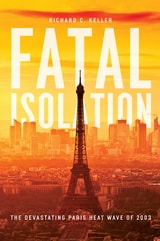
Fatal Isolation
The Devastating Paris Heat Wave of 2003Richard C. Keller
University of Chicago Press, 2015
In a cemetery on the southern outskirts of Paris lie the bodies of nearly a hundred of what some have called the first casualties of global climate change. They were the so-called abandoned victims of the worst natural disaster in French history, the devastating heat wave that struck in August 2003, leaving 15,000 dead. They died alone in Paris and its suburbs, and were then buried at public expense, their bodies unclaimed. They died, and to a great extent lived, unnoticed by their neighbors--their bodies undiscovered in some cases until weeks after their deaths.
Fatal Isolation tells the stories of these victims and the catastrophe that took their lives. It explores the multiple narratives of disaster--the official story of the crisis and its aftermath, as presented by the media and the state; the life stories of the individual victims, which both illuminate and challenge the ways we typically perceive natural disasters; and the scientific understandings of disaster and its management. Fatal Isolation is both a social history of risk and vulnerability in the urban landscape and a story of how a city copes with emerging threats and sudden, dramatic change.
Fatal Isolation tells the stories of these victims and the catastrophe that took their lives. It explores the multiple narratives of disaster--the official story of the crisis and its aftermath, as presented by the media and the state; the life stories of the individual victims, which both illuminate and challenge the ways we typically perceive natural disasters; and the scientific understandings of disaster and its management. Fatal Isolation is both a social history of risk and vulnerability in the urban landscape and a story of how a city copes with emerging threats and sudden, dramatic change.
[more]
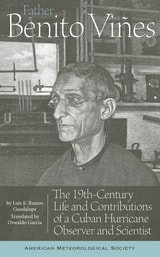
Father Benito Viñes
The 19th-Century Life and Contributions of a Cuban Hurricane Observer and ScientistLuis E. Ramos Guadalupe
American Meteorological Society, 2014
Before Doppler radar and broadcast weather reports, Spanish-born Benito Viñes (1837–1893) spent decades observing the skies at Belen Observatory in colonial Cuba, routinely issuing weather reports and forecasts to local newspapers. And before storm trackers and emergency alerts, Viñes made it his mission to teach the public what he was learning about the weather. He developed the first network of weather observation stations in the Caribbean, and his research laid the groundwork for the hurricane warning systems we use today. His sometimes eerily accurate hurricane forecasts helped save many lives—earning him the nickname “the Hurricane Priest.”
Father Benito Viñes is a fascinating look at the life of a man who worked on the cutting edge of weather science while still remaining devoted to his religious life. It explores Viñes as both pioneer in the study of tropical meteorology and a colonial Jesuit priest. With notes that put his life into modern context, this book puts a much deserved spotlight on a figure who played a crucial role in making our lives safer.
Father Benito Viñes is a fascinating look at the life of a man who worked on the cutting edge of weather science while still remaining devoted to his religious life. It explores Viñes as both pioneer in the study of tropical meteorology and a colonial Jesuit priest. With notes that put his life into modern context, this book puts a much deserved spotlight on a figure who played a crucial role in making our lives safer.
[more]
Floods, Droughts, and Climate Change
Michael Collier and Robert H. Webb
University of Arizona Press, 2002
No one in America would deny that the weather has changed drastically in our lifetime. We read about El Niño and La Niña, but how many of us really understand the big picture beyond our own front windows or even the headlines on the Weather Channel? Hydrologists and climatologists have long been aware of the role of regional climate in predicting floods and understanding droughts. But with our growing sense of a variable climate, it is important to reassess these natural disasters not as isolated events but as related phenomena.
This book shows that floods and droughts don't happen by accident but are the products of patterns of wind, temperature, and precipitation that produce meteorologic extremes. It introduces the mechanics of global weather, puts these processes into the longer-term framework of climate, and then explores the evolution of climatic patterns through time to show that floods and droughts, once considered isolated "acts of God," are often related events driven by the same forces that shape the entire atmosphere.
Michael Collier and Robert Webb offer a fresh, insightful look at what we know about floods, droughts, and climate variability—and their impact on people—in an easy-to-read text, with dramatic photos, that assumes no previous understanding of climate processes. They emphasize natural, long-term mechanisms of climate change, explaining how floods and droughts relate to climate variability over years and decades. They also show the human side of some of the most destructive weather disasters in history.
As Collier and Webb ably demonstrate, "climate" may not be the smooth continuum of meteorologic possibilities we supposed but rather the sum of multiple processes operating both regionally and globally on different time scales. Amid the highly politicized discussion of our changing environment, Floods, Droughts, and Climate Change offers a straightforward scientific account of weather crises that can help students and general readers better understand the causes of climate variability and the consequences for their lives.
[more]