Results by title
67 books match the query 'Mexican American women' and 4 start with f
Fertile Matters
The Politics of Mexican-Origin Women's ReproductionBy Elena R. Gutiérrez
University of Texas Press, 2008
While the stereotype of the persistently pregnant Mexican-origin woman is longstanding, in the past fifteen years her reproduction has been targeted as a major social problem for the United States. Due to fear-fueled news reports and public perceptions about the changing composition of the nation's racial and ethnic makeup—the so-called Latinization of America—the reproduction of Mexican immigrant women has become a central theme in contemporary U. S. politics since the early 1990s.
In this exploration, Elena R. Gutiérrez considers these public stereotypes of Mexican American and Mexican immigrant women as "hyper-fertile baby machines" who "breed like rabbits." She draws on social constructionist perspectives to examine the historical and sociopolitical evolution of these racial ideologies, and the related beliefs that Mexican-origin families are unduly large and that Mexican American and Mexican immigrant women do not use birth control.
Using the coercive sterilization of Mexican-origin women in Los Angeles as a case study, Gutiérrez opens a dialogue on the racial politics of reproduction, and how they have developed for women of Mexican origin in the United States. She illustrates how the ways we talk and think about reproduction are part of a system of racial domination that shapes social policy and affects individual women's lives.
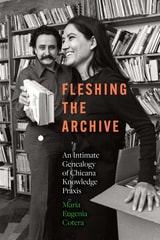
Fleshing the Archive
An Intimate Genealogy of Chicana Knowledge PraxisMaría Eugenia Cotera
University of Texas Press, 2025
The history of the Chicana por mi Raza Digital Memory Collective, an archive dedicated to preserving Chicana feminist knowledge of the 1970s and memory work.
The late 1960s and early 1970s witnessed an explosion of publishing by Chicana activists as they took part in the Movimiento against oppression of ethnic Mexicans in the United States. Today, thousands of these documents, including written works and oral histories, have been assembled by the Chicana por mi Raza Digital Memory Collective. Drawing on these unique resources, Fleshing the Archive traces the innovative Chicana knowledge projects of the Movimiento years.
Seeking to think with the past rather than about it, María Cotera explores transgressive sites and discourses of Chicana knowledge, from poems and essays to newspapers, bibliographies, and testimonies. Often published independently and distributed by readers themselves, these works embodied a praxis of feminist and queer consciousness-raising. Observing the startling convergences between Chicana praxis of the 1970s and digital knowledge production in the present, Cotera argues that the Chicana archive enables transformative moments of recognition across time that unsettle supposedly objective accounts of history. The materials preserved by Chicana por mi Raza offer Chicana scholars a model of teaching and learning liberated from a corporate academy that is increasingly hostile to intellectual inquiry.
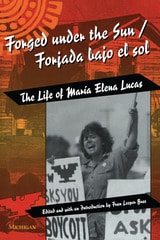
Forged under the Sun/Forjada bajo el sol
The Life of Maria Elena LucasEdited and with an Introduction by Fran Leeper Buss
University of Michigan Press, 1993
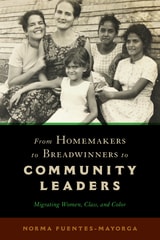
From Homemakers to Breadwinners to Community Leaders
Migrating Women, Class, and ColorNorma Fuentes-Mayorga
Rutgers University Press, 2022