Results by title
157 books match the query 'Mexican-American Border Region' and 10 start with f

Faith Run
Ray Gonzalez
University of Arizona Press, 2009
For Gonzalez, it seems, we humans can transcend the ordinary—just as these poems transcend genre and create a poetic realm of their own—but we never actually leave behind our rooted, earthbound lives. Although our landscape may be invisible to us, we never escape its powerful magnetism. Nor do we ever abandon our ancestors. No matter how fast or far we run, we can never outrun them. Like gravity, their influence is inexorable.
These poems enchant with their language, which often leaps unexpectedly from worldly to otherworldly in the same stanza, but they cling and linger in our memories—not unlike the voices of friends and relatives.
Fencing in Democracy
Border Walls, Necrocitizenship, and the Security StateMiguel Díaz-Barriga and Margaret Dorsey
Duke University Press, 2019
Fevered Measures
Public Health and Race at the Texas-Mexico Border, 1848–1942John Mckiernan-González
Duke University Press, 2012
Fifty Years of Change on the U.S.-Mexico Border
Growth, Development, and Quality of LifeBy Joan B. Anderson and James Gerber
University of Texas Press, 2007
Winner, Book Award, Associaton for Borderland Studies, 2008
The U.S. and Mexican border regions have experienced rapid demographic and economic growth over the last fifty years. In this analysis, Joan Anderson and James Gerber offer a new perspective on the changes and tensions pulling at the border from both sides through a discussion of cross-border economic issues and thorough analytical research that examines not only the dramatic demographic and economic growth of the region, but also shifts in living standards, the changing political climate, and environmental pressures, as well as how these affect the lives of people in the border region.
Creating what they term a Border Human Development Index, the authors rank the quality of life for every U.S. county and Mexican municipio that touches the 2,000-mile border. Using data from six U.S. and Mexican censuses, the book adeptly illustrates disparities in various aspects of economic development between the two countries over the last six decades.
Anderson and Gerber make the material accessible and compelling by drawing an evocative picture of how similar the communities on either side of the border are culturally, yet how divided they are economically. The authors bring a heightened level of insight to border issues not just for academics but also for general readers. The book will be of particular value to individuals interested in how the border between the two countries shapes the debates on quality of life, industrial growth, immigration, cross-border integration, and economic and social development.
Fires on the Border
The Passionate Politics of Labor Organizing on the Mexican FronteraRosemary Hennessy
University of Minnesota Press, 2013
The history of the maquiladoras has been punctuated by workers’ organized resistance to abysmal working and living conditions. Over years of involvement in such movements, Rosemary Hennessy was struck by an elusive but significant feature of these struggles: the extent to which organizing is driven by attachments of affection and antagonism, belief, betrayal, and identification.
What precisely is the “affective” dimension of organizing for justice? Are affects and emotions the same? And how can their value be calculated? Fires on the Border takes up these questions of labor and community organizing—its “affect-culture”—on Mexico’s northern border from the early 1970s to the present day. Through these campaigns, Hennessy illuminates the attachments and identifications that motivate people to act on behalf of one another and that bind them to a common cause. The book’s unsettling, even jarring, narratives bring together empirical and ethnographic accounts—of specific campaigns, the untold stories of gay and lesbian organizers, love and utopian longing—in concert with materialist theories of affect and the critical good sense of Mexican organizers.
Teasing out the integration of affect-culture in economic relations and cultural processes, Hennessy provides evidence that sexuality and gender as strong affect attractors are incorporated in the harvesting of surplus labor. At the same time, workers’ testimonies confirm that the capacities for bonding and affective attachment, far from being entirely at the service of capital, are at the very heart of social movements devoted to sustaining life.
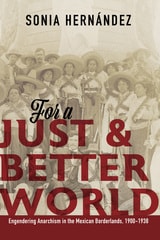
For a Just and Better World
Engendering Anarchism in the Mexican Borderlands, 1900-1938Sonia Hernandez
University of Illinois Press, 2021
A vivid look at a radical activist and her times, For a Just and Better World illuminates the lives and work of Mexican women battling for labor rights and gender equality in the early twentieth century.
Forgotten Futures, Colonized Pasts
Transnational Collaboration in Nineteenth-Century Greater MexicoCara Anne Kinnally
Bucknell University Press, 2019
Published by Bucknell University Press. Distributed worldwide by Rutgers University Press.
Free Trade
Informal Economies at the U.S.-Mexico BorderKathleen Staudt
Temple University Press, 1998
Residents counter national and international influences to build shelter and incomes, albeit meager. But the political machinery of both the U.S. and Mexico constrains the ability of these quintessential free traders to build political communities and organize around self-sufficient work and housing in visible ways.
Experiences at the border, along the central gateway for capital, job, and labor movement, offer insights to readers as the globalized economy spreads and engulfs the heartlands of both the U.S. and Mexico. People’s everyday victories in countering petty regulations can counter or feed the grand global hegemonies.
From the Republic of the Rio Grande
A Personal History of the Place and the PeopleBy Beatriz de la Garza
University of Texas Press, 2013
The Republic of the Rio Grande had a brief and tenuous existence (1838–1840) before most of it was reabsorbed by Mexico and the remainder annexed by the United States, yet this region that straddles the Rio Grande has retained its distinctive cultural identity to the present day. Born on one side of the Rio Grande and raised on the other, Beatriz de la Garza is a product of this region. Her birthplace and its people are the subjects of this work, which fuses family memoir and borderlands history.
From the Republic of the Rio Grande brings new insights and information to the study of transnational cultures by drawing from family papers supplemented by other original sources, local chronicles, and scholarly works. De la Garza has fashioned a history of this area from the perspective of individuals involved in the events recounted. The book is composed of nine sections spanning some two hundred years, beginning in the mid-1700s. Each section covers not only a chronological period but also a particular theme relating to the history of the region. De la Garza takes a personal approach, opening most sections with an individual observation or experience that leads to the central motif, whether this is the shared identity of the inhabitants, their pride in their biculturalism and bilingualism, or their deep attachment to the land of their ancestors.
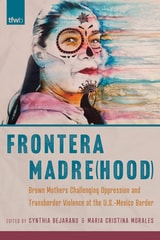
Frontera Madre(hood)
Brown Mothers Challenging Oppression and Transborder Violence at the U.S.-Mexico BorderEdited by Cynthia Bejarano and Maria Cristina Morales
University of Arizona Press, 2024
Borderlands Regional Library Association Southwest Book Award Winner
2025 International Latino Book Award Winner
The topic of mothers and mothering transcends all spaces, from popular culture to intellectual thought and critique. This collection of essays bridges both methodological and theoretical frameworks to explore forms of mothering that challenge hegemonic understandings of parenting and traditional notions of Latinx womxnhood. It articulates the collective experiences of Latinx, Black, and Indigenous mothering from both sides of the U.S.-Mexico border.
Thirty contributors discuss their lived experiences, research, or community work challenging multiple layers of oppression, including militarization of the border, border security propaganda, feminicides, drug war and colonial violence, grieving and loss of a child, challenges and forms of resistance by Indigenous mothers, working mothers in maquiladoras, queer mothering, academia and motherhood, and institutional barriers by government systems to access affordable health care and environmental justice. Also central to this collection are questions on how migration and detention restructure forms of mothering. Overall, this collection encapsulates how mothering is shaped by the geopolitics of border zones, which also transcends biological, sociological, or cultural and gendered tropes regarding ideas of motherhood, who can mother, and what mothering personifies.
Contributors
Elva M. Arredondo
Cynthia Bejarano
Bertha A. Bermúdez Tapia
Margaret Brown Vega
Macrina Cárdenas Montaño
Claudia Yolanda Casillas
Luz Estela (Lucha) Castro
Marisa Elena Duarte
Taide Elena
Sylvia Fernández Quintanilla
Paula Flores Bonilla
Judith Flores Carmona
Sandra Gutiérrez
Ma. Eugenia Hernández Sánchez
Irene Lara
Leticia López Manzano
Mariana Martinez
Maria Cristina Morales
Paola Isabel Nava Gonzales
Olga Odgers-Ortiz
Priscilla Pérez
Silvia Quintanilla Moreno
Cirila Quintero Ramírez
Felicia Rangel-Samponaro
Coda Rayo-Garza
Shamma Rayo-Gutierrez
Marisol Rodríguez Sosa
Brenda Rubio
Ariana Saludares
Victoria M. Telles
Michelle Téllez
Marisa S. Torres
Edith Treviño Espinosa
Mariela Vásquez Tobon
Hilda Villegas