Results by title
188 books match the query 'Middle Eastern' and 5 start with f
Fear in the Middle of a Vast Field and Other Stories
Mustafa Taj Aldeen Almosa; translated by Maisaa Tanjour and Alice Holttum
University of Texas Press, 2025
Short stories by a celebrated playwright bare the horrors of the Syrian civil war.
A selection of stories by Syrian author and playwright Mustafa Taj Aldeen Almosa about characters enduring the horrors of the Syrian civil war. With exquisite wit and lightness of touch, Almosa portrays the internal world of characters facing great physical violence or psychological pressures. Using both realism and fantastic elements, Almosa weaves short stories that are strange, violent, and delicate at the same time. This collection is an invaluable attempt to denounce war, to exist, to love life in all its manifestations and to learn how to cope with loss and disappointment. It is a cry against fear and death as much as it is an ode and a homage to life and love in times of both war and peace.
Floundering Stability
US Foreign Policy in EgyptAmir Magdy Kamel
University of Michigan Press, 2023
The US commitment to stability—both domestically and abroad—has been a consistent feature in the way Washington, DC carries out international relations. This commitment is complimented by the increased overlap between the economic and political spheres in international affairs. Consequently, this US approach to foreign interaction is informed by an assumption that foreign policy tools can influence global stability for the better. In order to investigate this assumption, this book details the foundations of what Amir Magdy Kamel refers to as the US Stability Policy—how it evolved over time and how it was implemented in Egypt. He finds that domestic and global forces were left unaccounted for by the Stability Policy, ultimately leading to a failure to achieve the self-stated stability goals.
Kamel’s analysis is informed through a unique mixed-method approach that sheds light on how and why this policy fared so poorly under Mubarak’s Egypt. He develops and tests a unique and particular way of examining the Stability Policy and presents a framework for future work to replicate and build on in the quest to understand other state-on-state relationships and the effectiveness of other foreign economic policies in achieving stability goals. Floundering Stability reflects on what Kamel’s findings mean for the relationship between the US and Egypt, as well as specific US foreign policy suggestions on how the same mistakes can be avoided in the future.
For God and Country?
Religious Student-Soldiers in the Israel Defense ForcesBy Elisheva Rosman-Stollman
University of Texas Press, 2014
In many modern armies the religious soldier is suspect. Civilians and officers alike wonder if such a soldier might represent a potential fifth column. This concern is especially prominent in the public discourse over the presence of religious Orthodox Jews serving in the Israel Defense Forces. Will they obey their commanding officer or their rabbi? With research collected over almost a decade, including hundreds of hours of interviews, Elisheva Rosman examines this question of loyalties and reveals how religious soldiers negotiate a place for themselves in an institution whose goals and norms sometimes conflict with those of Orthodox Judaism.
For God and Country? focuses on the pre-service study programs available to religious conscripts. Many journalists and scholars in Israel are suspicious of the student-soldiers who participate in these programs, but in fact, as Rosman’s research demonstrates, the pre-service study programs serve as mediating structures between the demands of Religious Zionism and the demands of the Israel Defense Forces and do not encourage their students to disobey orders. This was especially apparent during the disengagement from Gaza in 2005. Many in Israeli society predicted student-soldiers would defy their orders, per the instruction of their religious leaders, but this did not happen as expected. In high profile cases such as this and in matters encountered daily by religious soldiers—the mixing of the sexes, for instance—Rosman has discovered that the pre-service study programs can successfully serve as agents of civil society, both able to curb the military’s efforts to meddle in civilian affairs and vice versa.
Foucault in Iran
Islamic Revolution after the EnlightenmentBehrooz Ghamari-Tabrizi
University of Minnesota Press, 2016
Were the thirteen essays Michel Foucault wrote in 1978–1979 endorsing the Iranian Revolution an aberration of his earlier work or an inevitable pitfall of his stance on Enlightenment rationality, as critics have long alleged? Behrooz Ghamari-Tabrizi argues that the critics are wrong. He declares that Foucault recognized that Iranians were at a threshold and were considering if it were possible to think of dignity, justice, and liberty outside the cognitive maps and principles of the European Enlightenment.
Foucault in Iran centers not only on the significance of the great thinker’s writings on the revolution but also on the profound mark the event left on his later lectures on ethics, spirituality, and fearless speech. Contemporary events since 9/11, the War on Terror, and the Arab Uprisings have made Foucault’s essays on the Iranian Revolution more relevant than ever. Ghamari-Tabrizi illustrates how Foucault saw in the revolution an instance of his antiteleological philosophy: here was an event that did not fit into the normative progressive discourses of history. What attracted him to the Iranian Revolution was precisely its ambiguity.
Theoretically sophisticated and empirically rich, this interdisciplinary work will spark a lively debate in its insistence that what informed Foucault’s writing was not an effort to understand Islamism but, rather, his conviction that Enlightenment rationality has not closed the gate of unknown possibilities for human societies.
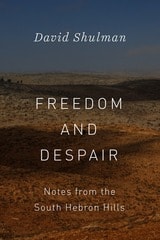
Freedom and Despair
Notes from the South Hebron HillsDavid Shulman
University of Chicago Press, 2018
David Shulman knows intimately what it takes to live your beliefs, to return, day after day, to the struggle, despite knowing you are often more likely to lose than win. Interweaving powerful stories and deep meditations, Freedom and Despair offers vivid firsthand reports from the occupied West Bank in Palestine as seen through the eyes of an experienced Israeli peace activist who has seen the Israeli occupation close up as it impacts on the lives of all Palestinian civilians.
Alongside a handful of beautifully written and often shocking tales from the field, Shulman meditates deeply on how to understand the evils around him, what it means to persevere as an activist decade after decade, and what it truly means to be free. The violent realities of the occupation are on full display. We get to know and understand the Palestinian shepherds and farmers and Israeli volunteers who face this situation head-on with nonviolent resistance. Shulman does not hold back on acknowledging the daily struggles that often leave him and his fellow activists full of despair. Inspired by these committed individuals who are not prepared to be silent or passive, Shulman suggests a model for ordinary people everywhere. Anyone prepared to take a risk and fight their oppressive political systems, he argues, can make a difference—if they strive to act with compassion and to keep hope alive.
This is the moving story of a man who continues to fight for good in the midst of despair. An indispensable book in our era of reactionary politics and refugee crises, political violence and ecological devastation, Freedom and Despair is a gripping memoir of struggle, activism, and hope for peace.