Results by title
941 books match the query 'Military' and 34 start with f
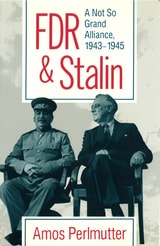
FDR & Stalin
A Not So Grand Alliance, 1943–1945Amos Perlmutter
University of Missouri Press, 1993
Perlmutter's hard-hitting, revisionist history of Roosevelt's foreign policy explores FDR's not-so-grand alliance with the ruthless Soviet leader. As the first Western scholar granted access to key foreign ministry documents recently declassified in the former Soviet Union, Perlmutter provides a provocative portrait of a popular leader whose failure to comprehend Stalin's long-range goals had devastating results for the postwar world.
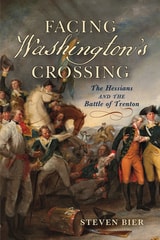
Facing Washington's Crossing
The Hessians and the Battle of TrentonSteven Bier
Westholme Publishing, 2025
They crossed the ocean to fight in someone else's war. They came for glory, honor, and plunder. Instead, they became America's most famous captives.
In Steven Bier's groundbreaking book, Facing Washington's Crossing: The Hessians at the Battle of Trenton, old stereotypes are shattered and new information emerges. Using newly translated documents, rare hard-to-find material, and obscure nearly-forgotten sources, Facing Washington's Crossing rewrites our understanding of the Battle of Trenton.
Bier maintains a gripping narrative, following the military exploits of a Hessian Brigade through six brutal battles. From their crushing victories in New York to the shocking reversal in the snow-covered village of Trenton, witness how professional European soldiers faced an enemy unlike any they had encountered.Bier offers a fresh perspective by narrating the story through Hessian eyes, presenting fascinating details: shipboard cockfights, St. Elmo's fires, how the militaristic Hessians were influenced by the peaceful philosopher Voltaire, when the Royal Navy accidentally landed the Hessians on a deserted island, and how Emanuel Leutze's iconic painting of Washington crossing the Delaware was created in a tavern.The author traces the Hessian Prince's decision to hire out his army, the army’s harrowing voyage across the Atlantic, and the numerous clashes leading up to Trenton. Washington’s Crossing and the subsequent battle itself are fully recounted, providing a much-needed understanding of the Hessian experience.For 250 years, the story has been told mostly from one side. Now the essential counterpoint is finally revealed.

Failed States and Fragile Societies
A New World Disorder?Ingo Trauschweizer
Ohio University Press, 2014
Since the end of the Cold War, a new dynamic has arisen within the international system, one that does not conform to established notions of the state’s monopoly on war. In this changing environment, the global community must decide how to respond to the challenges posed to the state by military threats, political and economic decline, and social fragmentation. This insightful work considers the phenomenon of state failure and asks how the international community might better detect signs of state decay at an early stage and devise legally and politically legitimate responses.
This collection of essays brings military and social historians into conversation with political and social scientists and former military officers. In case studies from the former Yugoslavia, Somalia, Iraq, and Colombia, the distinguished contributors argue that early intervention to stabilize social, economic, and political systems offers the greatest promise, whereas military intervention at a later stage is both costlier and less likely to succeed.
Contributors: David Carment, Yiagadeesen Samy, David Curp, Jonathan House, James Carter, Vanda Felbab-Brown, Robert Rotberg, and Ken Menkhaus.
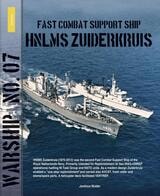
Fast Combat Support Ship HNLMS Zuiderkruis
Jantinus Mulder
Amsterdam University Press, 2023
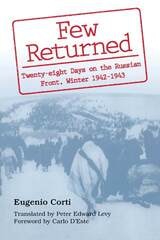
Few Returned
Twenty-eight Days on the Russian Front, Winter 1942-1943Eugenio Corti, Translated by Peter Edward Levy, & Foreword by Carlo D'Este
University of Missouri Press, 1997
After World War II more than one hundred books appeared that dealt with the experience of the Italian army in Russia, and particularly the terrible winter retreat of 1942-1943. Few Returned (I piu' non ritornano) is the only one of these that is still regularly reissued in Italy.
Eugenio Corti, who was a twenty-one-year-old second lieutenant at the time, found himself, together with 30,000 Italians and a smaller contingent of Germans, encircled on the banks of the River Don by enemy forces who far outnumbered them. To break out of this encirclement, these men undertook a desperate march across the snow, with constant engagements and in temperatures ranging from -20 to -30 degrees Fahrenheit. Whereas supplies were air-dropped to the Germans, the predicament of the Italians was far more difficult: lacking gasoline, they were compelled to abandon their vehicles and to proceed without heavy arms, equipment, ammunition, or provisions. Even the wounded had to be abandoned, though it was well known that the soldiers of the Red Army"enraged by the brutality of the German invasion"killed all the enemy wounded who fell into their hands. After twenty-eight days of encirclement, only 4,000 of the 30,000 Italians made it out of the pocket.
Why is it that Corti's book, which was first published in 1947, continues after fifty years to be reprinted in Italy? Because, as Mario Apollonio of the University of Milan said, when the book first appeared: "It is a chronicle . . . but it is much more than that: behind the physical reality, there is the truth" about man at his most tragic hour. Apollonio adds: "The power of the writing immediately transforms the document into drama"; the result is a "novel-poem-drama-history." The philosopher Benedetto Croce found in Corti's book "the not infrequent gleam of human goodness and nobility." Few Returned is a classic of war literature that succeeds in bringing home the full hatefulness of war.
Eugenio Corti began writing his diary at a military hospital immediately after being repatriated from the Russian front. When in September 1943 Italy found itself cut in two by the Armistice, Corti, loyal to his officer's oath, joined up with what remained of the Italian army in the south and with those few troops participated in driving the Germans off Italian soil, fighting at the side of the British Eighth and the American Fifth Armies.

Fiat G.91
Arno Landewers
Amsterdam University Press, 2023
It was in production for nineteen years. 756 aircraft were completed, including the prototypes and pre-production models. The assembly lines were finally closed in 1977. The Fiat G.91 enjoyed a long service life that extended over 35 years. It was widely used by Portugal in the Portuguese Colonial War in Africa.
Fighter Aircraft Combat Debuts, 1915–1945
Innovation in Air Warfare Before the Jet AgeJon Guttman
Westholme Publishing, 2014
Of all military aircraft, fighter planes hold a mystique all their own. Perhaps it is because fighters can afford the least compromise: when the goal is to seize and maintain control of the air, the confrontation is direct. During World War I, the concept of air superiority took hold and in the ensuing decades the development of fighter aircraft became an ongoing back-and-forth battle, with adversaries trying to gain an upper hand through innovations in aerodynamics, powerplants, and armament. Fighter Aircraft Combat Debuts, 1915–1945: Innovation in Air Warfare Before the Jet Age by prominent aviation expert Jon Guttman explores the first combats for a variety of fighters of World War I, the conflicts of the so-called "interwar years," and World War II—a thirty-year period that saw the birth of the fighter concept and its maturity on the threshold of the Jet Age. Most of the aircraft described are fairly well known to aviation historians and a few names, such as Sopwith Camel, Fokker Triplane, Messerschmitt Me-109, Mitsubishi Zero, North American Mustang, and Supermarine Spitfire, are familiar even to the most nonaviation- minded persons. Not so well-known are the circumstances of their combat debuts, in which some, such as the Zero, made their mark almost from the outset, but in which others, like the British Bristol F.2A, showed rather less promise than they would ultimately realize. While a certain amount of space must be devoted to the technical development of these famous fighters, these studies of first combats serve as a reminder that it is the human factor, with all its special quirks, that inevitably came into play when these deadly flying machines first fired their guns. Profusely illustrated, Fighter Aircraft Combat Debuts is an authoritative history of one of the most enduring subjects in military aviation.
Fighting for Paradise
A Military History of the Pacific NorthwestKurt R. Nelson
Westholme Publishing, 2007
One of the Most Important Battlegrounds in the History of America
While it is in the eastern United States where most Americans identify our military history, the vast, resource-rich Pacific Northwest, stretching from Northern California through British Columbia, endured a series of battles and wars over the course of the nineteenth century that were of regional and national importance. It was here where Great Britain and the United States had their final confrontation in the Americas, where Chief Joseph attempted to secure independence for the Nez Perce, and where the Oregon Trail marked the first great migration to the West of settlers bent on carving out new lives in the wilderness. The Pacific Northwest also saw some of the only attacks on the mainland by Japan during World War II.
Beginning with the earliest known accounts of wars among the American Indians of the region, Fighting for Paradise: A Military History of the Pacific Northwest describes early European contact, including British trappers of the Hudson's Bay Company, the Lewis and Clark Expedition, Jedediah Smith, and John Jacob Astor's trading post. The competition over the lucrative fur trade led to the "Pig War," which almost resulted in another armed conflict between Great Britain and the United States, but it was the influx of settlers from the Oregon Trail that touched off the long bitter battles between whites and American Indians. Starting with the 1847 Whitman Massacre and the ensuing war it touched off, the book covers the next three decades of violence, ending with the Sheepeater's War in 1879. Kurt R. Nelson then relates the Pacific Northwest's contributions to the Spanish-American and Philippine-American Wars, the Mexican Punitive Expedition, World War I, and finally World War II, where the region fought Japanese submarine attacks and was harassed by balloon bombs. Throughout, the author provides current information about the state of preservation of various battle sites and other points of historical interest. Accompanied by maps and photographs, Fighting for Paradise provides insight into an area of American military history, rich in drama, that is not generally known.
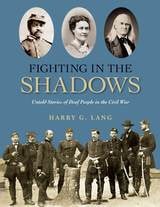
Fighting in the Shadows
Untold Stories of Deaf People in the Civil WarHarry G. Lang
Gallaudet University Press, 2017
Lang pieces together hundreds of stories, accompanied by numerous historical images, to reveal a powerful new perspective on the Civil War. These soldiers and civilians were not “disabled” by their deafness. On the contrary, despite the marginalization and paternalism they experienced in society, they were able to apply their skills and knowledge to support the causes in which they ardently believed.
Fighting in the Shadows is a story of how deaf civilians and soldiers put aside personal concerns about deafness, in spite of the discrimination they faced daily, in order to pursue a cause larger than themselves. Yet their stories have remained in the shadows, leaving most Americans, hearing and deaf, largely unaware of the deaf people who made significant contributions to the events that changed the course of our nation’s history. This book provides new insights into Deaf history as well as into mainstream interpretations of the Civil War.
Five Days in October
The Lost Battalion of World War IRobert H. Ferrell
University of Missouri Press, 2005
Now, in Five Days in October, historian Robert H. Ferrell presents new material—previously unavailable—about what really happened during those days in the forest. Despite the description of them as a lost battalion, the men were neither lost nor a battalion. The name was coined by a New York newspaper editor who, upon learning that a sizable body of troops had been surrounded, thought up the notion of a Lost Battalion—it possessed a ring sure to catch the attention of readers.
The trapped men actually belonged to companies from two battalions of the Seventy-seventh, and their exact placement was well known, reported by runners at the outset of the action and by six carrier pigeons released by their commander, Major Charles W. Whittlesey, during the five days his men were there. The causes of the entrapment were several, including command failures and tactical errors. The men had been sent ahead of the main division line without attention to flanks, and because of that failure, they were surrounded. Thus began a siege that took the lives of many men, leading to the collapse of the colonel of the 308th Infantry Regiment and, many believe, to the suicide of Major Whittlesey three years later.
This book grew out of Ferrell’s discovery of new material in the U.S. Army Military History Institute at the Army War College from the papers of General Hugh A. Drum and in the National Archives in College Park, Maryland. The Drum papers contain the court-martial record of the lieutenant of a machine-gun unit attached to the battalions, who advised Major Whittlesey to surrender, while the Seventy-seventh Division files contain full accounts of the taut relations between the Lost Battalion’s brigade commander and the Seventy-seventh’s division commander. By including this material, Ferrell gives a new accounting of this intriguing affair. Five Days in October will be welcomed by all those interested in a fuller understanding of the story of the Lost Battalion.
Five Four Whiskey
A Memory of WarRobert Sweatmon
Westholme Publishing, 2014
In late 1969, twenty-year-old Robert Sweatmon received a letter informing him that he had ten days to report to the United States Army. Like thousands of others, he had been drafted. Assigned as a rifleman with a mechanized unit, the author began a year-long odyssey in the Southeast Asian wilderness that would change his and his fellow soldiers’ lives forever.
Taking its title from the nighttime radio code call and response between base camp and those on ambush patrol, Five Four Whiskey: A Memory of War is a moving account of life as a combat soldier in the Vietnam War. Set mostly in the sprawling woods and rubber plantations northwest of Saigon, the author explains what his unit was asked to do and what obstacles they faced, including an elusive but deadly enemy, multiple kinds of booby traps, and antitank mines. The author, a notable television personality following the war, does not sensationalize his account; rather, his book allows a new generation to understand the emotional and physical pressures of the times. Coming of age in the maelstrom of civil rights and the free love culture, the author and his fellow soldiers saw their idealism quickly vaporize in the face of the grim realities of war. Here they learned to compartmentalize their lives as a way to survive, but it was their strong bonds that ultimately kept them from succumbing to the madness that surrounded them. Kept in the field for almost the entire time of his tour, the author was in a unit selected to conduct a clandestine reconnaissance in Cambodia and then lead the 1970 invasion, where he was wounded. Following his convalescence, he was sent to Nui Ba Den, the fabled ghost mountain haunted by the spirit of a Vietnamese princess, until he received his papers that he had completed his combat service. At that moment, his year-long mental wall between soldier and civilian fell away as he counted the last terrifying hours before he was safely out of Vietnam. A tour-de-force of military memoir, written in an objective and often literary prose, Five Four Whiskey perfectly captures how ordinary civilian-soldiers survived an ordeal set in one of the most turbulent times in American history.
Five Stars
Missouri's Most Famous GeneralsJames F. Muench
University of Missouri Press, 2006
Fokker C.11w
Edwin Hoogschagen
Amsterdam University Press, 2024
Fokker C.X
Edwin Hoogschagen
Amsterdam University Press, 2023
The C.X is a little-known member of the Dutch Fokker stable. Just like the D.XXI this biplane served in the air forces of two little neutral countries on the eve of World War II. Both fought gallantly in a war of David versus Goliath proportions, and the complete operational history of the type spans a total of 25 years. In retrospect, the C.X was the last fighting biplane type built by Fokker and the company's last pre-war military type to survive.
For All We Have and Are
Regina and the Experience of the Great WarJames M. Pitsula
University of Manitoba Press, 2008
For Duty and Destiny
The Life and Civil War Diary of William Taylor Stott, Hoosier Soldier and EducatorLloyd A. Hunter
Indiana Historical Society Press, 2011

For Might and Right
Cold War Defense Spending and the Remaking of American DemocracyMichael Brenes
University of Massachusetts Press, 2020
How did the global Cold War influence American politics at home? For Might and Right traces the story of how Cold War defense spending remade participatory politics, producing a powerful and dynamic political coalition that reached across party lines. This “Cold War coalition” favored massive defense spending over social welfare programs, bringing together a diverse array of actors from across the nation, including defense workers, community boosters, military contractors, current and retired members of the armed services, activists, and politicians. Faced with neoliberal austerity and uncertainty surrounding America's foreign policy after the 1960s, increased military spending became a bipartisan solution to create jobs and stimulate economic growth, even in the absence of national security threats.
Using a rich array of archival sources, Michael Brenes draws important connections between economic inequality and American militarism that enhance our understanding of the Cold War's continued impact on American democracy and the resilience of the military-industrial complex, up to the age of Donald Trump.
Forest Brothers
The Account of an Anti-Soviet Lithuanian Freedom Fighter, 1944–1948Translated and with an Introduction by Laima Vincė
Central European University Press, 2009
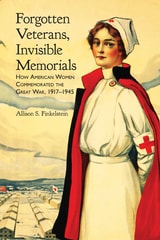
Forgotten Veterans, Invisible Memorials
How American Women Commemorated the Great War, 1917–1945Allison S. Finkelstein
University of Alabama Press, 2021
Investigates the groundbreaking role American women played in commemorating those who served and sacrificed in World War I
In Forgotten Veterans, Invisible Memorials: How American Women Commemorated the Great War, 1917–1945 Allison S. Finkelstein argues that American women activists considered their own community service and veteran advocacy to be forms of commemoration just as significant and effective as other, more traditional forms of commemoration such as memorials. Finkelstein employs the term “veteranism” to describe these women’s overarching philosophy that supporting, aiding, and caring for those who served needed to be a chief concern of American citizens, civic groups, and the government in the war’s aftermath. However, these women did not express their views solely through their support for veterans of a military service narrowly defined as a group predominantly composed of men and just a few women. Rather, they defined anyone who served or sacrificed during the war, including women like themselves, as veterans.
These women veteranists believed that memorialization projects that centered on the people who served and sacrificed was the most appropriate type of postwar commemoration. They passionately advocated for memorials that could help living veterans and the families of deceased service members at a time when postwar monument construction surged at home and abroad. Finkelstein argues that by rejecting or adapting traditional monuments or by embracing aspects of the living memorial building movement, female veteranists placed the plight of all veterans at the center of their commemoration efforts. Their projects included diverse acts of service and advocacy on behalf of people they considered veterans and their families as they pushed to infuse American memorial traditions with their philosophy. In doing so, these women pioneered a relatively new form of commemoration that impacted American practices of remembrance, encouraging Americans to rethink their approach and provided new definitions of what constitutes a memorial. In the process, they shifted the course of American practices, even though their memorialization methods did not achieve the widespread acceptance they had hoped it would.
Meticulously researched, Forgotten Veterans, Invisible Memorials utilizes little-studied sources and reinterprets more familiar ones. In addition to the words and records of the women themselves, Finkelstein analyzes cultural landscapes and ephemeral projects to reconstruct the evidence of their influence. Readers will come away with a better understanding of how American women supported the military from outside its ranks before they could fully serve from within, principally through action-based methods of commemoration that remain all the more relevant today.

Fort Ticonderoga, The Last Campaigns
The War in the North, 1777–1783Mark Edward Lender
Westholme Publishing, 2027
During the War for Independence, Fort Ticonderoga’s guns, sited critically between Lakes Champlain and George, dominated north-south communications in upstate New York that were vital to both the British and American war efforts. In the public mind Ticonderoga was the “American Gibraltar” or the “Key to the Continent,” and patriots considered holding the fort essential to the success of the Revolutionary cause. Ticonderoga was a primary target in British Lieutenant General John Burgoyne’s 1777 campaign to crush American resistance in the north and end the rebellion in a decisive stroke. American efforts to defend the fort in June against overwhelming odds entailed political and military intrigue, bungling, heroism, and ultimately a narrow escape for the Continental and provincial forces under Major General Arthur St. Clair. The loss of Ticonderoga stunned patriot morale and ignited one of the greatest political firestorms of the war. But the fortunes of war turned. Two months later, the rebels mounted a sensational—if little known—counter-attack on Ticonderoga that had major implications for Burgoyne’s eventual defeat at Saratoga in October. Yet Saratoga brought no peace, and Ticonderoga would be central to additional military and political maneuverings—many of them known only to specialist historians—that would keep the region on edge until the end of the war in 1783.
Based on new archival research and taking advantage of the latest scholarship, Fort Ticonderoga, The Last Campaigns: The War in the North, 1777-1783 by distinguished historian Mark Edward Lender highlights the strategic importance of the fort as British, American, and regional forces (including those of an independent Vermont Republic) fought for control of the northern front at a critical point in the war. The book tells the Ticonderoga story in all of its complexity and drama, correcting misconceptions embedded in many previous accounts, and sheds vital new light on this key chapter in America’s struggle for independence.
Franco
Michael Streeter
Haus Publishing, 2025
A narrative of the life of Francisco Franco, Spanish general and dictator.
Growing up in the wake of the Spanish military’s shattering defeat at the hands of the United States in 1898 over Cuba and having survived a bullet to the stomach while serving his country in Morocco, Francisco Franco’s fame and notoriety were eventually guaranteed by his ruthless pursuit of victory for the Nationalists in the Spanish Civil War.
Franco played a major role on the world stage until his death in 1975. At once intensely sentimental and affecting cool indifference at times of bad news, he emphasized the need to obey orders, the importance of individual bravery, absolute loyalty to the Fatherland, and the crucial role of the army. Franco was variously courted by the liberal democracies of Britain and France, the Fascist alliance of Hitler and Mussolini, and then by anti-communist administrations in Washington, but the memory of his successful policies, leading to rapid growth during a time of economic depression, is tempered by his government’s extreme repression of political opponents and perpetration of mass violence during the White Terror.
In this updated edition of Franco, featuring a new introduction by the author, Michael Streeter explores the Generalissimo’s legacy as the subject of a cult of personality in one of Europe’s longest-lasting modern dictatorships and considers his genesis, his successes (decades of relative stability and prosperity during a period of great European conflict), and the terrible cost at which they came.
Frigate HMS Leander
Jantinus Mulder
Amsterdam University Press, 2023
Frigate HNLMS Jacob van Heemskerck
Rindert van Zinderen-Bakker
Amsterdam University Press, 2023

Frigate USS Clark
Rindert van Zinderen-Bakker
Amsterdam University Press, 2023
Frigate USS Clark
Rindert van Zinderen-Bakker
Amsterdam University Press, 2023
From Anzio to the Alps
An American Soldier's StoryLloyd M. Wells
University of Missouri Press, 2019
From Cape Charles to Cape Fear
The North Atlantic Blockading Squadron during the Civil WarRobert M. Browning
University of Alabama Press, 2003
A definitive study of Union naval power and the blockade that reshaped the Civil War.
In From Cape Charles to Cape Fear, acclaimed historian Robert M. Browning, Jr. offers a vivid and authoritative account of the Union Navy’s North Atlantic Blockading Squadron, a critical force in the American Civil War. Charged with enforcing the blockade along the Atlantic coastline from Virginia to North Carolina, the squadron played a decisive role in crippling the Confederacy’s economy and restricting its access to vital supplies.
Browning reveals the blockade as far more than a passive defensive strategy. Through detailed analysis of naval operations, coastal engagements, and strategic planning, he demonstrates how Union forces exerted control over key waterways and ports, including Norfolk and Wilmington. These contested hubs became focal points in a high-stakes struggle involving daring blockade runners, shifting naval tactics, and constant pressure on Southern trade networks.
Blending operational history with compelling narrative, Browning also captures the human dimension of naval warfare. Sailors and officers faced unpredictable weather, dangerous missions, and the relentless demands of maintaining control over an expansive coastline. Their experiences illuminate the challenges and complexities of maritime warfare during one of America’s defining conflicts.
Accessible yet richly researched, this book highlights the central importance of naval power in shaping Civil War outcomes. From Cape Charles to Cape Fear stands as an essential work for readers interested in Civil War history, naval strategy, and the enduring impact of maritime operations on the American past.
From Disarmament to Rearmament
The Reversal of US Policy toward West Germany, 1946–1955Sheldon A. Goldberg
Ohio University Press, 2017
At the end of World War II, the Allies were unanimous in their determination to disarm the former aggressor Germany. As the Cold War intensified, however, the decision whether to reverse that policy and to rearm West Germany as a bulwark against the Soviet threat led to disagreements both within the US government and among members of the nascent NATO alliance. The US military took the practical view that a substantial number of German troops would be required to deter any potential Soviet assault. The State Department, on the other hand, initially advocated an alternative strategy of strengthening European institutions but eventually came around to the military’s position that an armed West Germany was preferable to a weak state on the dividing line between the Western democracies and the Soviet satellite states.
Sheldon A. Goldberg traces the military, diplomatic, and political threads of postwar policy toward West Germany and provides insights into the inner workings of alliance building and the roles of bureaucrats and military officers as well as those of diplomats and statesmen. He draws on previously unexamined primary sources to construct a cogent account of the political and diplomatic negotiations that led to West Germany’s accession to NATO and the shaping of European order for the next forty years.
From Home Guards to Heroes
The 87th Pennsylvania and Its Civil War CommunityDennis W. Brandt
University of Missouri Press, 2007
From Military to Academy
The Writing and Learning Transitions of Student-VeteransMark Blaauw-Hara
Utah State University Press, 2021
From Military to Academy is a detailed picture of how student-veterans may experience the shift to the college experience and academic writing. Grounding his research in the experiences of student-veterans at a community college, Blaauw-Hara integrates adult learning theory, threshold concepts, genre analysis, and student-veteran scholarship to help readers understand the challenges student-veterans experience and the strengths they bring as they enter the academic writing environment. Each chapter takes a different theoretical approach to frame student-veterans’ experiences, and Blaauw-Hara ends each chapter with specific, actionable pedagogical suggestions.
Composition studies scholars especially have demonstrated an ongoing interest in and commitment to understanding the experiences of student-veterans from military service to postsecondary education. From Military to Academy helps college writing faculty and writing program administrators understand and support the growing numbers of student-veterans who are making the transition to higher education.
From Slaves to Soldiers
The 1st Rhode Island Regiment in the American RevolutionRobert Geake
Westholme Publishing, 2024
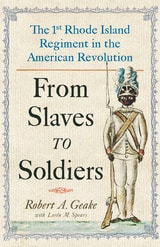
In December 1777, the Continental army was encamped at Valley Forge and faced weeks of cold and hunger, as well as the prospect of many troops leaving as their terms expired in the coming months. If the winter were especially cruel, large numbers of soldiers would face death or contemplate desertion. Plans were made to enlist more men, but as the states struggled to fill quotas for enlistment, Rhode Island general James Mitchell Varnum proposed the historic plan that a regiment of slaves might be recruited from his own state, the smallest in the union, but holding the largest population of slaves in New England. The commander-in-chief’s approval of the plan would set in motion the forming of the 1st Rhode Island Regiment. The “black regiment,” as it came to be known, was composed of indentured servants, Narragansett Indians, and former slaves. This was not without controversy. While some in the Rhode Island Assembly and in other states railed that enlisting slaves would give the enemy the impression that not enough white men could be raised to fight the British, owners of large estates gladly offered their slaves and servants, both black and white, in lieu of a son or family member enlisting. The regiment fought with distinction at the battle of Rhode Island, and once joined with the 2nd Rhode Island before the siege of Yorktown in 1781, it became the first integrated battalion in the nation’s history. In From Slaves to Soldiers: The 1st Rhode Island Regiment in the American Revolution, historian Robert A. Geake tells the important story of the “black regiment” from the causes that led to its formation, its acts of heroism and misfortune, as well as the legacy left by those men who enlisted to earn their freedom.
From Torpedoes to Aviation
Washington Irving Chambers & Technological Innovation in the New Navy 1876 to 1913Stephen K. Stein
University of Alabama Press, 2007
The central figure in the modernization of the U.S. Navy.
The career of Washington Irving Chambers spans a formative period in the development of the United States Navy: He entered the Naval Academy in the doldrum years of obsolete, often rotting ships, and left after he had helped like-minded officers convince Congress and the public of the need to adopt a new naval strategy built around a fleet of technologically advanced battleships. He also laid the groundwork for naval aviation and the important role it would play in the modern navy.
This work covers Chambers’s early naval career, his work at the new Office of Naval Intelligence, his participation in the Greeley Relief Expedition, and a survey for the projected isthmian canal through Nicaragua, before becoming the key advocate for naval modernization. As such, Chambers worked as a pioneering torpedo designer, supervised construction of the Maine, modernized the New York Navy Yard, and became a member of the first permanent faculty at the Naval War College.
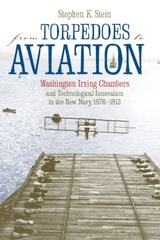
During his long career, Chambers not only designed torpedoes, but also several warships, including a prototype Dreadnought-style battleship and a host of small devices that ranged from torpedo guidance systems to the first catapult for launching airplanes from ships. At the close of his career, Chambers purchased the navy’s first aircraft and founded its air arm. Working with Glenn Curtiss, Chambers guided a coalition of aviation enthusiasts and pioneers who popularized naval aviation and demonstrated its capabilities. Chambers arranged the first take-off and landing of an airplane from a ship and other demonstrations of naval aviation. Combined with his tireless advocacy for modernization, these contributions secured a place in naval and aviation history for the innovator.
From the Uyu River to Omaha Beach and Beyond
The Life of General Willard G. WymanJed Wyman
University of Missouri Press, 2027
While many scholarly works explore the lives and careers of the United States’ senior WWII commanders—Eisenhower, Bradley, Patton, and MacArthur in particular—the stories of the brigadier and major generals who led at the division and corps level have not received the same degree of focus. Jed Wyman gives these general officers their due by telling the story of his grandfather, General Willard G. Wyman in From the Uyu River to Omaha Beach and Beyond: The Life of General Willard G. Wyman. Although General Wyman is best known for his decisive action on Omaha Beach as assistant division commander of the First Infantry Division, for which he won the Distinguished Service Cross, his career both before and after D-Day is as varied and fascinating as those of his more familiar colleagues.
Wyman’s WWII story is exceptional in its range both geographical—he was one of only a handful of general officers to serve in both the Asian/Pacific and European Theaters—and in rank, as he rose from colonel to major general and division commander over the course of the war. The array of important individuals he encountered and worked with during this demanding time is equally exceptional, including such military luminaries as Joseph Stilwell, Omar Bradley, George Patton, Dwight Eisenhower. There were political encounters as well, the most significant with Chinese Nationalist leader Chiang Kai-shek in Burma, and encounters with prominent journalists and entertainers. None of these people meant as much, however, to Wyman as the GIs under his command, for whom he worked tirelessly to ensure a safe and free return to a normal life.
While many questions about Wyman remain unanswered, the author brings him to life as a reliable, efficient combat commander unhindered by the extreme caution associated with General Lucas at Anzio, free from the impetuous nature exhibited by General Patton with the Brolo landing and Hammelburg raid, and lacking in the vainglorious publicity-seeking of some other prominent generals. More broadly, From the Uyu River to Omaha Beach and Beyond conveys the energy, stamina, presence of mind, critical thinking skills, and rapid decision-making of a number of the United States’ lesser-known brigadier and major generals.
Full Fathom Five
A Daughter's SearchMary Lee Coe Fowler
University of Alabama Press, 2008
One woman’s quest for knowledge of her father lost at sea
Mary Lee Coe Fowler was a posthumous child, born after her father, a submarine skipper in the Pacific, was lost at sea in 1943. Her mother quickly remarried into a difficult and troubled relationship, and Mary Lee’s biological father was never mentioned. It was not until her mother died and Mary Lee was a middle-aged adult that she set out to learn not only who her father was, but what happened to him and his crew, and why—and also to confront why she had shied away from asking these questions until it was nearly too late.
Fowler searched through old ships’ logs, letters, and naval communiqués; visited submarine museums, the Naval Academy, and other pertinent sites; interviewed old friends and crew members who knew her dad and mom or served concurrently; and slowly reconstructed the world in which they lived. Beautifully written, Fowler’s memoir reveals what she eventually learned: of the perils and harships of submarine service in wartime, of the tragic irony of how her father’s sub was probably lost, and of the long-term damage experienced by the families of those who do not come home from war.