Results by title
89 books match the query 'Mind & Body' and 4 start with f
Foucault and the Government of Disability
Shelley Tremain, Editor
University of Michigan Press, 2005
Foucault and the Government of Disability is the first book-length investigation of the relevance and importance of the ideas of Michel Foucault to the field of disability studies-and vice versa. Over the last thirty years, politicized conceptions of disability have precipitated significant social change, including the landmark Americans with Disabilities Act in 1990, the redesign of urban landscapes, the appearance of closed-captioning on televisions, and the growing recognition that disabled people constitute a marginalized and disenfranchised constituency.
The provocative essays in this volume respond to Foucault's call to question what is regarded as natural, inevitable, ethical, and liberating, while they challenge established understandings of Foucault's analyses and offer fresh approaches to his work. The book's roster of distinguished international contributors represents a broad range of disciplines and perspectives, making this a timely and necessary addition to the burgeoning field of disability studies.
Foucault and the Government of Disability
Shelley Tremain, Editor
University of Michigan Press, 2005
“[A]n important, prescient, and necessary contribution…a kind of litmus test for the efficacy of Foucault’s concepts in the study of disability, concepts that lead to a refusal of the biological essentialism implied in the disability/impairment binary.”
—Foucault Studies
“Tremain has done an exceptional job at organizing and procuring important, rigorously argued, and entertaining essays…. This book should be a mandatory read for anyone interested in contemporary philosophical debates surrounding the experience of disability."
—Essays in Philosophy
“A beautiful exploration of how Foucault’s analytics of power and genealogies of discursive knowledges can open up new avenues for thinking critically about phenomena that many of us take to be inevitable and thus new ways of resisting and possibly at times redirecting the forces that shape our lives. Every scholar, every person with an interest in Foucault or in political theory generally, needs to read this book.”
—Ladelle McWhorter, University of Richmond
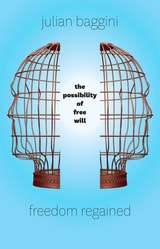
Freedom Regained
The Possibility of Free WillJulian Baggini
University of Chicago Press, 2015
Freedom Regained brings the issues raised by the possibilities—and denials—of free will to thought-provoking life, drawing on scientific research and fascinating encounters with everyone from artists to prisoners to dissidents. He looks at what it means for us to be material beings in a universe of natural laws. He asks if there is any difference between ourselves and the brains from which we seem never able to escape. He throws down the wildcards and plays them to the fullest: What about art? What about addiction? What about twins? And he asks, of course, what this all means for politics.
Ultimately, Baggini challenges those who think free will is an illusion. Moving from doubt to optimism to a hedged acceptance of free will, he ultimately lands on a satisfying conclusion: it is something we earn. The result is a highly engaging, new, and more positive understanding of our sense of personal freedom, a freedom that is definitely worth having.
Freedom and the Human Person
Richard Velkley
Catholic University of America Press, 2007