Results by title
187 books match the query 'Minorities' and 5 start with f
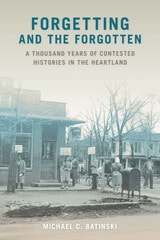
Forgetting and the Forgotten
A Thousand Years of Contested Histories in the HeartlandMichael C. Batinski
Southern Illinois University Press, 2022
Revealing the forgotten in community histories
Histories try to forget, as this evocative study of one community reveals. Forgetting and the Forgotten details the nature of how a community forged its story against outsiders. Historian Michael C. Batinski explores the habits of forgetting that enable communities to create an identity based on silencing competing narratives. The white settlers of Jackson County, Illinois, shouldered the hopes of a community and believed in the justice of their labor as it echoed the national story. The county’s pastkeepers, or keepers of the past, emphasizing the white settlers’ republican virtue, chose not to record violence against Kaskaskia people and African Americans and to disregard the numerous transient laborers. Instead of erasing the presence of outsiders, the pastkeepers could offer only silence, but it was a silence that could be broken.
Batinski’s historiography critically examines local historical thought in a way that illuminates national history. What transpired in Jackson County was repeated in countless places throughout the nation. At the same time, national history writing rarely turns to experiences that can be found in local archives such as court records, genealogical files, archaeological reports, coroner’s records, and veterans’ pension files. In this archive, juxtaposed with the familiar actors of Jackson County history—Benningsen Boon, John A. Logan, and Daniel Brush—appear the Sky People, Italian immigrant workers, black veterans of the Civil War and later champions of civil rights whose stories challenge the dominant narrative.
Framing Identities
Autobiography and the Politics of PedagogyWendy S. Hesford
University of Minnesota Press, 1999
A trenchant examination of the political dynamics of autobiography in education.
How do historically marginalized groups expose the partiality and presumptions of educational institutions through autobiographical acts? How are the stories we tell used to justify resistance to change or institutional complacency? These are the questions Wendy S. Hesford asks as she considers the uses of autobiography in educational settings. This book demonstrates how autobiographical acts-oral, written, performative, and visual-play out in vexed and contradictory ways and how in the academy they can become sites of cultural struggle over multicultural education, sexual harassment, institutional racism, hate speech, student activism, and commemorative practices.
Within the context of Oberlin, a small liberal arts college in Ohio, and beginning with a speak-out organized by Asian American students in 1995, this book looks at the uses of autobiographical practices in empowering groups traditionally marginalized in academic settings. Investigating the process of self-representation and the social, spatial, and discursive frames within which academic bodies and identities are constituted, Framing Identities explores the use of autobiographical acts in terms of power, influence, risks involved, and effectiveness. Hesford does not endorse autobiography as an unequivocal source of empowerment, however. Instead, she illustrates how autobiographical practices in the academy can mobilize competing and often irreconcilable interests. Hesford argues that by integrating self-reflection into cultural, rhetorical, and material analyses-and encouraging students to do the same-teachers not only will largely justify attention to the personal in the classroom, they will help their communities move beyond a naive identity politics. Framing Identities provides a model for teacher-researchers across the disciplines (education, English, composition, cultural studies, women’s studies, to name a few) to investigate the contradictory uses and consequences of autobiography at their own institutions, and to carve out new pedagogical spaces from which they and their students can emerge as social, political, and intellectual subjects.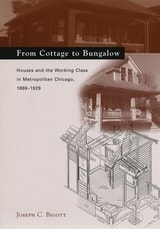
From Cottage to Bungalow
Houses and the Working Class in Metropolitan Chicago, 1869-1929Joseph C. Bigott
University of Chicago Press, 2001
Joseph C. Bigott takes on all of these fields in From Cottage to Bungalow, a sophisticated study of domestic structures and ethnic working-class neighborhoods in Chicago during the critical period of 1869 to 1929, when the city attracted huge numbers of immigrants. Exploring the meaning of home ownership in this context, Bigott develops two case studies that combine the intimate lives of ordinary people (primarily in Chicago's Polish and German communities) with broad analysis of everything from real estate markets to the very carpentry practices used to construct houses. His progressive methods and the novel conclusions they support chronicle not only the history of housing in Chicago, but also the organizations of people's lives, and the ways in which housing has affected notions of who is—and who is not—a worthy American citizen.
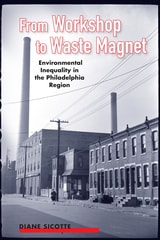
From Workshop to Waste Magnet
Environmental Inequality in the Philadelphia RegionSicotte, Diane
Rutgers University Press, 2016

Frontera Freeways
Highway Building and Displacement in El Paso, TexasMiguel Juarez
University of North Texas Press, 2025