Results by title
73 books match the query 'Modern (late 19th Century to 1945)' and 6 start with f
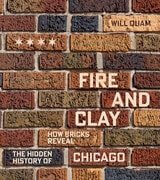
Fire and Clay
How Bricks Reveal the Hidden History of ChicagoWill Quam
University of Chicago Press, 2026
By the late 1920s, at its peak of brick making and consumption, Chicago was making over a billion bricks a year for its buildings and importing almost another billion nicer face bricks for their front facades. Throughout Chicago’s history, brick dramatically transformed from a simple fireproof building material into an integral piece of architectural design. And no one knows the hidden details and stories of this fascinating history like Chicago’s foremost brick aficionado, Will Quam.
In Fire and Clay, Quam takes us on journeys to experience the beauty and mystery of Chicago’s buildings. He also explores how developers, architects, and masons followed changing fashions as they designed and built the city, creating connections across disparate neighborhoods. The red bricks that make up Lincoln Park mansions, for example, are the same as those found on Pullman row homes and Pilsen workers’ cottages, just as Rogers Park’s colorful bricks can also be found far across the city in South Shore. Known for his popular walking tours, Quam has built his life around the appreciation, study, and evangelizing of this most humble building block’s many wonders. Here, he pours all his knowledge into the first book of its kind, beautifully illustrated with more than one hundred of his own full-color photographs.
More than just an investigation into brick, Fire and Clay gives readers a fresh lens through which to explore the city anew and find clear connections across its different neighborhoods. By the end of this lively tour through Chicago’s history, readers will never look at a brick building the same way again.
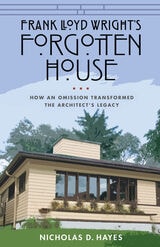
Frank Lloyd Wright's Forgotten House
How an Omission Transformed the Architect's LegacyNicholas D. Hayes
University of Wisconsin Press, 2021
When Nicholas and Angela Hayes became stewards of the unassuming Elizabeth Murphy House near Milwaukee, they began to unearth evidence that ultimately revealed a one-hundred-year-old fiasco fueled by competing ambitions and conflicting visions of America. The couple’s forensic pursuit of the truth untangled the ways Wright’s ASBH experiment led to the architect’s most productive, creative period. Frank Lloyd Wright’s Forgotten House includes a wealth of drawings and photographs, many of which have never been previously published. Historians, architecture buffs, and Wrightophiles alike will be fascinated by this untold history that fills a crucial gap in the architect’s oeuvre.
Frank Lloyd Wright's Larkin Building
Myth and FactJack Quinan
University of Chicago Press, 2006
Quinan’s history draws on engineering documents, personal accounts of the building, and other papers he acquired from the family of Darwin D. Martin, a Larkin executive who proposed commissioning Wright to design the company’s offices. With access to these rare sources, Quinan reveals how a young Wright landed the commission and traces the evolution of his cutting-edge plans. Quinan then takes Wright studies to a new level, examining the Larkin Building as a structure at the center of economic and personal relationships.
Illustrated with more than one hundred photographs, floor plans, maps, and diagrams, Frank Lloyd Wright’s Larkin Building provides a concise but complete record of how the building was conceived, built, evaluated, and finally demolished in what has been called a tragic loss for American architecture.

Frank Lloyd Wright
A BiographyMeryle Secrest
University of Chicago Press, 1998
The result is the most engaging and thorough account ever of Wright's life, work, and professional and personal circle, a gripping account of a complicated, challenging genius.
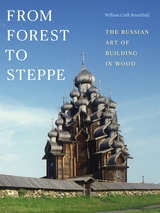
From Forest to Steppe
The Russian Art of Building in WoodWilliam Craft Brumfield
Duke University Press, 2025
In From Forest to Steppe, renowned scholar and photographer William Craft Brumfield offers a panoramic survey of Russia’s centuries-long heritage of wooden architecture. Lavishly illustrated with more than 400 color photographs, the volume links log-built barns, windmills, houses, and churches in the Far North; Buddhist shrines in the Transbaikal region; and eighteenth-century palaces on the outskirts of Moscow. Brumfield also takes readers to the estate houses of many Russian literary giants, from Chekhov and Tolstoy to Dostoevsky and Pushkin. Spanning thousands of photographed sites, five decades of field work, and seven time zones, Brumfield’s photographs offer compelling evidence of the adaptability of log construction and its ability to transcend class, cultural, and aesthetic boundaries.
In the decades since Brumfield began photographing Russian architecture, many of the buildings he has documented have been demolished or abandoned and left to rot at alarming rates. Brumfield observes a contradiction in contemporary Russia: It acknowledges the cultural importance of wooden buildings yet struggles to find and dedicate the resources and solutions needed to save them. A hymn and elegy to the long Russian practice of building with wood, From Forest to Steppe is an unparalleled look into one of the world’s most singular architectural traditions.

Furnishing Fascism
Modernist Design and Politics in ItalyIgnacio G. Galán
University of Minnesota Press, 2025
The role of modernist interior design in the construction of Italian nationalism
Along with the rise of Mussolini’s fascist regime, the interwar years in Italy also saw the widespread development of its modernist interior design and furnishing practices. While the regime’s politics were overtly manifest in monumental government architecture, Furnishing Fascism examines the subtler yet effective role of household goods and decor in the cultivation of Italy’s exclusionary sense of national identity.
Presenting a fresh look at the work of various architects and designers, including iconic figures such as Gio Ponti and Carlo Enrico Rava, Ignacio G. Galán explores how seemingly neutral products of everyday life contributed to the propagation of fascist ideology. Through extensive promotion in popular magazines and department stores, on the film sets of Cinecittà Studios, and throughout the country’s colonial territories, Italy’s modernist design practices were part of a larger political project that aimed to produce a totalizing image of cultural hegemony.
Interweaving design theory, architectural history, and media scholarship, Furnishing Fascism reexamines the period’s so-called minor arts to reveal the political entanglement of modernism in early twentieth-century Italy and offers valuable insight into the complications of cultural production under the auspices of authoritarian power.
Retail e-book files for this title are screen-reader friendly with images accompanied by short alt text and/or extended descriptions.