193 books match the query 'Modernism (Literature)' and 9 start with f
cover of FEMINIST REALISM AT THE FIN DE SIÈCLE: The Influence of the Late-Victorian Woman’s Press on the Development of the Novel

FEMINIST REALISM AT THE FIN DE SIÈCLE

The Influence of the Late-Victorian Woman’s Press on the Development of the Novel

Molly Youngkin

The Ohio State University Press, 2007
Molly Youngkin takes on a major literary problem of the turn-of-the-century: Was the transition from the Victorian novel to the modern novel enabled by antirealist or realist narrative strategies? To answer this question, Youngkin analyzes book reviews that appeared in two prominent feminist periodicals circulated during the late-Victorian era—Shafts and The Woman’s Herald.
 
Through reviews of the works of important male and female authors of the decade—Thomas Hardy, Sarah Grand, George Gissing, Mona Caird, George Meredith, Ménie Dowie, George Moore, and Henrietta Stannard—these periodicals developed a feminist realist aesthetic that drew on three aspects of woman’s agency (consciousness, spoken word, and action) and emphasized corresponding narrative strategies (internal perspective, dialogue, and description of characters’ actions). Still, these periodicals privileged consciousness over spoken word and action and, by doing so, encouraged authors to push the boundaries of traditional realism and anticipate the modernist aesthetic.
 
By acknowledging the role of the woman’s press in the development of the novel, this book revises our understanding of the transition from Victorianism to modernism, which often is characterized as antirealist. Late-Victorian authors working within the realist tradition also contributed to this transition, particularly through their engagement with feminist realism. Youngkin deftly illustrates this transition and in so doing proves that it cannot be attributed to antirealist narrative strategies alone.
[more]
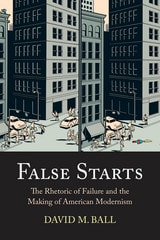
cover of False Starts: The Rhetoric of Failure and the Making of American Modernism

False Starts

The Rhetoric of Failure and the Making of American Modernism

David M. Ball

Northwestern University Press, 2014
From Herman Melville’s claim that “failure is the true test of greatness” to Henry Adams’s self-identification with the “mortifying failure in [his] long education” and William Faulkner’s eagerness to be judged by his “splendid failure to do the impossible,” the rhetoric of failure has served as a master trope of modernist American literary expression. David Ball’s magisterial study addresses the fundamental questions of language, meaning, and authority that run counter to well-rehearsed claims of American innocence and positivity, beginning with the American Renaissance and extending into modernist and contemporary literature. The rhetoric of failure was used at various times to engage artistic ambition, the arrival of advanced capitalism, and a rapidly changing culture, not to mention sheer exhaustion. False Starts locates a lively narrative running through American literature that consequently queries assumptions about the development of modernism in the United States.
[more]
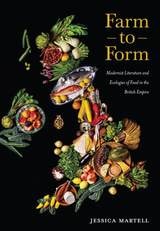
cover of Farm to Form: Modernist Literature and Ecologies of Food in the British Empire

Farm to Form

Modernist Literature and Ecologies of Food in the British Empire

Jessica Martell

University of Nevada Press, 2020

In this groundbreaking book, Jessica Martell investigates the relationship between industrial food and the emergence of literary modernisms in Britain and Ireland. By the early twentieth century, the industrialization of the British Empire’s food system had rendered many traditional farming operations, and attendant agrarian ways of life, obsolete. Weaving insights from modernist studies, food studies, and ecocriticism, Farm to Form contends that industrial food made nature “modernist,” a term used as literary scholars understand it—stylistically disorienting, unfamiliar, and artificial but also exhilarating, excessive, and above all, new. Martell draws in part upon archives in the United Kingdom but also presents imperial foodways as an extended rehearsal for the current era of industrial food supremacy. She analyzes how pastoral mode, anachronism, fragmentation, and polyvocal narration reflect the power of the literary arts to reckon with—and to resist—the new “modernist ecologies” of the twentieth century.

Deeply informed by Martell’s extensive knowledge of modern British, Irish, American, and World Literatures, this progressive work positions modernism as central to the study of narratives of resistance against social and environmental degradation. Analyzed works include those of Thomas Hardy, E. M. Forster, Virginia Woolf, Joseph Conrad, George Russell, and James Joyce.

In light of climate change, fossil fuel supremacy, nutritional dearth, and other pressing food issues, modernist texts bring to life an era of crisis and anxiety similar to our own. In doing so, Martell summons the past as a way to employ the modernist term of “defamiliarizing” the present so that entrenched perceptions can be challenged. Our current food regime is both new and constantly evolving with the first industrial food trades. Studying earlier cultural responses to them invites us to return to persistent problems with new insights and renewed passion.
 
[more]
cover of Fiction, Crime, and Empire: CLUES TO MODERNITY AND POSTMODERNISM

Fiction, Crime, and Empire

CLUES TO MODERNITY AND POSTMODERNISM

Jon Thompson

University of Illinois Press, 1993

[more]
cover of First Love: The Affections of Modern Fiction

First Love

The Affections of Modern Fiction

Maria DiBattista

University of Chicago Press, 1991

All of us remember our First Love. In this brilliant and often passionate book, Maria DiBattista shows that the yearning for the freshness of First Love, and the sadness of that yearning, are central to modern literature. DiBattista offers a sweeping and wholly original reinterpretation of modern fiction, allowing us to see the romantic affections that lie behind the seemingly most ironic of modernist texts.

DiBattista argues that modernity reinvented First Love as a myth of creative initiative, as its characteristic response to a pervasive sense of historical belatedness. Anxious that its own creations can never be more than diminished forms of mightier originals, modernity idolizes First Love as the beginning that can never be repeated. First Love hence epitomizes the dream of a new self-incarnation. From Turgenev's First Love to the formative works of Virginia Woolf, Gertrude Stein, E. M. Forster, and Vladimir Nabokov, First Love confirms the birth of an artistic vocation. For modern men and women intent on becoming the original authors of their own lives, First Love becomes paradigmatic of those life-altering moments that transform the undifferentiated sequence of days into a fateful narrative.

DiBattista focuses on the enunciation of First Love in the fiction of Thomas Hardy, D. H. Lawrence, James Joyce, and Samuel Beckett. In reading their works, DiBattista dramatically revises the accepted view of irony as the dominant tone of modernism. First Love constitutes, she shows, a new apprehension of the world characterized not by the frigid distances of irony but by a belief in the creative individual who may begin the world anew, as if for the first time.
[more]
cover of Fishing by Obstinate Isles: Modern and Postmodern British Poetry and American Readers

Fishing by Obstinate Isles

Modern and Postmodern British Poetry and American Readers

Keith Tuma

Northwestern University Press, 1998
Fishing by Obstinate Isles explores the relations of recent British and American poetries, challenging American views of a British poetry dominated by antimodernism while discussing the role of rhetorics of national identity on both sides of the Atlantic in the persistence of these views. Devoting its most extensive commentary to a collection of British modernist and postmodernist poets, it attacks the relegation of British poetry to the zones of the quaint, making a compelling case for renewed engagements with fields of British poetry deserving of attention.
[more]
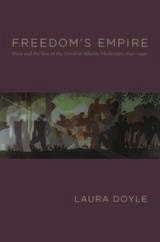
cover of Freedom's Empire: Race and the Rise of the Novel in Atlantic Modernity, 1640-1940

Freedom's Empire

Race and the Rise of the Novel in Atlantic Modernity, 1640-1940

Laura Doyle

Duke University Press, 2007

In this pathbreaking work of scholarship, Laura Doyle reveals the central, formative role of race in the development of a transnational, English-language literature over three centuries. Identifying a recurring freedom plot organized around an Atlantic Ocean crossing, Doyle shows how this plot structures the texts of both African-Atlantic and Anglo-Atlantic writers and how it takes shape by way of submerged intertextual exchanges between the two traditions. For Anglo-Atlantic writers, Doyle locates the origins of this narrative in the seventeenth century. She argues that members of Parliament, religious refugees, and new Atlantic merchants together generated a racial rhetoric by which the English fashioned themselves as a “native,” “freedom-loving,” “Anglo-Saxon” people struggling against a tyrannical foreign king. Stories of a near ruinous yet triumphant Atlantic passage to freedom came to provide the narrative expression of this heroic Anglo-Saxon identity—in novels, memoirs, pamphlets, and national histories. At the same time, as Doyle traces through figures such as Friday in Robinson Crusoe, and through gothic and seduction narratives of ruin and captivity, these texts covertly register, distort, or appropriate the black Atlantic experience. African-Atlantic authors seize back the freedom plot, placing their agency at the origin of both their own and whites’ survival on the Atlantic. They also shrewdly expose the ways that their narratives have been “framed” by the Anglo-Atlantic tradition, even though their labor has provided the enabling condition for that tradition.

Doyle brings together authors often separated by nation, race, and period, including Aphra Behn, Eliza Haywood, Olaudah Equiano, Nathaniel Hawthorne, Harriet Wilson, Pauline Hopkins, George Eliot, and Nella Larsen. In so doing, she reassesses the strategies of early women novelists, reinterprets the significance of rape and incest in the novel, and measures the power of race in the modern English-language imagination.
[more]
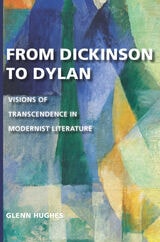
cover of From Dickinson to Dylan: Visions of Transcendence in Modernist Literature

From Dickinson to Dylan

Visions of Transcendence in Modernist Literature

Glenn Hughes

University of Missouri Press, 2020

Glenn Hughes examines the ways in which six literary modernists—Emily Dickinson, Marcel Proust, T. S. Eliot, Ezra Pound, Samuel Beckett, and Bob Dylan—have explored the human relationship to a transcendent mystery of meaning. Hughes argues that visions of transcendence are, perhaps surprisingly, a significant feature in modernist literature, and that these authors’ works account for many of the options for interpreting what transcendent reality might be.

This work is unique in its extended focus, in a comparative study spanning a century, on the persistence and centrality in modernist literature of the struggle to understand and articulate the dependence of human meaning on the mystery of transcendent meaning. Hughes shows us that each of these authors is a mystic in his or her way, and that none are tempted by the modern inclination to suppose that meaning originates with human beings. Together, they address one of the most difficult and important challenges of modern literature: how to be a mystic in modernity.
[more]
cover of Future of Modernism

Future of Modernism

Hugh Witemeyer, Editor

University of Michigan Press, 1997

The modernism of the future will not look like the modernism of the past. Over the past twenty years, W. B. Yeats, James Joyce, T. S. Eliot, Ezra Pound, and other major figures of the modernist movement have been subject to postmodernist critiques that have seen them as reactionary upholders of oppressive class, gender, racial, or other hierarchies; these critiques have permanently altered conceptions of the program and the canon of modernism. Today, revolutions in editing and publishing seem likely to transform them still further. The contributors to The Future of Modernism take these sea-changes into account, acknowledging and learning from the developments of recent years. Some interrogate the antithesis between modernism and postmodernism, showing that the former contains many features commonly claimed for the latter. Other essays dissociate modernism from the New Critical formalism with which it is often confused. Still others explore the modernist legacy of engagement with political and social events, challenging characterizations of modernism as an ahistorical, universalistic ideology. Together, these eleven essays by distinguished scholars contest facile dismissals of modernist writing and affirm an unshakable conviction of its continuing relevance and value. Although they project no unified vision or prophecy, the essays suggest a variety of lively trajectories into the next century.
[more]