149 books match the query 'Modernity' and 5 start with f

cover of Fiction, Crime, and Empire: CLUES TO MODERNITY AND POSTMODERNISM

Fiction, Crime, and Empire

CLUES TO MODERNITY AND POSTMODERNISM

Jon Thompson

University of Illinois Press, 1993
[more]
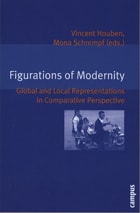
cover of Figurations of Modernity: Global and Local Representations in Comparative Perspective

Figurations of Modernity

Global and Local Representations in Comparative Perspective

Edited by Vincent Houben and Mona Schrempf

Campus Verlag, 2008
Conventional wisdom holds that globalization has made the world more modern, not less. But how has modernity been conceived of in colonial, postcolonial, and post-revolutionary worlds? In Figurations of Modernity, an international team of scholars probe how non-European worlds have become modern ones, from the perspective of a broad range of societies around the globe.           
 
From vocational education in Argentina to secular morality in Tibet, from the construction of heroes in Central Asia to historical memory in Nigeria, this comprehensive volume reckons with the legacy of empire in a globalizing world. Enhanced by the perspectives of historians, anthropologists, and scholars of comparative education, Figurations of Modernity will be an essential book for those studying post-colonial nations across disciplines.
 
[more]
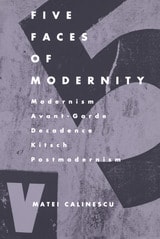
cover of Five Faces of Modernity: Modernism, Avant-garde, Decadence, Kitsch, Postmodernism

Five Faces of Modernity

Modernism, Avant-garde, Decadence, Kitsch, Postmodernism

Matei Calinescu

Duke University Press, 1987

Five Faces of Modernity is a series of semantic and cultural biographies of words that have taken on special significance in the last century and a half or so: modernity, avant-garde, decadence, kitsch, and postmodernism. The concept of modernity—the notion that we, the living, are different and somehow superior to our predecessors and that our civilization is likely to be succeeded by one even superior to ours—is a relatively recent Western invention and one whose time may already have passed, if we believe its postmodern challengers. Calinescu documents the rise of cultural modernity and, in tracing the shifting senses of the five terms under scrutiny, illustrates the intricate value judgments, conflicting orientations, and intellectual paradoxes to which it has given rise.
Five Faces of Modernity attempts to do for the foundations of the modernist critical lexicon what earlier terminological studies have done for such complex categories as classicism, baroque, romanticism, realism, or symbolism and thereby fill a gap in literary scholarship. On another, more ambitious level, Calinescu deals at length with the larger issues, dilemmas, ideological tensions, and perplexities brought about by the assertion of modernity.
[more]
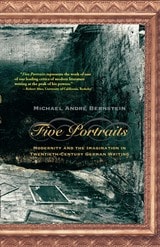
cover of Five Portraits: Modernity and the Imagination in Twentieth-Century German Writing

Five Portraits

Modernity and the Imagination in Twentieth-Century German Writing

Michael Bernstein

Northwestern University Press, 2000

In Five Portraits, one of the most acute critical thinkers of our time presents essays on five of the most important writers of the past hundred years: Rainer Maria Rilke, Paul Celan, Robert Musil, Martin Heidegger, and Walter Benjamin. The result is a remarkable examination of a moment when these writers, caught between the dream of creating an abiding masterpiece and the reality of a brutal culture fascinated by apocalyptic catastrophe, deliberately put themselves and their work at the center of the storm. Written in elegant and jargon-free prose, Michael Andre Bernstein's essays create a vivid image of an epoch whose aspirations and torments continues to shape the world we inhabit today.
[more]
cover of From Fear to Fraternity: A Russian Tale of Crime, Economy and Modernity

From Fear to Fraternity

A Russian Tale of Crime, Economy and Modernity

Patricia Rawlinson

Pluto Press, 2010

The end of communism marked the re-emergence of a huge rise in organised crime across Russia and Eastern Europe. High-profile efforts to combat it have met with little success.
 
Patricia Rawlinson argues that burgeoning crime rates result not only from the failures of communism but also from the problems of free market economies.
 
Drawing on interviews with members of the Russian criminal underworld, the business community, journalists and the militia, she argues that organised crime provides us with a barometer of economic well-being, not just for Russia but for any market economy.

[more]