Results by title
62 books match the query 'Musicians' and 3 start with f
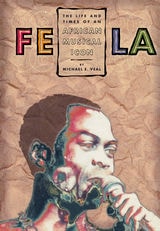
Fela
Life And Times Of An AfricanMichael Veal
Temple University Press, 2000
Although harassed, beaten, and jailed by Nigerian authorities, he continued his outspoken and derisive criticism of political corruption at home and economic exploitation from abroad. A volatile mixture of personal characteristics -- charisma, musical talent, maverick lifestyle, populist ideology, and persistence in the face of persecution -- made him a legend throughout Africa and the world. Celebrated during the 1970s as a musical innovator and spokesman for the continent's oppressed masses, he enjoyed worldwide celebrity during the 1980s and was recognized in the 1990s as a major pioneer and elder statesman of African music. By the time of his death in 1997 from AIDS-related complications, Fela had become something of a Nigerian institution.
In Africa, the idea of transnational alliance, once thought to be outmoded, has gained new currency. In African America, during a period of increasing social conservatism and ethnic polarization, Africa has re-emerged as a symbol of cultural affirmation. At such an historical moment, Fela's music offers a perspective on race, class, and nation on both sides of the Atlantic. As Professor Veal demonstrates, over three decades Fela synthesized a unique musical language while also clearing -- if only temporarily -- a space for popular political dissent and a type of counter-cultural expression rarely seen in West Africa. In the midst of political turmoil in Africa, as well as renewal of pro-African cultural nationalism throughout the diaspora, Fela's political music functions as a post-colonial art form that uses cross-cultural exchange to voice a unique and powerful African essentialism.
Fire in the Water, Earth in the Air
Legends of West Texas MusicBy Christopher J. Oglesby
University of Texas Press, 2006
From Buddy Holly and the Crickets to the Flatlanders, Terry Allen, and Natalie Maines, Lubbock, Texas, has produced songwriters, musicians, and artists as prolifically as cotton, conservatives, and windstorms. While nobody questions where the conservatives come from in a city that a recent nonpartisan study ranked as America's second most conservative, many people wonder why Lubbock is such fertile ground for creative spirits who want to expand the boundaries of thought in music and art. Is it just that "there's nothing else to do," as some have suggested, or is there something in the character of Lubbock that encourages creativity as much as conservatism?
In this book, Christopher Oglesby interviews twenty-five musicians and artists with ties to Lubbock to discover what it is about this community and West Texas in general that feeds the creative spirit. Their answers are revealing. Some speak of the need to rebel against conventional attitudes that threaten to limit their horizons. Others, such as Joe Ely, praise the freedom of mind they find on the wide open plains. "There is this empty desolation that I could fill if I picked up a pen and wrote, or picked up a guitar and played," he says. Still others express skepticism about how much Lubbock as a place contributes to the success of its musicians. Jimmie Dale Gilmore says, "I think there is a large measure of this Lubbock phenomenon that is just luck, and that is the part that you cannot explain."
As a whole, the interviews create a portrait not only of Lubbock's musicians and artists, but also of the musical community that has sustained them, including venues such as the legendary Cotton Club and the original Stubb's Barbecue. This kaleidoscopic portrait of the West Texas music scene gets to the heart of what it takes to create art in an isolated, often inhospitable environment. As Oglesby says, "Necessity is the mother of creation. Lubbock needed beauty, poetry, humor, and it needed to get up and shake its communal ass a bit or go mad from loneliness and boredom; so Lubbock created the amazing likes of Jimmie Dale Gilmore, Butch Hancock, Terry Allen, and Joe Ely."
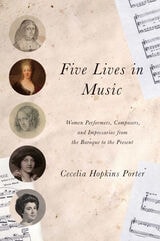
Five Lives in Music
Women Performers, Composers, and Impresarios from the Baroque to the PresentCecelia Hopkins Porter
University of Illinois Press, 2014
Representing a historical cross-section of performance and training in Western music since the seventeenth century, Five Lives in Music brings to light the private and performance lives of five remarkable women musicians and composers. Elegantly guiding readers through the Thirty Years War in central Europe, elite courts in Germany, urban salons in Paris, Nazi control of Germany and Austria, and American musical life today, as well as personal experiences of marriage, motherhood, and widowhood, Cecelia Hopkins Porter provides valuable insights into the culture in which each woman was active.