52 books match the query 'Nature in literature' and 2 start with f
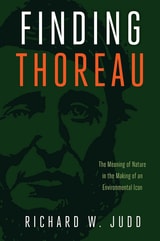
cover of Finding Thoreau: The Meaning of Nature in the Making of an Environmental Icon

Finding Thoreau

The Meaning of Nature in the Making of an Environmental Icon

Richard W. Judd

University of Massachusetts Press, 2018

In his 1862 eulogy for Henry David Thoreau, Ralph Waldo Emerson reflected that his friend “dedicated his genius with such entire love to the fields, hills, and waters of his native town, that he made them known and interesting to all reading Americans, and to people over the sea.” Finding Thoreau traces the reception of Thoreau's work from the time of his death to his ascendancy as an environmental icon in the 1970s, revealing insights into American culture's conception of the environment.

Moving decade by decade through this period, Richard W. Judd unveils a cache of commentary from intellectuals, critics, and journalists to demonstrate the dynamism in the idea of nature, as Americans defined and redefined the organic world around them amidst shifting intellectual, creative, and political forces. This book tells the captivating story of one writer's rise from obscurity to fame through a cultural reappraisal of the work he left behind.
[more]
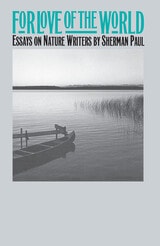
cover of For Love of the World: Essays on Nature Writers

For Love of the World

Essays on Nature Writers

Sherman Paul

University of Iowa Press, 1992

Along with poets, philosophers, and deep ecologists, nature writers—who may be something of all three—address the world alienation of Western civilization. By example as well as with words, they teach us to turn from the self to the world, from ego to ecos.In these deeply felt meditative essays, Sherman Paul contemplates the cosmological homecoming of nature writers who show us how to reenter the world, participate in it, and recover respect for it.
In For Love of the World Sherman Paul considers Thoreau, John Muir, and Aldo Leopold, major writers in the American tradition of nature writing; Henry Beston and Loren Eiseley, writers not yet so canonical; and Richard Nelson and Barry Lopez, our estimable contemporaries.
Paul's meditative mode follows the practice of naturalists who enter the field, come into the open, and relate their immediate experiences. In the most primary and direct way, his essays belong to our moment in history when nothing is more essential than our reattachment to earthly existence. They will reawaken our love of the world—the necessary eros of ecos—and our wonder at and gratitude for being.
[more]