Results by title
176 books match the query 'Nevada' and 4 start with f
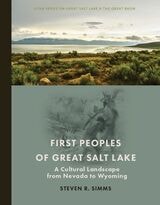
First Peoples of Great Salt Lake
A Cultural Landscape from Nevada to WyomingSteven R. Simms
University of Utah Press, 2023
Great Salt Lake is a celebrated, world-recognized natural landmark. It, and the broader region bound to it, is also a thoroughly cultural landscape; generations of peoples made their lives there. In an eminently readable narrative, Steven Simms, one of the foremost archaeologists of the region, traces the scope of human history dating from the Pleistocene, when First Peoples interacted with the lapping waters of Lake Bonneville, to nearly the present day. Through vivid descriptions of how people lived, migrated, and mingled, with persistence and resilience, Simms honors the long human presence on the landscape.
First Peoples of Great Salt Lake takes a different approach to understanding the ancients than is typical of archaeology. De-emphasizing categories and labels, it traces changing environments, climates, and peoples through the notion of place. It challenges the "Pristine Myth," the cultural bias that Indigenous peoples were timeless, changeless, primitive, and the landscapes they lived in sparsely populated and perpetually pristine. First Peoples and their descendants modified the forests and understory vegetation, shaped wildlife populations, and adapted to long-term climate change. Native Americans of Great Salt Lake were very much part of their world, and the story here is one of long continuity through dramatic cultural change.
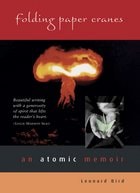
Folding Paper Cranes
An Atomic MemoirLeonard Bird
University of Utah Press, 2005
Among the monuments to tragedy and hope in Hiroshima’s Peace Park stands a statue of Sadako Sasaki holding a crane in her outstretched arms. Sadako was two years old when the atomic bomb was dropped on her city; she was diagnosed with leukemia ten years later. According to popular Japanese belief, folding a thousand paper cranes brings good fortune. Sadako spent the last months of her young life folding hundreds of paper cranes. She folded 644 before she died.
As he journeys from the Geiger counters, radioactive dust, and mushroom clouds of the Nevada desert to the bronze and ivory memorials for the dead in Japan, Bird—himself a survivor of radiation-induced cancer—seeks to make peace with his past and with a future shadowed by nuclear proliferation. His paper cranes are the poetry and prose of this haunting memoir.
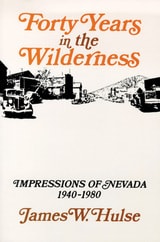
Forty Years In The Wilderness
Impressions Of Nevada, 1940-1980James W. Hulse
University of Nevada Press, 1986
A view of Nevada history by native Nevadan and historian Hulse that suggests prosperity be based on diverse businesses rather than on a gaming-financed economy.
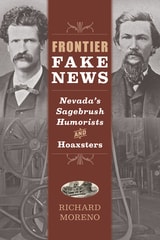
Frontier Fake News
Nevada's Sagebrush Humorists and HoaxstersRichard Moreno
University of Nevada Press, 2023
When readers see the names Mark Twain and Dan De Quille, fake news may not be the first thing that comes to mind. But these legendary journalists were some of the original, and most prolific, fake news writers in the early years of Nevada’s history. Frontier Fake News puts a spotlight on the hoaxes, feuds, pranks, outright lies, witty writing, and other literary devices utilized by a number of the Silver State’s frontier newsmen from the mid-nineteenth through the early twentieth centuries. Often known collectively as the Sagebrush School, these journalists were opinionated, talented, and individualistic.
While Mark Twain (Samuel Clemens), who got his start at Virginia City’s Territorial Enterprise, and Dan De Quille (William Wright), who some felt was a better writer than Twain, are the most well-known members of the Sagebrush School, author Richard Moreno includes others such as Fred Hart, who concocted a fake social club and reported on its gatherings for Austin’s Reese River Reveille, and William Forbes, who enjoyed sprinkling clever puns with political undertones in his newspaper articles.
Moreno traces the beginnings of genuine fake news from founding father Benjamin Franklin’s “Supplement to the Boston Independent Chronicle, Number 705, March 1782,” a fake newspaper aimed at swaying British public opinion, to the fake news articles of New York and Baltimore papers in the early 1800s. But these examples are only a prelude to the amazing accounts of petrified men, freeze-inducing solar armor, magically magnetic rocks, blood-curdling massacres, and other nonsense stories that appeared in Nevada’s frontier newspapers and beyond.