Results by title
110 books match the query 'New Mexico' and 4 start with f
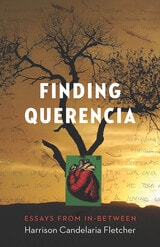
Finding Querencia
Essays from In-BetweenHarrison Candelaria Fletcher
The Ohio State University Press, 2022
Winner, 2022 New Mexico-Arizona Book Award (Autobiography/Memoir category)
With its roots in the Spanish verb querer—“to want, to love”—the term querencia has been called untranslatable but has come to mean a place of safety and belonging, that which we yearn for when we yearn for home. In this striking essay collection, Harrison Candelaria Fletcher shows that querencia is also a state of being: the peace that arises when we reconcile who we are. A New Mexican of mixed Latinx and white ethnicity, Candelaria Fletcher ventures into the fault lines of culture, landscape, and spirit to discover the source of his lifelong hauntings. Writing in the persona of coyote, New Mexican slang for “mixed,” he explores the hyphenated elements within himself, including his whiteness. Blending memory, imagination, form, and language, each essay spirals outward to investigate, accept, and embrace hybridity. Ultimately, Finding Querencia offers a new vocabulary of mixed-ness, a way to reconcile the crosscurrents of self and soul.
With its roots in the Spanish verb querer—“to want, to love”—the term querencia has been called untranslatable but has come to mean a place of safety and belonging, that which we yearn for when we yearn for home. In this striking essay collection, Harrison Candelaria Fletcher shows that querencia is also a state of being: the peace that arises when we reconcile who we are. A New Mexican of mixed Latinx and white ethnicity, Candelaria Fletcher ventures into the fault lines of culture, landscape, and spirit to discover the source of his lifelong hauntings. Writing in the persona of coyote, New Mexican slang for “mixed,” he explores the hyphenated elements within himself, including his whiteness. Blending memory, imagination, form, and language, each essay spirals outward to investigate, accept, and embrace hybridity. Ultimately, Finding Querencia offers a new vocabulary of mixed-ness, a way to reconcile the crosscurrents of self and soul.
[more]
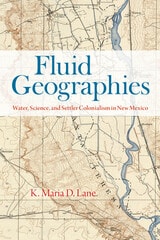
Fluid Geographies
Water, Science, and Settler Colonialism in New MexicoK. Maria D. Lane
University of Chicago Press, 2024
An unprecedented analysis of the origin story of New Mexico’s modern water management system.
Maria Lane’s Fluid Geographies traces New Mexico’s transition from a community-based to an expert-led system of water management during the pre-statehood era. To understand this major shift, Lane carefully examines the primary conflict of the time, which pitted Indigenous and Nuevomexicano communities, with their long-established systems of irrigation management, against Anglo-American settlers, who benefitted from centralized bureaucratic management of water. The newcomers’ system eventually became settled law, but water disputes have continued throughout the district courts of New Mexico’s Rio Grande watershed ever since.
Using a fine-grained analysis of legislative texts and nearly two hundred district court cases, Lane analyzes evolving cultural patterns and attitudes toward water use and management in a pivotal time in New Mexico’s history. Illuminating complex themes for a general audience, Fluid Geographies helps readers understand how settler colonialism constructed a racialized understanding of scientific expertise and legitimized the dispossession of nonwhite communities in New Mexico.
[more]
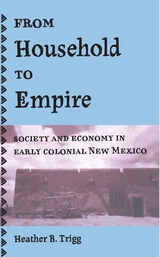
From Household to Empire
Society and Economy in Early Colonial New MexicoHeather B. Trigg
University of Arizona Press, 2005
Published in cooperation with the
William P. Clements Center for Southwest Studies, Southern Methodist University
Settlers at Santa Fe and outlying homesteads during the seventeenth century established a thriving economy that saw the exchange of commodities produced by indigenous peoples, settlers, and Franciscan friars for goods manufactured as far away as China, France, and Turkey. This early Spanish colonial period in New Mexico provides an opportunity to explore both economic activity within a colony and the relations between colony and homeland. By examining the material remains of this era from 1598 to 1680, Heather Trigg reveals a more complete picture of colonial life. Drawing on both archaeological and historical sources, Trigg analyzes the various levels of economic activity that developed: production of items in colonial households, exchanges between households, and trade between the colony and Mexico. Rather than focusing only on the flow of products and services, she also explores the social mechanisms that likely had a significant impact on the economic life of the colony. Because economic activity was important to so many aspects of daily life, she is able to show how and why colonial society worked the way it did. While focusing on the colonists, she also explores their relations with Pueblo peoples. Through her analysis of these two pools of data, Trigg generates insights not usually gleaned from the limited texts of the period, providing information about average colonists in addition to the governors and clergy usually covered in historical accounts. By using specific examples from historical documents and archaeological materials, she shows that colonists from all levels of society modified both formal and informal rules of economic behavior to better fit the reality of the colonial frontier. With its valuable comparative data on colonization, From Household to Empire provides a novel way of examining colonial economies by focusing on the maintenance and modification of social values. For all readers fascinated by the history of the Southwest, this book provides a fuller picture of life in early New Mexico than has previously been seen.
[more]
From Mountain Top to Valley Bottom
Understanding Past Land Use in the Northern Rio Grande Valley, New MexicoBradley J. Vierra
University of Utah Press, 2013
The American Southwest is characterized by environmentally and culturally diverse landscapes, which include the northern Rio Grande valley as it cuts through north-central New Mexico from Taos to Albuquerque. The region has a long and rich history of anthropological research primarily focused on the archaeological remains found along this valley corridor. Only recently has research involving large-scale surveys and excavations been conducted on the nearby mesas and mountains that form the rugged margins of the river valley. From Mountain Top to Valley Bottom incorporates this new research into a perspective that links the ever-changing and complementary nature of lowland and upland land use.
The essays in this collection are unified by three specific themes: landscape, movement, and technology. Landscape involves the ecological backdrop of the northern Rio Grande valley, including past and present environments. Movement refers to the positioning of people across the landscape along with the dynamic and fluid nature with which people—past and present—view their relationship with the “above” and “below.” Technology not only refers to the tools and facilities that past people may have used but to the organization of labor needed to cooperatively exploit a variety of subsistence resources and the exchange of products across the region. This volume provides both a cross section of current research from expert scholars and a broad perspective that seeks to integrate new data from lowland and upland contexts. From Mountain Top to Valley Bottom will appeal to those interested in obsidian source studies, geoarchaeology, past climatic regimes, foraging societies, early agriculture, ceramic technology, subsistence, early village formation, ethnogenesis, and historic multiethnic economies.
[more]