Results by title
92 books match the query 'Notes' and 3 start with f

FASTING FOR RAMADAN
Notes from a Spiritual PracticeKazim Ali
Tupelo Press, 2011
Fasting for Ramadan is structured as a chronicle of daily meditations, during two cycles of the 30-day rite of daytime abstinence required by Ramadan for purgation and prayer. Estranged in certain ways from his family’s cultural traditions when he was younger, Ali has in recent years re-embraced the Ramadan ritual, and brings to this rediscovery an extraordinary delicacy of reflection, a powerfully inquiring mind, and the linguistic precision and ardor of a superb poet.
[more]
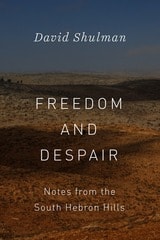
Freedom and Despair
Notes from the South Hebron HillsDavid Shulman
University of Chicago Press, 2018
Lately, it seems as if we wake up to a new atrocity each day. Every morning is now a ritual of scrolling through our Twitter feeds or scanning our newspapers for the latest updates on fresh horrors around the globe. Despite the countless protests we attend, the phone calls we make, or the streets we march, it sometimes feels like no matter how hard we fight, the relentless crush of injustice will never abate.
David Shulman knows intimately what it takes to live your beliefs, to return, day after day, to the struggle, despite knowing you are often more likely to lose than win. Interweaving powerful stories and deep meditations, Freedom and Despair offers vivid firsthand reports from the occupied West Bank in Palestine as seen through the eyes of an experienced Israeli peace activist who has seen the Israeli occupation close up as it impacts on the lives of all Palestinian civilians.
Alongside a handful of beautifully written and often shocking tales from the field, Shulman meditates deeply on how to understand the evils around him, what it means to persevere as an activist decade after decade, and what it truly means to be free. The violent realities of the occupation are on full display. We get to know and understand the Palestinian shepherds and farmers and Israeli volunteers who face this situation head-on with nonviolent resistance. Shulman does not hold back on acknowledging the daily struggles that often leave him and his fellow activists full of despair. Inspired by these committed individuals who are not prepared to be silent or passive, Shulman suggests a model for ordinary people everywhere. Anyone prepared to take a risk and fight their oppressive political systems, he argues, can make a difference—if they strive to act with compassion and to keep hope alive.
This is the moving story of a man who continues to fight for good in the midst of despair. An indispensable book in our era of reactionary politics and refugee crises, political violence and ecological devastation, Freedom and Despair is a gripping memoir of struggle, activism, and hope for peace.
[more]
From Notes to Narrative
Writing Ethnographies That Everyone Can ReadKristen Ghodsee
University of Chicago Press, 2016
Ethnography centers on the culture of everyday life. So it is ironic that most scholars who do research on the intimate experiences of ordinary people write their books in a style that those people cannot understand. In recent years, the ethnographic method has spread from its original home in cultural anthropology to fields such as sociology, marketing, media studies, law, criminology, education, cultural studies, history, geography, and political science. Yet, while more and more students and practitioners are learning how to write ethnographies, there is little or no training on how to write ethnographies well.
From Notes to Narrative picks up where methodological training leaves off. Kristen Ghodsee, an award-winning ethnographer, addresses common issues that arise in ethnographic writing. Ghodsee works through sentence-level details, such as word choice and structure. She also tackles bigger-picture elements, such as how to incorporate theory and ethnographic details, how to effectively deploy dialogue, and how to avoid distracting elements such as long block quotations and in-text citations. She includes excerpts and examples from model ethnographies. The book concludes with a bibliography of other useful writing guides and nearly one hundred examples of eminently readable ethnographic books.
From Notes to Narrative picks up where methodological training leaves off. Kristen Ghodsee, an award-winning ethnographer, addresses common issues that arise in ethnographic writing. Ghodsee works through sentence-level details, such as word choice and structure. She also tackles bigger-picture elements, such as how to incorporate theory and ethnographic details, how to effectively deploy dialogue, and how to avoid distracting elements such as long block quotations and in-text citations. She includes excerpts and examples from model ethnographies. The book concludes with a bibliography of other useful writing guides and nearly one hundred examples of eminently readable ethnographic books.
[more]