Results by title
74 books match the query 'Paleontology' and 8 start with f
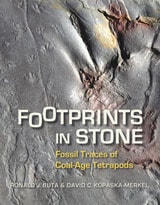
Footprints in Stone
Fossil Traces of Coal-Age TetrapodsRonald J. Buta and David C. Kopaska-Merkel
University of Alabama Press, 2016
Where ancient creatures walked—science uncovers their lasting impressions.
The Steven C. Minkin (Union Chapel) Paleozoic Footprint Site ranks among the most important fossil sites in the world today, and Footprints in Stone recounts the accidental revelation of its existence and detailed findings about its fossil record.
Currently 2,500 miles from the equator and more than 250 miles north of the Gulf of Mexico, the Minkin site was a swampy tropical forest adjacent to a tidal flat during the Coal Age or Carboniferous Period more than 300 million years ago. That fecund strand of sand and mud at the ocean’s edge teemed with the earth’s earliest reptiles as well as amphibians, fish, horseshoe crabs, spiders, jumping insects, and other fascinating organisms. Unlike dinosaurs and other large animals whose sturdy bodies left hard fossil records, most of these small, soft-bodied creatures left no concrete remains. But they did leave something else. Preserved in the site’s coal beds along with insect wings and beautifully textured patterns of primeval plants are their footprints, fossilized animal tracks from which modern paleontologists can glean many valuable insights about their physical anatomies and behaviors.
The paleontological examination of fossil tracks is now the cutting-edge of contemporary scholarship, and the Minkin site is the first and largest site of its kind in eastern North America. Discovered by a local high school science teacher, the site provides both professional and amateur paleontologists around the world with a wealth of fossil track samples along with an inspirational story for amateur explorers and collectors.
Authoritative and extensively illustrated, Footprints in Stone brings together the contributions of many geologists and paleontologists who photographed, documented, and analyzed the Minkin site’s fossil trackways. An engrossing tale of its serendipitous discovery and a detailed study of its fossil records, Footprints in Stone is a landmark publication in the history of paleontology.
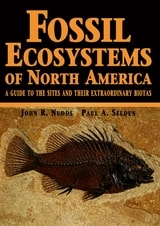
Fossil Ecosystems of North America
A Guide to the Sites and Their Extraordinary BiotasJohn R. Nudds and Paul A. Selden
University of Chicago Press, 2008
Fossil Ecosystems of North America describes these and eleven other sites that range across the continent.

Fossil Lake and the Rise of Modern Birds
Snapshots from Early Avian EvolutionLance Grande, Daniel T Ksepka, and Gerald Mayr
University of Chicago Press, 2027
Lavishly produced with color fossil photographs throughout, the first comprehensive summary of findings at one of the world’s best fossil bird localities, offering profound insight into early avian evolution after the end-of-Cretaceous extinction event.
What is today a high mountain desert in southwestern Wyoming was, 52 million years ago, a magnificent subtropical lake system. Part of the famed Green River Formation, the limestone layers of this region’s Fossil Lake provide an unparalleled record of life in the Early Eocene of North America. Evolutionary biologist Lance Grande has spent much of his career collecting and studying the beautiful and diverse assemblage of fossils from this locality. Since his 2013 book, The Lost World of Fossil Lake, researchers have uncovered many new fossil bird specimens—often stunningly preserved skeletons, sometimes even including feathers—and benefited from significant advances in our understanding of avian evolution. Their findings help to illuminate the early days of bird life on Earth.
In this volume, Grande and his collaborators—paleornithologists Daniel T. Ksepka and Gerald Mayr—explore these birds of Fossil Lake, where various researchers have formally named and described thirty avian species. The authors also present an additional twenty possible new species awaiting further study and formal review, birds that may soon be added to that list. Fossil Lake and the Rise of Modern Birds then places these avian ancestors within the global context of other fossil birds. Like Grande’s previous publications, this comprehensive work features stunning imagery, including nearly two hundred detailed fossil photographs—fifty that have never appeared elsewhere.
Whether you are an ornithologist, paleontologist, evolutionary biologist, or amateur fossil enthusiast interested in the early evolutionary diversification of modern birds, this book is a treasure.
Fossil Vertebrates of Alabama
John T. Thurmond and Douglas E. Jones
University of Alabama Press, 1981
The only comprehensive description of the fossil-vertebrate content of this important part of the world.
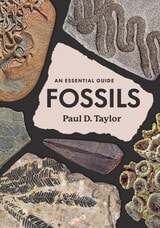
Fossils
An Essential GuidePaul D. Taylor
University of Chicago Press, 2025
Ancient Earth seems like an alien world. But the fossil record can help reveal the mysteries of the organisms that have lived on our planet since its formation some 4,600 million years ago. In this engaging and beautifully illustrated book, world-renowned paleontologist Paul D. Taylor provides a comprehensive guide to all aspects of fossils to tell the story of life on Earth.
Taylor begins with the basics: how fossils form, how they mark geological time, and what they tell us about the origins of life and major evolutionary events like the Cambrian Explosion. He then shows the oldest fossils—single-celled bacteria in amazing, three-billion-year-old microbial rock structures—before introducing the first animals in the fossil record. From fishes to amphibians, reptiles, and mammals, we meet these animal fossils in an appropriate evolutionary parade. Next, we imagine plants long past, charting the evolution of this kingdom and learning how ephemeral botanical remains can become permanent records. While comprehensive in his coverage of fossil groups and ages, Taylor pays particular attention to specimens fossil hunters are most likely to encounter, like crinoids and the iconic ammonites. Throughout, he introduces us to fascinating fossil folklore—like the idea that ammonites are the petrified remains of coiled snakes—and helps us distinguish true fossils from fakes.
With stunning color images of many original specimens from the collections of London’s Natural History Museum, Fossils is an essential introduction, connecting life on Earth today to the ancient past.
Foundations of Paleoecology
Classic Papers with CommentariesEdited by S. Kathleen Lyons, Anna K. Behrensmeyer, and Peter J. Wagner
University of Chicago Press, 2019
This book brings together forty-four classic papers published between 1924 and 1999 that trace the origins and development of paleoecology. The articles cross taxonomic groups, habitat types, geographic areas, and time and have made substantial contributions to our knowledge of the evolution of life. Encompassing the full breadth of paleoecology, the book is divided into six parts: community and ecosystem dynamics, community reconstruction, diversity dynamics, paleoenvironmental reconstruction, species interaction, and taphonomy. Each paper is also introduced by a contemporary expert who gives context and explains its importance to ongoing paleoecological research. A comprehensive introduction to the field, Foundations of Paleoecology will be an essential reference for new students and established paleoecologists alike.
Frozen Fauna of the Mammoth Steppe
The Story of Blue BabeR. Dale Guthrie
University of Chicago Press, 1990
The 36,000-year-old bison mummy, coated with blue mineral crystals, was dubbed "Blue Babe." Guthrie conveys the excitement of its excavation and shows how he made use of evidence from living animals, other Pleistocene mummies, Paleolithic art, and geological data. With photographs and scores of detailed drawings, he takes the reader through the excavation and subsequent detective work, analyzing the animal's carcass and its surroundings, the circumstances of its death, its appearance in life, the landscape it inhabited, and the processes of preservation by freezing. His examination shows that Blue Babe died in early winter, falling prey to lions that inhabited the Arctic during the Pleistocene era.
Guthrie uses information gleaned from his study of Blue Babe to provide a broad picture of bison evolutionary history and ecology, including speculations on the interactions of bison and Ice Age peoples. His description of the Mammoth Steppe as a cold, dry, grassy plain is based on an entirely new way of reading the fossil record.
Fundamentals of Tree Ring Research
James H. Speer
University of Arizona Press, 2010
This comprehensive text addresses all of the subjects that a reader who is new to the field will need to know and will be a welcome reference for practitioners at all levels. It includes a history of the discipline, biological and ecological background, principles of the field, basic scientific information on the structure and growth of trees, the complete range of dendrochronology methods, and a full description of each of the relevant subdisciplines.
Individual chapters address the composition of wood, methods of field and laboratory study, dendroarchaeology, dendroclimatology, dendroecology, dendrogeomorphology, and dendrochemistry. The book also provides thorough introductions to common computer programs and methods of statistical analysis. In the final chapter, the author describes “frontiers in dendrochronology,” with an eye toward future directions in the field. He concludes with several useful appendixes, including a listing of tree and shrub species that have been used successfully by dendrochronologists. Throughout, photographs and illustrations visually represent the state of knowledge in the field.