Results by title
104 books match the query 'Parenting' and 10 start with f
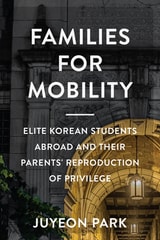
Families for Mobility
Elite Korean Students Abroad and Their Parents' Reproduction of PrivilegeJuyeon Park
Rutgers University Press, 2025

Father Nature
Fathers as Guides to the Natural WorldPaul S. & Stan Piper & Tag
University of Iowa Press, 2003

Fatherhood Arrested
Parenting from Within the Juvenile Justice SystemAnne M. Nurse
Vanderbilt University Press, 2002
By taking us inside the prison system, Nurse shows how its structure actively shapes an inmate's relationship with his children. For example, visitation is sometimes restricted to blood relatives and wives. Because relationships between unmarried men and the mothers of their children are often strained, some mothers are unwilling to allow their children to go to the prison with the inmate's family. Or the father may be allowed to receive visits from only one "girlfriend," which forces a man with multiple relationships, or with children by different women, to make impossible choices. Special attention is paid to the gendered nature of prison, its patriarchal and punitive structure, and its high-stress environment. The book then follows newly paroled men as they are released and return to their children.
The author spent four years doing research at the California Youth Authority, during which time she surveyed 258 paroled fathers. The group included young white, black, and Latino men, ages sixteen to twenty-five. She conducted in-depth interviews with men selected from this group, participated in forty parenting class sessions, and observed visiting hours at three different institutions. The data provide fascinating information about the characteristics of the men, their attitudes toward fatherhood, and the ways they are involved with their children. The diversity of the fathers allows for an analysis of racial and ethnic variation in their attitudes and involvement. The study concludes with a series of policy suggestions, especially important in light of the large number of fathers now living under the care and control of the juvenile justice system.
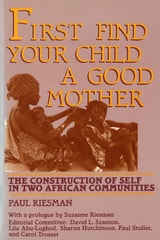
First Find Your Child a Good Mother
The Construction of Self in Two African CommunitiesRiesman, Paul
Rutgers University Press, 1992
Through a systematic comparison of the life circumstances, child-rearing practices, and personalities of the FulBe and their former slaves, the RiimaayBe, this book develops an alternative theory of the way personality is formed in the Fulani society of West Africa. Riesman discusses the different characters, economies, and life plans of adult men and women of both groups, focusing on their ideas about the value of relatives. He further presents detailed observations of child-rearing practices, and concludes that the FulBe and RiimaayBe do not differ in these practices. Contrasting Fulani and Western notions of parenting, he suggests that child-rearing practices are themselves irrelevant to the formation of adult personality, but that a people's ideas about the meaning of life, social relations, and the development of character are very important. Finally, Riesman outlines a sociocultural theory of personality and its formation, and uses this theory to make sense of the differences between FulBe and RiimaayBe.
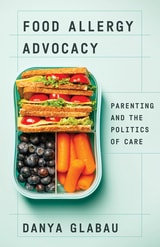
Food Allergy Advocacy
Parenting and the Politics of CareDanya Glabau
University of Minnesota Press, 2022
A detailed exploration of parents’ fight for a safe environment for their kids, interrogating how race, class, and gender shape health advocacy
The success of food allergy activism in highlighting the dangers of foodborne allergens shows how illness communities can effectively advocate for the needs of their members. In Food Allergy Advocacy, Danya Glabau follows parents and activists as they fight for allergen-free environments, accurate labeling, the fair application of disability law, and access to life-saving medications for food-allergic children in the United States. At the same time, she shows how this activism also reproduces the culturally dominant politics of personhood and responsibility, based on an idealized version of the American family, centered around white, middle-class, and heteronormative motherhood.
By holding up the threat of food allergens to the white nuclear family to galvanize political and scientific action, Glabau shows, the movement excludes many, including Black women and disabled adults, whose families and health have too often been marginalized from public health and social safety net programs. Further, its strategies are founded on the assumption that market-based solutions will address issues of social exclusion and equal access to healthcare.
Sharing the personal experiences of a wide spectrum of people, including parents, support group leaders, physicians, entrepreneurs, and scientists, Food Allergy Advocacy raises important questions about who controls illness activism. Using critical, intersectional feminism to interrogate how race, class, and gender shape activist priorities and platforms, it shows the way to new, justice-focused models of advocacy.
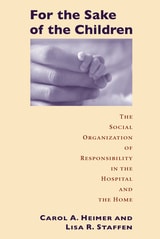
For the Sake of the Children
The Social Organization of Responsibility in the Hospital and the HomeCarol A. Heimer and Lisa R. Staffen
University of Chicago Press, 1998
Rather than treating responsibility as an ethical issue, the authors focus on how responsibility is socially produced and sustained. The authors ask: How do staff members encourage parents to take responsibility, but keep them from interfering in medical matters, and how do parents encourage staff vigilance when they are novices attempting to supervise the experts?
The authors conclude that it is not sufficient simply to be responsible individuals. Instead, we must learn how to be responsible in an organizational world, and organizations must learn how to support responsible individuals.
Formulas for Motherhood in a Chinese Hospital
Suzanne Gottschang
University of Michigan Press, 2018
Formulas for Motherhood follows a group of women over eighteen months as they visited a Beijing Baby- Friendly Hospital over the course of their pregnancies and throughout their postpartum recoveries. The book shows how the space of the hospital operates as a microcosm of the larger social, political, and economic forces that urban Chinese women navigate in the process of becoming a mother. Relations between biomedical practices, heightened expectations of femininity and sexuality demanded by a consumer culture, alongside international and national agendas to promote maternal and child health, reveal new agents of maternal governance emerging at the very moment China’s economy heats up. This ethnography provides insight into how women’s creative pragmatism in a rapidly changing society leads to their views and decisions about motherhood.

Foxes for Everybody
Twenty-Four Hours of Early MotherhoodCatherine Pierce
Northwestern University Press, 2026
Like a newborn’s patterns of sleeping and waking, the revelations of motherhood don’t follow a reasonable schedule, and there’s no clocking out. Organized around the hours of the day, Foxes for Everybody gives voice to the marvels, fears, absurdities, and astonishments of parenthood. These essays offer twenty-four glimpses into how we experience time, our families, our planet, and all of those small moments that aren’t small at all. In memories and reflections that weave through tornadoes and jellyfish, cemeteries and carousels, mortality, mental health, and the exquisite gift of a perfect sentence, acclaimed writer Catherine Pierce reminds us that fear and joy can and do live side by side, and urges us to stay awake—even when, especially when, we’re at the brink of exhaustion—to the possibility of wonder.
From Parent to Child
Intrahousehold Allocations and Intergenerational Relations in the United StatesJere R. Behrman, Robert A. Pollak, and Paul Taubman
University of Chicago Press, 1995
The analyses in From Parent to Child explore these questions by developing and testing a model in which the earnings of children with different genetic endowments respond differently to investments in human capital. Behrman, Pollak, and Taubman use this model to investigate issues such as parental bias in resource allocations based on gender or birth order; the extent of intergenerational mobility in income, earnings, and schooling in the United States; the relative importance of environmental and genetic factors in determining variations in schooling; and whether parents' distributions offset the intended effects of government programs designed to subsidize children. In allocating scarce resources, parents face a trade-off between equity and efficiency, between the competing desires to equalize the wealth of their children and to maximize the sum of their earnings.
Building on the seminal work of Gary Becker, From Parent to Child integrates careful modeling of household behavior with systematic empirical testing, and will appeal to anyone interested in the economics of the family.
Frontera Madre(hood)
Brown Mothers Challenging Oppression and Transborder Violence at the U.S.-Mexico BorderEdited by Cynthia Bejarano and Maria Cristina Morales
University of Arizona Press, 2024
Borderlands Regional Library Association Southwest Book Award Winner
2025 International Latino Book Award Winner
The topic of mothers and mothering transcends all spaces, from popular culture to intellectual thought and critique. This collection of essays bridges both methodological and theoretical frameworks to explore forms of mothering that challenge hegemonic understandings of parenting and traditional notions of Latinx womxnhood. It articulates the collective experiences of Latinx, Black, and Indigenous mothering from both sides of the U.S.-Mexico border.
Thirty contributors discuss their lived experiences, research, or community work challenging multiple layers of oppression, including militarization of the border, border security propaganda, feminicides, drug war and colonial violence, grieving and loss of a child, challenges and forms of resistance by Indigenous mothers, working mothers in maquiladoras, queer mothering, academia and motherhood, and institutional barriers by government systems to access affordable health care and environmental justice. Also central to this collection are questions on how migration and detention restructure forms of mothering. Overall, this collection encapsulates how mothering is shaped by the geopolitics of border zones, which also transcends biological, sociological, or cultural and gendered tropes regarding ideas of motherhood, who can mother, and what mothering personifies.
Contributors
Elva M. Arredondo
Cynthia Bejarano
Bertha A. Bermúdez Tapia
Margaret Brown Vega
Macrina Cárdenas Montaño
Claudia Yolanda Casillas
Luz Estela (Lucha) Castro
Marisa Elena Duarte
Taide Elena
Sylvia Fernández Quintanilla
Paula Flores Bonilla
Judith Flores Carmona
Sandra Gutiérrez
Ma. Eugenia Hernández Sánchez
Irene Lara
Leticia López Manzano
Mariana Martinez
Maria Cristina Morales
Paola Isabel Nava Gonzales
Olga Odgers-Ortiz
Priscilla Pérez
Silvia Quintanilla Moreno
Cirila Quintero Ramírez
Felicia Rangel-Samponaro
Coda Rayo-Garza
Shamma Rayo-Gutierrez
Marisol Rodríguez Sosa
Brenda Rubio
Ariana Saludares
Victoria M. Telles
Michelle Téllez
Marisa S. Torres
Edith Treviño Espinosa
Mariela Vásquez Tobon
Hilda Villegas