Results by title
194 books match the query 'People' and 7 start with f
Fabricating the People
Politics and Administration in the Biopolitical StateThomas J. Catlaw
University of Alabama Press, 2012
Fabricating the People boldly proposes post-representational governance that reframes the practice of modern democracy and reinvents the role of public administration.
Since the 1960s, hostility and mistrust toward the U.S. government has risen precipitously. At the same time, the field of public administration has wrestled with its own crisis of legitimacy. What is at the root of current antigovernment sentiment? Conventionally, two explanations for this problem persist. Some see it primarily in moral terms, a deficit of Constitutional or democratic values in government. Others emphasize government’s performance failures and managerial inefficiency.
Thomas J. Catlaw departs from both explanations in this groundbreaking study and demonstrates that the current crisis of government originates in the uncritical manner in which we have accepted the idea of “the People.” He contends that this unifying, foundational concept—and the notion of political representation it entails—have failed. While illuminating some of our most pressing social and political problems, Catlaw shows how the idea of the People, far from serving to unify, relies in fact on a distinctive logic of exclusion. True political power is the power to determine what constitutes the normal, natural life of the electorate. Today, the exclusionary practices that once made up or fabricated the People are increasingly contested. In turn, government and political power now appear more invasive, less legitimate, and our shared reality appears more fragmented and disconnected.
In order to address this crisis and reinvigorate democracy, Catlaw argues, we must accept as bankrupt the premise of the People and the idea of representation itself. Fabricating the People boldly proposes post-representational governance that reframes the practice of modern democracy and reinvents the role of public administration.
Farmers, Kings, and Traders
The People of Southern Africa, 200-1860Martin Hall
University of Chicago Press, 1990
Through a close reading of the accounts of early travelers, colonialists, archaeologists, and historians, Hall places in context the often contradictory histories that have been written of this region. The result is an illuminating look at how ideas about the past have themselves changed over time.
Film Festivals
Culture, People, and Power on the Global ScreenWong, Cindy H
Rutgers University Press, 2011
Movies, stars, auteurs, critics, and the sheer excitement of cinema come together in film festivals as quintessential constellations of art, business, and glamour. Yet, how well do we actually understand the forces and meanings that these events embody?
Film Festivals offers the first comprehensive overview of the history, people, films, and multiple functions of the festival world. From Sundance to Hong Kong, from the glitter of Cannes to edgier festivals that challenge boundaries or foster LGBTQ cultural production, film festivals celebrate art, promote business, bring cinema to diverse audiences, and raise key issues about how we see our world. Cindy Hing-Yuk Wong situates festivals within changing global practices of film, including their important ties to both Hollywood and independent cinema. She explores how these events have become central in the construction of cinema knowledge as well as the behind-the-scene mechanics of finance, distribution, and evaluation. By linking general structures and connections to specific films and auteurs, Wong addresses the components and creation of film festivals that continue to reshape filmmaking as art and business.
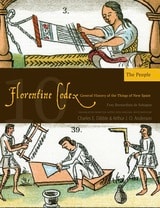
Florentine Codex
Book 10: Book 10: The PeopleBernardino de Sahagun
University of Utah Press, 1981
Two of the world’s leading scholars of the Aztec language and culture have translated Sahagún’s monumental and encyclopedic study of native life in Mexico at the time of the Spanish Conquest. This immense undertaking is the first complete translation into any language of Sahagún’s Nahuatl text, and represents one of the most distinguished contributions in the fields of anthropology, ethnography, and linguistics.
Written between 1540 and 1585, the Florentine Codex (so named because the manuscript has been part of the Laurentian Library’s collections since at least 1791) is the most authoritative statement we have of the Aztecs’ lifeways and traditions—a rich and intimate yet panoramic view of a doomed people.
The Florentine Codex is divided by subject area into twelve books and includes over 2,000 illustrations drawn by Nahua artists in the sixteenth century.
Book Ten gives a broad overview of the different occupations, classes, and characteristics of Aztecs during this time period. Arguably the most fascinating part of this book is the detailed documentation of human anatomy and commonly used cures for physical ailments.
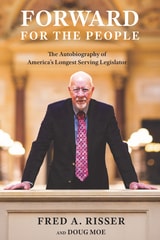
Forward for the People
The Autobiography of America's Longest Serving LegislatorFred A. Risser and Doug Moe
Wisconsin Historical Society Press, 2025
When Fred Risser retired from the Wisconsin Senate in 2021, his sixty-four years in state government made him the longest serving legislator in US history. Now, in this candid and illuminating autobiography, Risser shares his singular perspective on events that transformed the state and the nation over the course of his remarkable career. From his role in the “Joe Must Go” drive to recall US Senator Joseph McCarthy in the 1950s to his position as the senior senator among the “Fab Fourteen” Wisconsin Democrats who opposed Governor Scott Walker’s Act 10 legislation against collective bargaining in 2011, Risser was a leader in state politics for decades, always maintaining an unwavering belief that political action can change people’s lives for the better.
Forward for the People provides a unique peek behind the political curtain from the viewpoint of someone who saw it all. Risser worked with thirteen governors and authored more than 240 bills that became law, championing public health and safety, environmental protection, women’s and reproductive rights, organized labor, civil rights, and social justice, among many other causes. Risser also recounts interactions with prominent national politicians, including Robert La Follette Jr., Hubert Humphrey, Jimmy Carter, and Bill Clinton. More than forty photographs from Risser’s personal collection and the Wisconsin Senate paint a vivid picture of his six-decade journey through Wisconsin politics.
Forward for the People details Risser’s experiences out of state, from a stint in the Panama Canal Zone as a navy hospital corpsman to his undergraduate debate-team days at Minnesota’s Carleton College to his years studying law at the University of Oregon and his travels to all seven continents. The book also depicts the quirky habits that made Risser a memorable and beloved politician: biking his age in miles every birthday and never taking the elevator in his sixty-four years at the Wisconsin State Capitol. Enhanced with details sourced from correspondence, personal notes, newspaper accounts, and recollections from friends and former colleagues, Risser and coauthor Doug Moe have crafted an engaging account of an extraordinary life in public service.
Forward for the People
The Autobiography of America's Longest Serving LegislatorFred A. Risser and Doug Moe
Wisconsin Historical Society Press, 2026
When Fred Risser retired from the Wisconsin Senate in 2021, his sixty-four years in state government made him the longest serving legislator in US history. Now, in this candid and illuminating autobiography, Risser shares his singular perspective on events that transformed the state and the nation over the course of his remarkable career. From his role in the “Joe Must Go” drive to recall US Senator Joseph McCarthy in the 1950s to his position as the senior senator among the “Fab Fourteen” Wisconsin Democrats who opposed Governor Scott Walker’s Act 10 legislation against collective bargaining in 2011, Risser was a leader in state politics for decades, always maintaining an unwavering belief that political action can change people’s lives for the better.
Forward for the People provides a unique peek behind the political curtain from the viewpoint of someone who saw it all. Risser worked with thirteen governors and authored more than 240 bills that became law, championing public health and safety, environmental protection, women’s and reproductive rights, organized labor, civil rights, and social justice, among many other causes. Risser also recounts interactions with prominent national politicians, including Robert La Follette Jr., Hubert Humphrey, Jimmy Carter, and Bill Clinton.
Forward for the People details Risser’s experiences out of state, from a stint in the Panama Canal Zone as a navy hospital corpsman to his undergraduate debate-team days at Minnesota’s Carleton College to his years studying law at the University of Oregon and his travels to all seven continents. The book also depicts the quirky habits that made Risser a memorable and beloved politician: biking his age in miles every birthday and never taking the elevator in his sixty-four years at the Wisconsin State Capitol. Enhanced with details sourced from correspondence, personal notes, newspaper accounts, and recollections from friends and former colleagues, Risser and coauthor Doug Moe have crafted an engaging account of an extraordinary life in public service.
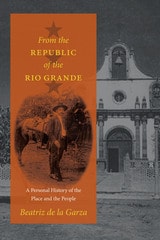
From the Republic of the Rio Grande
A Personal History of the Place and the PeopleBy Beatriz de la Garza
University of Texas Press, 2013
The Republic of the Rio Grande had a brief and tenuous existence (1838–1840) before most of it was reabsorbed by Mexico and the remainder annexed by the United States, yet this region that straddles the Rio Grande has retained its distinctive cultural identity to the present day. Born on one side of the Rio Grande and raised on the other, Beatriz de la Garza is a product of this region. Her birthplace and its people are the subjects of this work, which fuses family memoir and borderlands history.
From the Republic of the Rio Grande brings new insights and information to the study of transnational cultures by drawing from family papers supplemented by other original sources, local chronicles, and scholarly works. De la Garza has fashioned a history of this area from the perspective of individuals involved in the events recounted. The book is composed of nine sections spanning some two hundred years, beginning in the mid-1700s. Each section covers not only a chronological period but also a particular theme relating to the history of the region. De la Garza takes a personal approach, opening most sections with an individual observation or experience that leads to the central motif, whether this is the shared identity of the inhabitants, their pride in their biculturalism and bilingualism, or their deep attachment to the land of their ancestors.