Results by title
230 books match the query 'Physics' and 9 start with f
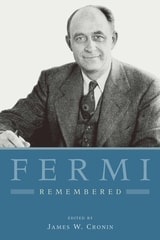
Fermi Remembered
Edited by James W. Cronin
University of Chicago Press, 2004
Born out of a symposium held to commemorate the hundredth anniversary of Fermi's birth, Fermi Remembered combines essays and newly commissioned reminiscences with private material from Fermi's research notebooks, correspondence, speech outlines, and teaching to document the profound and enduring significance of Fermi's life and labors. The volume also features extensives archival material—including correspondence between Fermi and biophysicist Leo Szilard and a letter from Harry Truman—with new introductions that provide context for both the history of physics and the academic tradition at the University of Chicago.
Edited by James W. Cronin, a University of Chicago physicist and Nobel laureate himself, Fermi Remembered is a tender tribute to one of the greatest scientists of the twentieth century.
Contributors:
Harold Agnew
Nina Byers
Owen Chamberlain
Geoffrey F. Chew
James W. Cronin
George W. Farwell
Jerome I. Friedman
Richard L. Garwin
Murray Gell-Mann
Maurice Glicksman
Marvin L. Goldberger
Uri Haber-Schaim
Roger Hildebrand
Tsung Dao Lee
Darragh Nagle
Jay Orear
Marshall N. Rosenbluth
Arthur Rosenfeld
Robert Schluter
Jack Steinberger
Valentine Telegdi
Al Wattenberg
Frank Wilczek
Lincoln Wolfenstein
Courtenay Wright
Chen Ning Yang
Gaurang Yodh
Fermilab
Physics, the Frontier, and MegascienceLillian Hoddeson, Adrienne W. Kolb, and Catherine Westfall
University of Chicago Press, 2008
Fermi National Accelerator Laboratory, located in the western suburbs of Chicago, has stood at the frontier of high-energy physics for forty years. Fermilab is the first history of this laboratory and of its powerful accelerators told from the point of view of the people who built and used them for scientific discovery.
Focusing on the first two decades of research at Fermilab, during the tenure of the laboratory’s charismatic first two directors, Robert R. Wilson and Leon M. Lederman, the book traces the rise of what they call “megascience,” the collaborative struggle to conduct large-scale international experiments in a climate of limited federal funding. In the midst of this new climate, Fermilab illuminates the growth of the modern research laboratory during the Cold War and captures the drama of human exploration at the cutting edge of science.
Foundations of Applied Electromagnetics
Kamal Sarabandi
Michigan Publishing Services, 2022
Foundations of High-Energy Astrophysics
Mario Vietri
University of Chicago Press, 2008
The most thorough and engaging survey of high-energy astrophysics available today, Foundations of High-Energy Astrophysics introduces the main physical processes relevant to the field in a rigorous yet accessible way, while paying careful attention to observational issues. Vietri’s book will quickly become a classic text for students and active researchers in astronomy and astrophysics. Those in adjoining fields will also find it a valuable addition to their personal libraries.
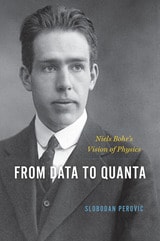
From Data to Quanta
Niels Bohr’s Vision of PhysicsSlobodan Perovic
University of Chicago Press, 2021
Niels Bohr was a central figure in quantum physics, well known for his work on atomic structure and his contributions to the Copenhagen interpretation of quantum mechanics. In this book, philosopher of science Slobodan Perović explores the way Bohr practiced and understood physics, and analyzes its implications for our understanding of modern science. Perović develops a novel approach to Bohr’s understanding of physics and his method of inquiry, presenting an exploratory symbiosis of historical and philosophical analysis that uncovers the key aspects of Bohr’s philosophical vision of physics within a given historical context.
To better understand the methods that produced Bohr’s breakthrough results in quantum phenomena, Perović clarifies the nature of Bohr’s engagement with the experimental side of physics and lays out the basic distinctions and concepts that characterize his approach. Rich and insightful, Perović’s take on the early history of quantum mechanics and its methodological ramifications sheds vital new light on one of the key figures of modern physics.
From Science to Computational Sciences
Studies in the History of Computing and its Influence on Today‘s SciencesEdited by Gabriele Gramelsberger
Diaphanes, 2011
During the last decades hundreds of computational departments have been established all over the world and countless computer-based simulations have been conducted. This volume explores the epoch-making influence of automatic computing machines on science, in particular as simulation tools.
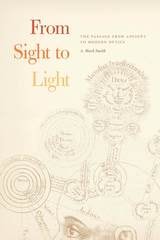
From Sight to Light
The Passage from Ancient to Modern OpticsA. Mark Smith
University of Chicago Press, 2014
Breaking from previous scholarship that sees Johannes Kepler as the culmination of a long-evolving optical tradition that traced back to Greek antiquity via the Muslim Middle Ages, Smith presents Kepler instead as marking a rupture with this tradition, arguing that his theory of retinal imaging, which was published in 1604, was instrumental in prompting the turn from sight to light. Kepler’s new theory of sight, Smith reveals, thus takes on true historical significance: by treating the eye as a mere light-focusing device rather than an image-producing instrument—as traditionally understood—Kepler’s account of retinal imaging helped spur the shift in analytic focus that eventually led to modern optics.
A sweeping survey, From Sight to Light is poised to become the standard reference for historians of optics as well as those interested more broadly in the history of science, the history of art, and cultural and intellectual history.

From White Dwarfs to Black Holes
The Legacy of S. ChandrasekharEdited by G. Srinivasan
University of Chicago Press, 1999
Over the course of more than six decades of active research Chandrasekhar investigated a dizzying array of subjects. G. Srinivasan notes in the preface to this book that "the range of Chandra's contributions is so vast that no one person in the physics or astronomy community can undertake the task of commenting on his achievements." Thus, in this collection, ten eminent scientists evaluate Chandrasekhar's contributions to their own fields of specialization. Donald E. Osterbrock closes the volume with a historical discussion of Chandrasekhar's interactions with graduate students during his more than quarter century at Yerkes Observatory.
Contributors are James Binney, John L. Friedman, Norman R. Lebovitz, Donald E. Osterbrock, E. N. Parker, Roger Penrose, A. R. P. Rau, George B. Rybicki, E. E. Salpeter, Bernard F. Schutz, and G. Srinivasan.
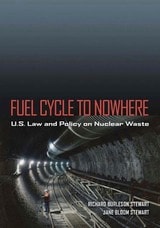
Fuel Cycle to Nowhere
U.S. Law and Policy on Nuclear WasteRichard Burleson Stewart
Vanderbilt University Press, 2011
The first comprehensive history and overview of U.S. nuclear waste law and regulation, Fuel Cycle to Nowhere traces sixty years of nuclear weapons programs, the growth of nuclear power, and their waste legacies, the rise of environmentalism, and the responses of federal agencies. Richard and Jane Stewart expertly analyze the changing policies for storing low-level waste, transuranic waste, spent nuclear fuel, and high-level waste and for regulating their transport by rail and by truck. They also chronicle "a tale of two repositories"--one, the Waste Isolation Pilot Plant in New Mexico, known as WIPP, the world's only operating deep geologic nuclear waste disposal facility, which emerged from a contentious but ultimately successful struggle between federal and state interests; the other, Yucca Mountain, mandated top down by Congress and a failure.
Fuel Cycle to Nowhere provides the critical information and analysis on the waste disposal issues and solutions that the commission, Congress, the administration, journalists, policymakers, and the public so urgently need.
This book is a project of the Consortium for Risk Evaluation with Stakeholder Participation (CRESP), a Vanderbilt University-led, multi-university consortium supported as a cooperative agreement by the U.S. Department of Energy, Office of Environmental This book is a project of the Consortium for Risk Evaluation with Stakeholder Participation (CRESP), a Vanderbilt University-led, multi-university consortium supported as a cooperative agreement by the U.S. Department of Energy, Office of Environmental Management to support safe, effective, publicly credible, risk informed management of existing and future nuclear waste from government and civilian sources through independent strategic analysis, review, applied research and education.