Results by title
413 books match the query 'Pictorial works' and 29 start with f

Faces of Freedom Summer
Herbert Randall and Bobs M. Tusa
University of Alabama Press, 2001
Witness the faces that defined a movement for freedom and equality
The old adage “One picture is worth ten thousand words” is definitely true for Faces of Freedom Summer. There are simply not enough words to describe the period in our history that is recorded by the pictures in this book.
As this book afirms, the resurgence of overt activities by hate groups—both the old traditional ones (e.g., the Ku Klux Klan) and the new ones (e.g., the Skin Heads)—however much the hard work and sacrifices of the modern civil rights movement humanized American society, much still remains to be done. The modern civil rights movement associated with the 1960s was not in vain, yet it did not eradicate from our society the evils of racism and sexism. While we activists made the United States more of an open society than it has ever been in its history, our vision and desire for the beloved community did not reach into all sectors of American society. “Freedom,” it has been said, “is a constant struggle, a work of eternal vigilance.”
Faces of Freedom Summer brings to life that there was such a time and there were such people and, if such a people were once, then they are still among us. Yet, they may only become aware of themselves when they are confronted with visible evidence, such as the evidence contained in the pictures of Herbert Randall.
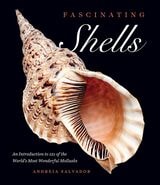
Fascinating Shells
An Introduction to 121 of the World’s Most Wonderful MollusksAndreia Salvador
University of Chicago Press, 2022
Beautiful photographs of stunning shells from London's Natural History Museum, home to one of the most significant and comprehensive collections in the world.
Collected and treasured for their beauty, used in religious rituals, or even traded as currency, shells have fascinated humans for millennia. Ancient and enchanting, dazzling in form and variety, these beautiful objects come from mollusks, one of the most diverse groups in the animal kingdom, including snails, oysters, cuttlefish, and chitons. Soft-bodied, these creatures rely on shells for protection from enemies and their environments, from snowy mountains to arid deserts, in deep-sea hydrothermal vents and the jungles of the tropics, on rocky shores, and in coral reefs.
In this book, mollusk expert Andreia Salvador profiles some of the world’s most beautiful and quirky shells, each selected from the more than eight million specimens held in the collection at London’s Natural History Museum. We lock eyes with the hundred-eyed cowry, named after "the all-seeing one," the giant Argus Panoptes of Greek mythology. We see how shells' appearances translate into defense strategies, as with the zigzag nerite, which varies its patterning to deceive and confuse predators. And we meet shell inhabitants, such as the amber snail, which eats earthworms by sucking them up like spaghetti. Reproduced in full color and striking detail, these shells have much to reveal about the history of collecting, the science of taxonomy, and the human desire to understand the natural world.
Fault Lines
Life and Landscape in Saskatchewan's Oil EconomyValerie Zink
University of Manitoba Press, 2016

Fawn Island
Douglas Wood
University of Minnesota Press, 2018
Fawn Island is a place where crows serve as alarm clocks, white-throated sparrows leave the tracks of their songs upon the evening hush, and chickadees help a woodsman learn to whistle. The island is also a jumping-off place for journeys large and small, earthly and spiritual-to nearby Mallard Island, Gull Island, or Bald Rock, by sea kayak into the wild recesses of sprawling Voyageurs National Park, or on a midnight paddle in which the paddler can reach the silent wilderness of the stars themselves. In his latest book, best-selling author Douglas Wood guides the reader on a deep journey into the heart of the North Woods.
For Wood, Fawn Island is not merely a charming wilderness hideaway; it is the entry to realms of thought and meaning as well. From its pine-clad shores he probes for insights into the nature of neighborliness and independence, of community and solitude. Out of an ancient Ojibwe legend comes an exploration of personal loss and life after death. Wood questions the notion of being a “force of nature” and the concept of the passage of time in the context of seemingly eternal trees, lakes, rock ledges, and stars. From beneath the ascending trunks of pines comes an inquiry into the principles of optimism and, finally, a personal response to the eternal question: Is the universe a friendly place?
Embedded in the text like roots of the island’s pines is Wood’s gentle, self-effacing humor and the author’s own original pen-and-ink drawings that superbly evoke the poetry and mystery of this “small bit of rock and tree,” this “lucky place” in the wilderness.
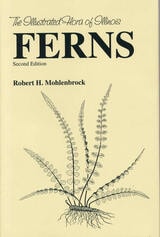
Ferns
Robert H. Mohlenbrock
Southern Illinois University Press, 1999
Perhaps no other group of plants attracts more interest among both professional and amateur botanists than ferns. As early as 1846, when one of the first lists of Illinois plants was published, sixteen species of ferns were already known in the state. The longtime interest of a great many people makes the distribution of ferns better known than that of any other group of plants in Illinois.
This detailed account of ferns and fern-allies was first published in 1967 as the first volume in the series The Illustrated Flora of Illinois. Eminent botanist Robert H. Mohlenbrock has now revised Ferns to include twenty-five additional taxa of ferns that have since been discovered in Illinois. In addition, numerous nomenclatural changes have occurred for plants already known in the state.
The introductory information of Ferns includes discussions of the morphology and life history of the ferns and fern-allies, the taxonomic history of the group in Illinois, and the habitats where they can be found.
The semitechnical keys and descriptions, familiar to the professional botanist, have been simplified for the novice and are accompanied by a glossary and a profuse use of illustrations. A new key has been included for the additional ferns. Two general keys enable the reader to identify the order and the genus of the fern or fern-ally in question. One of these is designed for use with specimens that have sporangia; the other is for use with sterile specimens. The keys are composed of a hierarchy of characteristics for determining the order, family, and genus of any given specimen. Once a genus is ascertained, the reader can apply its key to more than one species of the same genus.
Each species has its own description, statement of habitat and range, Illinois distribution, map, discussion, synonymy, and full-page line illustration showing its diagnostic characteristics.

Field Guide to Oregon Rivers
Tim Palmer
Oregon State University Press, 2024
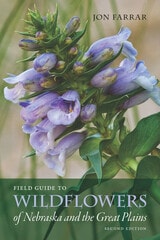
Field Guide to Wildflowers of Nebraska and the Great Plains
Second EditionJon Farrar
University of Iowa Press, 2012
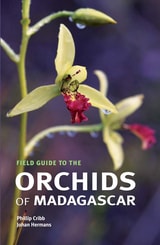
Field Guide to the Orchids of Madagascar
Phillip Cribb and Johan Hermans
Royal Botanic Gardens, Kew, 2009
As is the case with many other rare and sought-after species of plant and animal, Madagascar is one of the world’s prime locations for orchids, which make up the largest family of flowering plants on the island. Madagascar is home to nearly one thousand different species of orchids—which make up nearly ten percent of the island’s flora—nearly nine hundred of them endemic. Orchids are found in almost every habitat on the island, from the mountains to the coasts, and this field guide—the first of its kind, fully illustrated with color photographs and packed with details to aid identification—is an invaluable tool for researchers and ecotourists visiting the island.
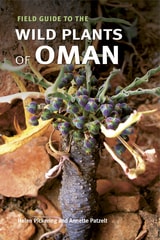
Field Guide to the Wild Plants of Oman
Helen Pickering and Annette Patzelt
Royal Botanic Gardens, Kew, 2008
This compact volume is a handy, thorough guide to the wild plants found in the small Middle Eastern nation of Oman. A short introduction provides an overview of Oman’s geography and remarkable environmental diversity, followed by catalog of more than 250 common species of plants, enhanced by color photographs designed to assist with quick identification in the field. Descriptive accounts—including details of habitat, uses, and worldwide distribution—round out the individual entries, while a glossary of botanical terms, a bibliography, and an index of scientific and vernacular names combine to make this an invaluable reference.
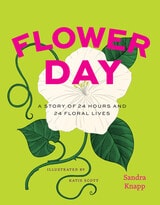
Flower Day
A Story of 24 Hours and 24 Floral LivesSandra Knapp
University of Chicago Press, 2025
Is it 4 AM or chicory o’clock? In this short book, botanist and award-winning author Sandra Knapp walks us through a day in a global garden. Each chapter of Flower Day introduces a single flower during a single hour, highlighting twenty-four different species from around the world.
Beginning at midnight in the Americas, we spot the long tubular flowers of the moonflower, Ipomoea alba; they attract a frenzy of hawk moths before the dawn arrives and the flowers wither and collapse. As day breaks, dandelions and chicory open their heads—actually made up of many individual flowers tightly packed together—and flies and bees visit to get the energy they need to lay eggs and raise their young. Later, at eight o’clock in the morning, the sun rises over the watery Amazon basin, and we meet the giant waterlily, slowly turning from white to pink and purple. Trapped inside are the beetles who feasted on the flowers during the night. That evening, at seven o’clock, we travel to the Caribbean to smell night-blooming jessamine’s powerful—some may say nauseating—sweet scent. But this member of the nightshade family isn’t just a thing of beauty—it has a reputation as both a poison and invasive species, crowding out endangered native trees.
For each hour in our flower day, celebrated artist Katie Scott has depicted these scenes with gorgeous pen-and-ink illustrations. Working closely together to narrate and illustrate these unique moments in time, Knapp and Scott have created an engaging read that is a perfect way to spend an hour or two—and a true gift for amateur botanists, gardeners, and anyone who wants to stop and appreciate the flowers.

Flowering Plants
Basswoods to SpurgesRobert H. Mohlenbrock
Southern Illinois University Press, 1982
This is the fourth volume in The Illustrated Flora of Illinois devoted to dicotyledons, or dicot plants. Dicots are the greatest group of flowering plants, exceeding the monocotyledons, or monocots. Dicots produce a pair of seed leaves during germination while monocots produce only a single seed leaf.
This volume contains four orders and ten families of dicots. The orders included in this volume are Malvales, Urticales, Rhamnales, and Euphorbiales. Within the Malvales are the families Tiliaceae, Sterculiaceae, and Malvaceae. The families Ulmaceae, Moraceae, and Urticaceae comprise the Urticales. Rhamnaceae and Elaeagnaceae make up the Rhamnales. The Euphorbiales include only the Thymelaeceae and the Euphorbiaceae.
Flowering Plants
Lilies to OrchidsRobert H. Mohlenbrock
Southern Illinois University Press, 1970
A continuation of “The Illustrated Flora of Illinois” series, this volume features Illinois flowering plants. This series is designed to provide a working reference for the identification and classification of all the plant forms found in the state. This series is the first of its kind, as no other study of this sort has been undertaken in any other state, and as such, is an unparalleled contribution to its field.
In his introduction to this volume, Mr. Mohlenbrock discusses some of the terms and procedures used in the identification and classification of the plants. He outlines the life histories and morphologies of some of the representative monocots, and also illustrates some of their habits and frequencies in Illinois. Since these volumes are meant to be used by the amateur as well as the professional botanist, the methods and terms used in the text are explained. The directions for the use of the various identification keys are given so that even the novice plant lover will be able to identify the species encountered. For the uninitiated, a glossary is provided which gives definitions for all terms that might be unfamiliar.
All necessary aids to identification are included in the text itself. The identification keys make it initially possible to classify the plants according to order, family, genus and finally, species and the identifying characteristics of each descending class are given in detail. The morphology of each species is outlined, along with data on frequency of occurrence, related soil and climate conditions and history of past collections, and history of past collections. An illustration showing the more important features of the species in detail is included with the description, as well as a map indicating its geographical locations in Illinois.
This book will be invaluable to students, teachers and professionals; particularly those who are interested in observing the plants in their natural habitat. Those who use it will find it possible to obtain a broad view of changing plant forms as they relate to soil and climate variations throughout the state. And it will provide a delightful diversion for all who enjoy viewing beautiful forms in nature. A walk through the forest will become an opportunity for discovery and appreciation.
Flowering Plants
Magnolias to Pitcher PlantsRobert H. Mohlenbrock
Southern Illinois University Press, 1981
This volume, the eighth devoted to flowering plants in the Illustrated Flora of Illinois series, is the third of several devoted to dicotyledons, which include such well-known plants as roses, peas, mustards, mints, nightshades, milkweeds, and asters. Mohlenbrock here represents four orders (Annonales, Berberidales, Nymphaeales, and Sarraceniales) and fifteen families of plants. As in previous volumes in this series, the common names are those used locally in Illinois. An illustration of each species depicts the distinguishing features and the habitat in Illinois.
Flowering Plants
Nightshades to MistletoeRobert H. Mohlenbrock
Southern Illinois University Press, 1990
This sixth volume of dicots contains three orders and eight families. The orders included are Solanales, Campanulales, and Santalales. Within the Solanales are the families Solanaceae, Convolvulaceae, Cuscutaceae, and Polemoniaceae. The Campanulales contain only the family Campanulaceae. The Santalales include the families Celastraceae, Santalaceae, and Viscaceae. As with each volume in this series Mohlenbrock includes a complete plant description, illustrations showing diagnostic features, distribution maps, and ecological notes.
Flowering Plants
Pokeweeds, Four-o'clocks, Carpetweeds, Cacti, Purslanes, Goosefoots, Pigweeds, and PinksRobert H. Mohlenbrock
Southern Illinois University Press, 2001
Robert H. Mohlenbrock provides a definitive account of the pokeweed, four-o'clock, carpetweed, cactus, purslane, goosefoot, pigweed, and pink families in Illinois.
Flowering Plants: Pokeweeds, Four-o’clocks, Carpetweeds, Cacti, Purslanes, Goosefoots, Pigweeds, and Pinks is the fifteenth volume of the Illustrated Flora of Illinois series and the ninth devoted to dicots, or plants that have two seed-leaves, or cotyledons, upon germination. Each of the 141 plants is beautifully illustrated by Paul W. Nelson.
Nelson shows the full habitat of the plant and close-ups of various vegetative and reproductive structures that are crucial for the identification of individual species. Each illustration includes detailed drawings of the flowers, fruits, and seeds of the plant covered. Mohlenbrock provides a complete description of each species as well as a discussion of the nomenclature and habitats, and his fifty-three years of experience enable him to present little-known diagnostic features for many species. Range maps show the county distribution of each species in Illinois. Mohlenbrock includes a statement giving the overall range of each species in the United States as well as a detailed key for the identification of the species.
Flowering Plants contains many plants whose obscure flower parts make them exceedingly difficult to identify. The close-up illustrations of these parts will aid the user of the book immensely in identification of the species. Included are several species previously unknown in Illinois.
New illustrations, which include detailed drawings of the flowers, fruits, and seeds are presented for each species covered in this book. Mohlenbrock’s fifty-three years of experience enable him to present little-known diagnostic features for many species.
Flowering Plants
Smartweeds to HazelnutsRobert H. Mohlenbrock and Paul M. Thomson Jr.
Southern Illinois University Press, 2009
Since the publication of the first edition of Smartweeds to Hazelnuts in 1987, thirteen additional species and one hybrid have been discovered in Illinois. In addition, numerous nomenclatural changes have occurred for plants already known.
This second edition updates the status of the Polygonaceae, Hamamelidaceae, Platanaceae, Fagaceae, Betulaceae, and Corylaceae in Illinois. Each of the newly discovered species has been added and is fully illustrated. Updated nomenclature as well as Illinois distributional data are included for each species. In addition to the fourteen new plant illustrations, the appendix contains new information on the descriptions and the geographical locations of plants in the first edition, and revised identification keys.
Robert H. Mohlenbrock and Paul M. Thomson Jr. have included a complete description, illustrations showing diagnostic features, distribution maps, and ecological notes for each plant included in this volume.
This new edition will be invaluable to scholars of botany as well as laypersons interested in observing plants in their natural habitat.
Flowering Plants
Willows to MustardsRobert H. Mohlenbrock
Southern Illinois University Press, 1980
This eighth volume in the comprehensive Illustrated Flora of Illinois series is the seventh volume devoted to flowering plants (the eighth volume is devoted to ferns) and the second treating dicotyledons, which include such well-known plants as roses, peas, mustards, mints, nightshades, milkweeds, and asters. The previous volume on dicots, Flowering Plants: Hollies to Loasas, was published in 1978.
In the present volume, Mohlenbrock includes three orders of vascular plants encompassing five families. The orders are Salicales and Tamaricales, of the Salicaceae and Tamaricaceae families, and Capparidales, of the Capparidaceae, Resedaceae, and Brassicaceae families. In all, 44 genera and 117species are treated in this volume, each species illustrated in detail.
Fluorspar Mining
Photos from Illinois and Kentucky, 1905-1995Herbert K. Russell
Southern Illinois University Press, 2019
This first-ever pictorial record of the people and methods of the Illinois-Kentucky Fluorspar District from the 1900s to the 1990s covers early and modern means of extracting, hoisting, processing, and transporting the mineral from mine mouth to end user. Nearly one hundred images carefully selected by author Herbert K. Russell show early pick-and-shovel extraction and open-flame lighting as well as primitive drilling methods and transportation by barrels, buckets, barges, mule teams, and trams, in addition to the use of modern equipment and sophisticated refinement procedures such as froth flotation. Russell also provides an overview of the many industrial uses of fluorspar, from metal work by ancient Romans to the processing of uranium by scientists seeking to perfect the atomic bomb. Preserving what is known about the industry by miners, managers, and museums, this detailed and fascinating pictorial history looks both above and below ground at fluorspar mining.

Following the Barn Quilt Trail
Suzi Parron
Ohio University Press, 2016
Suzi Parron, in cooperation with Donna Sue Groves, documented the massive public art project known as the barn quilt trail in her 2012 book Barn Quilts and the American Quilt Trail Movement. The first of these projects began in 2001, when Groves and community members created a series of twenty painted quilt squares in Adams County, Ohio. Since then, barn quilts have spread throughout forty-eight states and several Canadian provinces.
In Following the Barn Quilt Trail, Parron brings readers along as she, her new love, Glen, their dog Gracie, and their converted bus Ruby, leave the stationary life behind. Suzi and Glen follow the barn quilt trail through thirty states across thirteen thousand miles as Suzi collects the stories behind the brightly painted squares. With plentiful color photographs, this endearing hybrid of memoir and travelogue is for quilt lovers, Americana and folk art enthusiasts, or anyone up for a good story.

For Love and Money
Portraits of Wisconsin Family BusinessesCarl Corey
Wisconsin Historical Society Press, 2014

Framing Oak Cliff
A Visual Diary of a Dallas NeighborhoodRichard Doherty
University of North Texas Press, 2024
Framing the Holocaust
Edited by Valerie Hébert
University of Wisconsin Press, 2023
While photographs are central to our memory of modern historical events, they often inhabit an ambivalent intellectual space. What separates the sincere desire to understand from voyeuristic curiosity? Comprehending atrocity photographs requires viewers to place themselves in the very positions of the perpetrators who took the images. When we engage with these photographs, do we risk replicating the original violence? In this tightly organized book, scholars of history, photography, language, gender, photojournalism, and pedagogy examine the images of the Šķēde atrocity along with other difficult images, giving historical, political, and ethical depth to the acts of looking and interpreting.
With a foreword by Edward Anders, who narrowly escaped the December 1941 shooting, Framing the Holocaust represents an original approach to an iconic series of Holocaust photographs. This book will contribute to compelling debates in the emerging field of visual history, including the challenges and responsibilities of using photographs to teach about atrocity.

Frank Lloyd Wright’s Taliesin
Illustrated by Vintage PostcardsRandolph C. Henning
University of Wisconsin Press, 2011
The Wisconsin-born Frank Lloyd Wright (1867–1959) is recognized worldwide as an iconic architectural genius. In 1911 he designed Taliesin to use as his personal residence, architectural studio, and working farm. A century later Randolph C. Henning has assembled a splendid collection of rare vintage postcards, some never before published, that provides a revealing and visually unique journey through Wright’s work at Taliesin. Included are intimate images of Taliesin at various stages and views of the building just after the tragic 1914 fire. The postcards also depict nearby buildings designed by Wright, including the Romeo and Juliet windmill and two buildings for the Hillside Home School. Henning provides useful explanations that highlight relevant details and accompany each image. Frank Lloyd Wright’s Taliesin documents and celebrates Wright’s 100-year-old masterpiece.
Best Books for General Audiences, selected by the American Association of School Librarians
Best Books for General Audiences, selected by the Public Library Reviewers
Frog Day
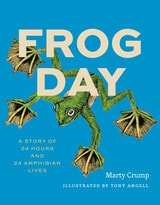
A Story of 24 Hours and 24 Amphibian LivesMarty Crump
University of Chicago Press, 2024
In this short book, celebrated biologist Marty Crump leads readers on a worldwide field trip in search of frogs. Each chapter of Frog Day covers a single frog during a single hour, highlighting how twenty-four different species spend their time. Our day begins at midnight in Indonesia, with the rustle of leaves above. It’s not a bird, but Wallace’s flying frog, using its webbed feet and emerald-green skin flaps to glide through the forest canopy. In the early hours of the morning, we hear a horned marsupial frog “bopping” and a wood frog “quacking” to attract mates. At six o’clock in the morning, beneath a streetlight in Honolulu, we meet a corpulent, invasive cane toad slurping insects—and sometimes snakes, lizards, turtles, birds, and mice. At noon, we watch parenting in action as an African bullfrog bulldozes a path through the mud to free his tadpoles from a drying pond. At dusk, in a Peruvian rain forest, we observe “the ultimate odd couple”—a hairy tarantula and what looks like a tiny amphibian pet taking shelter in the spider’s burrow. Other frogs make a tasty meal for this tarantula, but the dotted humming frog is a friend, eating the ants that might otherwise make a meal of the tarantula’s eggs.
For each hour in our Frog Day, award-winning artist Tony Angell has depicted these scenes with his signature pen and ink illustrations. Working closely together to narrate and illustrate these unique moments in time, Crump and Angell have created an engaging read that is a perfect way to spend an hour or two—and a true gift for readers, amateur scientists, and all frog fans.

From Forest to Steppe
The Russian Art of Building in WoodWilliam Craft Brumfield
Duke University Press, 2025
In From Forest to Steppe, renowned scholar and photographer William Craft Brumfield offers a panoramic survey of Russia’s centuries-long heritage of wooden architecture. Lavishly illustrated with more than 400 color photographs, the volume links log-built barns, windmills, houses, and churches in the Far North; Buddhist shrines in the Transbaikal region; and eighteenth-century palaces on the outskirts of Moscow. Brumfield also takes readers to the estate houses of many Russian literary giants, from Chekhov and Tolstoy to Dostoevsky and Pushkin. Spanning thousands of photographed sites, five decades of field work, and seven time zones, Brumfield’s photographs offer compelling evidence of the adaptability of log construction and its ability to transcend class, cultural, and aesthetic boundaries.
In the decades since Brumfield began photographing Russian architecture, many of the buildings he has documented have been demolished or abandoned and left to rot at alarming rates. Brumfield observes a contradiction in contemporary Russia: It acknowledges the cultural importance of wooden buildings yet struggles to find and dedicate the resources and solutions needed to save them. A hymn and elegy to the long Russian practice of building with wood, From Forest to Steppe is an unparalleled look into one of the world’s most singular architectural traditions.
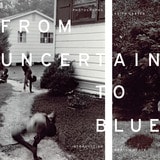
From Uncertain to Blue
By Keith Carter
University of Texas Press, 2011
"In the beginning, there was no real plan, just a road trip that became a journey." In the years 1986 and 1987, Keith Carter and his wife, Patricia, visited one hundred small Texas towns with intriguing names like Diddy Waw Diddy, Elysian Fields, and Poetry. He says, "I tried to make my working method simple and practical: one town, one photograph. I would take several rolls of film but select only one image to represent that dot on my now-tattered map. The titles of the photographs are the actual names of the small towns. . . ." Carter created a body of work that evoked the essence of small-town life for many people, including renowned playwright and fellow Texan, Horton Foote. In 1988, Carter published his one town/one picture collection in From Uncertain to Blue, a landmark book that won acclaim both nationally and internationally for the artistry, timelessness, and universal appeal of its images—and established Carter as one of America's most promising fine art photographers.
Now a quarter century after the book's publication, From Uncertain to Blue has been completely re-envisioned and includes a new essay in which Carter describes how the search for photographic subjects in small towns gradually evolved into his first significant work as an artist. He also offers additional insight into his creative process by including some of his original contact sheets. And Patricia Carter gives her own perspective on their journey in her amplified notes about many of the places they visited as they discovered the world of possibilities from Uncertain to Blue.
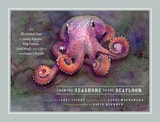
From the Seashore to the Seafloor
An Illustrated Tour of Sandy Beaches, Kelp Forests, Coral Reefs, and Life in the Ocean's DepthsJanet Voight and Peggy Macnamara
University of Chicago Press, 2022
Have you ever walked along the beach and wondered what kind of creatures can be found beneath the waves? Have you pictured what it would be like to see the ocean not from the shore but from its depths? These questions drive Janet Voight, an expert on mollusks who has explored the seas in the submersible Alvin that can dive some 14,000 feet below the water’s surface. In this book, she partners with artist Peggy Macnamara to invite readers to share her undersea journeys of discovery.
With accessible scientific descriptions, Voight introduces the animals that inhabit rocky and sandy shores, explains the fragility of coral reefs, and honors the extraordinary creatures that must search for food in the ocean’s depths, where light and heat are rare. These fascinating insights are accompanied by Macnamara’s stunning watercolors, which illuminate these ecosystems and other scenes from Voight’s research. Together, they show connections between life at every depth—and warn of the threats these beguiling places and their eccentric denizens face.

Front Row Seat
A Photographic Portrait of the Presidency of George W. BushBy Eric Draper
University of Texas Press, 2013
America’s forty-third president, George W. Bush, presided over eight of the most dramatic years in recent history, from the 9/11 attacks early in his administration to the worldwide economic crisis of 2008. By his side, recording every event from the momentous to the intimate, was his personal White House photographer, Eric Draper. From a collection of nearly one million photographs, Draper has selected more than one hundred images of President Bush that portray both the public figure and the private man.
Front Row Seat presents a compelling, behind-the-scenes view of the presidency of George W. Bush. Through Draper’s lens, we follow Bush through moments of crisis that called for strong leadership, such as 9/11; emotional meetings with troops in war zones, wounded soldiers at home, and Katrina survivors; and happy, relaxed times with his wife Laura, daughters Barbara and Jenna, and parents President George H. W. and Barbara Bush. We also see Bush at work within his inner circle of trusted advisors, including Vice President Richard Cheney, National Security Advisor and Secretary of State Condoleezza Rice, and Secretary of Defense Donald Rumsfeld.
Capturing moments that reveal the essence of the man, Front Row Seat is an irreplaceable portrait of George W. Bush.

Fruit of the Orchard
Environmental Justice in East TexasPhyllis Glazer
University of North Texas Press, 2006