50 books match the query 'Plants & Animals' and 3 start with f
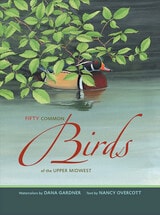
cover of Fifty Common Birds of the Upper Midwest

Fifty Common Birds of the Upper Midwest

Dana Gardner

University of Iowa Press, 2006
No bird is common, if we use “common” to mean ordinary. But birds that are seen more commonly than others can seem less noteworthy than species that are rarely glimpsed. In this gathering of essays and illustrations celebrating fifty of the most common birds of the Upper Midwest, illustrator Dana Gardner and writer Nancy Overcott encourage us to take a closer look at these familiar birds with renewed appreciation for their not-so-ordinary beauty and lifeways.Beginning with the garishly colored male and the more gently colored female wood duck, whose tree cavity nest serves as a launching pad for ducklings in the summer months, and ending on a bright yellow note with the American goldfinch, whose cheerful presence enlivens the midwestern landscape all year long, Overcott combines field observations drawn from her twenty-plus years of living and birding in Minnesota's Big Woods with anecdotes and data from other ornithologists to portray each species' life cycle, its vocalizations and appearance, and its habitat, food, and foraging methods as well as migration patterns and distribution. Infused with a dedication to conserving natural resources, her succinct yet personable prose forms an ideal complement to Gardner's watercolors as this renowned illustrator of avian life worldwide revisits the birds of his childhood. Together art and text ensure that the wild turkey, great blue heron, sharp-shinned hawk, barred owl, pileated woodpecker, house wren, ovenbird, field sparrow, rose-breasted grosbeak, red-winged blackbird, and forty other species of the Upper Midwest are never seen as common again.
[more]
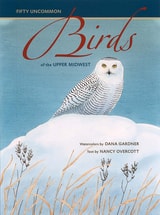
cover of Fifty Uncommon Birds of the Upper Midwest

Fifty Uncommon Birds of the Upper Midwest

Dana Gardner

University of Iowa Press, 2007
No bird is common, if we use “common” to mean ordinary. But birds that are seen more commonly than others can seem less noteworthy than species that are rarely glimpsed. In this gathering of essays and illustrations celebrating fifty of the most common birds of the Upper Midwest, illustrator Dana Gardner and writer Nancy Overcott encourage us to take a closer look at these familiar birds with renewed appreciation for their not-so-ordinary beauty and lifeways.Beginning with the garishly colored male and the more gently colored female wood duck, whose tree cavity nest serves as a launching pad for ducklings in the summer months, and ending on a bright yellow note with the American goldfinch, whose cheerful presence enlivens the midwestern landscape all year long, Overcott combines field observations drawn from her twenty-plus years of living and birding in Minnesota's Big Woods with anecdotes and data from other ornithologists to portray each species' life cycle, its vocalizations and appearance, and its habitat, food, and foraging methods as well as migration patterns and distribution. Infused with a dedication to conserving natural resources, her succinct yet personable prose forms an ideal complement to Gardner's watercolors as this renowned illustrator of avian life worldwide revisits the birds of his childhood. Together art and text ensure that the wild turkey, great blue heron, sharp-shinned hawk, barred owl, pileated woodpecker, house wren, ovenbird, field sparrow, rose-breasted grosbeak, red-winged blackbird, and forty other species of the Upper Midwest are never seen as common again.
[more]
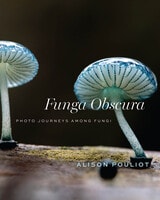
cover of Funga Obscura: Photo Journeys Among Fungi

Funga Obscura

Photo Journeys Among Fungi

Alison Pouliot

University of Chicago Press, 2025

An unforgettable visual journey through the kingdom of fungi, both enigmatic and entrancing.

Recyclers, creators of soil, enablers of life, and food for many—fungi are as dynamic as they are diverse. And, throughout her career, Alison Pouliot has observed these organisms with a unique vision. As a scientist and photographer, she has led hundreds of forays through the forests of the Americas, Australia, and Europe. In this book, readers can travel along with her on these global explorations through stunning photographs and meditations on the landscape. She says her camera is where fungal lives come most clearly into focus. And like the camera obscura, this book, Funga Obscura, captures brief mycological moments and unforgettable fungus microcosms.

The word funga refers to the fungi of a region, and Pouliot’s photography spans continents. We see a parade of violet webcap mushrooms, spotted in the understory of a Pacific Northwest forest; brilliantly blue pixie’s parasols in Australia; an Italian alpine lichen, looking for all the world like a treasure map; and a showstopping whitelaced shank, ready to spread its spores in Switzerland. We learn that fungi live almost everywhere, from our lawns to forests and woodlands, from the ocean’s depths to deserts and alpine peaks. Yet, like a web of rootlike mycelium, Funga Obscura goes deeper to investigate how fungi shape landscapes and interact with other organisms, including humans. This journey spans eons, from long ago in evolutionary time, when fungi first emerged from the ocean onto land, to today, when we witness their work all around us. The scenes here challenge our ideas about what fungi are, what they do, and why they matter.

In Pouliot’s photographs, you might recognize a few old friends, but many mushrooms will be new acquaintances. Sometimes they make their presence immediately known; at other times, they just provide clues—and trails to follow.

[more]