267 books match the query 'Poetics' and 8 start with f
cover of FEELING HISTORY: LUCAN, STOICISM, AND THE POETICS OF PASSION

FEELING HISTORY

LUCAN, STOICISM, AND THE POETICS OF PASSION

Francesca D’Alessandro Behr

The Ohio State University Press, 2007
Feeling History is a study of apostrophe (i.e., the rhetorical device in which the narrator talks directly to his characters) in Lucan’s Bellum Civile. Through the narrator’s direct addresses, irony, and grotesque imagery, Lucan appears not as a nihilist, but as a character deeply concerned about ethics. The purpose of this book is to demonstrate how Lucan’s style represents a criticism of the Roman approach to history, epic, ethics, and aesthetics. The book’s chief interest lies in the ethical and moral stance that the poet-narrator takes toward his characters and his audience. To this end, Francesca D’Alessandro Behr studies the ways in which the narrator communicates ethical and moral judgments. Lucan’s retelling of this central historical epic triggers in the mind of the reader questions about the validity of the Roman imperial project as a whole.
 
An analysis of selected apostrophes from the Bellum Civile allows us to confront issues that are behind Lucan’s disquieting imagery: how can we square the poet’s Stoic perspectives with his poetically conveyed emotional urgency? Lucan’s approach seems inspired by Aristotle, especially his Poetics, as much as by Stoic philosophy. In Lucan’s aesthetic project, participation and alienation work as phases through which the narrator leads the reader to a desired understanding of his work of art. At the same time, the reader is confronted with the ends and limits of the aesthetic enterprise in general. 
 
Lucan’s long-acknowledged political engagement must therefore be connected to his philosophical and aesthetic stance. In the same way that Lucan is unable to break free from the Virgilian model, neither can he develop a defense of morality outside of the Stoic mold. His philosophy is not a crystal ball to read the future or a numbing drug imposing acceptance. The philosophical vision that Lucan finds intellectually and aesthetically compelling does not insulate his characters (and readers) from suffering, nor does it excuse them from wrongdoing. Rather, it obligates them to confront the responsibilities and limits of acting morally in a chaotic world.
[more]
cover of Fieldworks: From Place to Site in Postwar Poetics

Fieldworks

From Place to Site in Postwar Poetics

Lytle Shaw

University of Alabama Press, 2013

Fieldworks offers a historical account of the social, rhetorical, and material attempts to ground art and poetry in the physicality of a site.

Arguing that place-oriented inquiries allowed poets and artists to develop new, experimental models of historiography and ethnography, Lytle Shaw draws out the shifting terms of this practice from World War II to the present through a series of illuminating case studies. Beginning with the alternate national genealogies unearthed by William Carlos Williams in Paterson and Charles Olson in Gloucester, Shaw demonstrates how subsequent poets sought to ground such inquiries in concrete social formations—to in effect live the poetics of place: Gary Snyder in his back-to-the-land familial compound, Kitkitdizze; Amiri Baraka in a black nationalist community in Newark; Robert Creeley and the poets of Bolinas, California, in the capacious “now” of their poet-run town. Turning to the work of Robert Smithson—who called one of his essays an “appendix to Paterson,” and who in turn has exerted a major influence on poets since the 1970s—Shaw then traces the emergence of site-specific art in relation both to the poetics of place and to the larger linguistic turn in the humanities, considering poets including Clark Coolidge, Bernadette Mayer, and Lisa Robertson.

By putting the poetics of place into dialog with site-specificity in art, Shaw demonstrates how poets and artists became experimental explicators not just of concrete locations and their histories, but of the discourses used to interpret sites more broadly. It is this dual sense of fieldwork that organizes Shaw’s groundbreaking history of site-specific poetry.
[more]
cover of Figuring Jerusalem: Politics and Poetics in the Sacred Center

Figuring Jerusalem

Politics and Poetics in the Sacred Center

Sidra DeKoven Ezrahi

University of Chicago Press, 2022

Figuring Jerusalem explores how Hebrew writers have imagined Jerusalem, both from the distance of exile and from within its sacred walls.
 
For two thousand years, Hebrew writers used their exile from the Holy Land as a license for invention. The question at the heart of Figuring Jerusalem is this: how did these writers bring their imagination “home” in the Zionist century? Sidra DeKoven Ezrahi finds that the same diasporic conventions that Hebrew writers practiced in exile were maintained throughout the first half of the twentieth century. And even after 1948, when the state of Israel was founded but East Jerusalem and its holy sites remained under Arab control, Jerusalem continued to figure in the Hebrew imagination as mediated space. It was only in the aftermath of the Six Day War that the temptations and dilemmas of proximity to the sacred would become acute in every area of Hebrew politics and culture.

Figuring Jerusalem ranges from classical texts, biblical and medieval, to the post-1967 writings of S. Y. Agnon and Yehuda Amichai. Ultimately, DeKoven Ezrahi shows that the wisdom Jews acquired through two thousand years of exile, as inscribed in their literary imagination, must be rediscovered if the diverse inhabitants of Jerusalem are to coexist.
[more]
cover of Flight Lines: A Poetics of Black Space

Flight Lines

A Poetics of Black Space

Elleza Kelley

Duke University Press, 2026
In Flight Lines, Elleza Kelley argues that African American art and writing make visible the unmappable dimensions of black space, not simply by depicting black worlds but by registering how black spatial praxis takes form under conditions of racial enclosure. Reading across literature and visual art, from W. E. B. Du Bois and Zora Neale Hurston to Faith Ringgold, Romare Bearden, and Gwendolyn Brooks, Kelley tracks spatial knowledge across media and contends that where mediums meet, black aesthetic form emerges as a crucial site for conceptualizing black space in the United States. Moving from Southern landscapes shaped by racialized property to the postmigration geographies of Harlem and Chicago, Flight Lines follows fences, railroads, blocks, apartments, and rooftops as sites where enclosure is contested, improvised on, and transformed. Proposing that black space and black form are mutually constitutive, Kelley shows how black aesthetics illuminate the racial operations of enclosure while preserving alternative ways of inhabiting, sensing, and remaking racialized worlds.
[more]
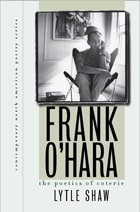
cover of Frank O'Hara: The Poetics of Coterie

Frank O'Hara

The Poetics of Coterie

Lytle Shaw

University of Iowa Press, 2006
In this stimulating and innovative synthesis of New York's artistic and literary worlds, Lytle Shaw uses the social and philosophical problems involved in “reading” a coterie to propose a new language for understanding the poet, art critic, and Museum of Modern Art curator Frank O'Hara (1926-1966). O'Hara's poems are famously filled with proper names---from those of his immediate friends and colleagues in the New York writing and art worlds (John Ashbery, Kenneth Koch, Grace Hartigan, Willem de Kooning, and many musicians, dancers, and filmmakers) to a broad range of popular cultural and literary heroes (Apollinaire to Jackie O). But rather than understand O'Hara's most commonly referenced names as a fixed and insular audience, Shaw argues that he uses the ambiguities of reference associated with the names to invent a fluid and shifting kinship structure---one that opened up radical possibilities for a gay writer operating outside the structure of the family. As Shaw demonstrates, this commitment to an experimental model of association also guides O'Hara's art writing. Like his poetry, O'Hara's art writing too has been condemned as insular, coterie writing. In fact, though, he was alone among 1950s critics in his willingness to consider abstract expressionism not only within the dominant languages of existentialism and formalism but also within the cold war political and popular cultural frameworks that anticipate many of the concerns of contemporary art historians. Situating O'Hara within a range of debates about art's possible relations to its audience, Shaw demonstrates that his interest in coterie is less a symptomatic offshoot of his biography than a radical literary and artistic invention.
[more]
cover of Free Verse: An Essay on Prosody

Free Verse

An Essay on Prosody

Charles O. Hartman

Northwestern University Press, 1996
To make sense of "free verse" in theory of in practice, the study of prosody—the function of rhythm in poetry—must be revised and rethought. In Free Verse: An Essay on Prosody, Charles Hartman develops a theory of prosody that includes the most characteristic form of twentieth-century poetry.
[more]
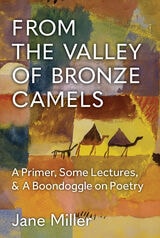
cover of From the Valley of Bronze Camels: A Primer, Some Lectures, & A Boondoggle on Poetry

From the Valley of Bronze Camels

A Primer, Some Lectures, & A Boondoggle on Poetry

Jane Miller

University of Michigan Press, 2022

Jane Miller loves poetry. In these provocative and deeply insightful essays, she unpacks the work of giants like Adrienne Rich, Paul Celan, Marina Tsvetaeva, Osip Mandelstam, and Federico García Lorca alongside painters such as Caravaggio and Paul Klee, as well as ancient Chinese music and techniques of the contemporary poem. Miller explores the use of the question mark in the history of poetry and its function as a revelation of poetic voice. She considers the positive and negative aspects of surrealism on the contemporary poem, its anti-feminist origins in France, its contemporary usage, and the benefits of super-real images. Miller examines how identity politics might affect the imagination. She describes ancient Chinese musical instruments to show how their sounds resonate off/in American poems and on the aural integrity of the lyric poem. She interrogates the political implications of language and the degeneration and regeneration of words. Finally, in an essay about what she dares not say about poetry, she comes out against forms of surrealism, narrative, jargon, rhetoric, irony, and appropriation. This masterful work can be read as advice to a young writer, but it also invites us into the mind of a writer who has developed her craft through the course of a lifetime of writing, reading, and exploring the world, showing not only the ideas that influenced her—feminist, lesbian, and international works—but also how Miller has, in turn, influenced ideas.
[more]
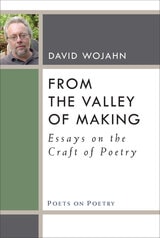
cover of From the Valley of Making: Essays on the Craft of Poetry

From the Valley of Making

Essays on the Craft of Poetry

David Wojahn

University of Michigan Press, 2015

David Wojahn examines the state of American verse as it enters the first decades of a new millennium, focusing on both the challenges and opportunities of an ancient art as it tries to adapt to the cultural, technological, and political transformations of our turbulent era. Each of these nine essays makes an impassioned and nuanced argument against the so-called marginalization of poetry in contemporary American culture. Among the work included is a penetrating essay on the role of politics in contemporary verse, a querulous examination of the rise of what Wojahn terms “the Google poem,” and a meditation on poetry and “self-doubt.” Among the figures he considers are American poets such as Hayden Carruth, John Berryman, Linda Bierds, and Tom Sleigh, as well as crucial modern international poets, among them Nazim Hikmet, Zbigniew Herbert, C.P. Cavafy, and Tomas Transtromer. These are personable, opinionated, and, above all, readable essays by a widely admired poet-critic.
[more]