Results by title
87 books match the query 'Political Freedom' and 3 start with f
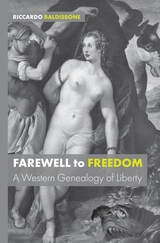
Farewell to Freedom
A Western Genealogy of LibertyRiccardo Baldissone
University of Westminster Press, 2018
Understandings of freedom are often discussed in moral, theological, legal and political terms, but they are not often set in a historical perspective, and they are even more rarely considered within their specific language context. From Homeric poems to contemporary works, the author traces the words that express the various notions of freedom in Classical Greek, Latin, and medieval and modern European idioms. Examining writers as varied as Plato, Aristotle, Luther, La Boétie, Hobbes, Rousseau, Kant, Stirner, Nietzsche, and Foucault among others, this theoretical mapping shows old and new boundaries of the horizon of freedom. The book suggests the possibility of transcending these boundaries on the basis of a different theorization of human interactions, which constructs individual and collective subjects as processes rather than entities. This construction shifts and disseminates the very locus of freedom, whose vocabulary would be better recast as a relational middle path between autonomous and heteronomous alternatives.
[more]
Feminist Surveillance Studies
Rachel E. Dubrofsky and Soshana Amielle Magnet, eds.
Duke University Press, 2015
Questions of gender, race, class, and sexuality have largely been left unexamined in surveillance studies. The contributors to this field-defining collection take up these questions, and in so doing provide new directions for analyzing surveillance. They use feminist theory to expose the ways in which surveillance practices and technologies are tied to systemic forms of discrimination that serve to normalize whiteness, able-bodiedness, capitalism, and heterosexuality. The essays discuss the implications of, among others, patriarchal surveillance in colonial North America, surveillance aimed at curbing the trafficking of women and sex work, women presented as having agency in the creation of the images that display their bodies via social media, full-body airport scanners, and mainstream news media discussion of honor killings in Canada and the concomitant surveillance of Muslim bodies. Rather than rehashing arguments as to whether or not surveillance keeps the state safe, the contributors investigate what constitutes surveillance, who is scrutinized, why, and at what cost. The work fills a gap in feminist scholarship and shows that gender, race, class, and sexuality should be central to any study of surveillance.
Contributors. Seantel Anaïs, Mark Andrejevic, Paisley Currah, Sayantani DasGupta, Shamita Das Dasgupta, Rachel E. Dubrofsky, Rachel Hall, Lisa Jean Moore, Yasmin Jiwani, Ummni Khan, Shoshana Amielle Magnet, Kelli Moore, Lisa Nakamura, Dorothy Roberts, Andrea Smith, Kevin Walby, Megan M. Wood, Laura Hyun Yi Kang
Contributors. Seantel Anaïs, Mark Andrejevic, Paisley Currah, Sayantani DasGupta, Shamita Das Dasgupta, Rachel E. Dubrofsky, Rachel Hall, Lisa Jean Moore, Yasmin Jiwani, Ummni Khan, Shoshana Amielle Magnet, Kelli Moore, Lisa Nakamura, Dorothy Roberts, Andrea Smith, Kevin Walby, Megan M. Wood, Laura Hyun Yi Kang
[more]
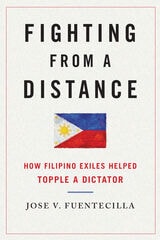
Fighting from a Distance
How Filipino Exiles Helped Topple a DictatorJose V. Fuentecilla
University of Illinois Press, 2013
During February 1986, a grassroots revolution overthrew the fourteen-year dictatorship of former president Ferdinand Marcos in the Philippines. In this book, Jose V. Fuentecilla describes how Filipino exiles and immigrants in the United States played a crucial role in this victory, acting as the overseas arm of the opposition to help return their country to democracy.
A member of one of the major U.S.-based anti-Marcos movements, Fuentecilla tells the story of how small groups of Filipino exiles--short on resources and shunned by some of their compatriots--arrived and survived in the United States during the 1970s, overcame fear, apathy, and personal differences to form opposition organizations after Marcos's imposition of martial law, and learned to lobby the U.S. government during the Cold War. In the process, he draws from multiple hours of interviews with the principal activists, personal files of resistance leaders, and U.S. government records revealing the surveillance of the resistance by pro-Marcos White House administrations. The first full-length book to detail the history of U.S.-based opposition to the Marcos regime, Fighting from a Distance provides valuable lessons on how to persevere against a well-entrenched opponent.
[more]