Results by title
207 books match the query 'Political participation' and 7 start with f
Feeling Like a State
Desire, Denial, and the Recasting of AuthorityDavina Cooper
Duke University Press, 2019
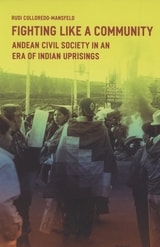
Fighting Like a Community
Andean Civil Society in an Era of Indian UprisingsRudi Colloredo-Mansfeld
University of Chicago Press, 2009
The indigenous population of the Ecuadorian Andes made substantial political gains during the 1990s in the wake of a dynamic wave of local activism. The movement renegotiated land development laws, elected indigenous candidates to national office, and successfully fought for the constitutional redefinition of Ecuador as a nation of many cultures. Fighting Like a Community argues that these remarkable achievements paradoxically grew out of the deep differences—in language, class, education, and location—that began to divide native society in the 1960s.
Drawing on fifteen years of fieldwork, Rudi Colloredo-Mansfeld explores these differences and the conflicts they engendered in a variety of communities. From protestors confronting the military during a national strike to a migrant family fighting to get a relative released from prison, Colloredo-Mansfeld recounts dramatic events and private struggles alike to demonstrate how indigenous power in Ecuador is energized by disagreements over values and priorities, eloquently contending that the plurality of Andean communities, not their unity, has been the key to their political success.

For Might and Right
Cold War Defense Spending and the Remaking of American DemocracyMichael Brenes
University of Massachusetts Press, 2020
How did the global Cold War influence American politics at home? For Might and Right traces the story of how Cold War defense spending remade participatory politics, producing a powerful and dynamic political coalition that reached across party lines. This “Cold War coalition” favored massive defense spending over social welfare programs, bringing together a diverse array of actors from across the nation, including defense workers, community boosters, military contractors, current and retired members of the armed services, activists, and politicians. Faced with neoliberal austerity and uncertainty surrounding America's foreign policy after the 1960s, increased military spending became a bipartisan solution to create jobs and stimulate economic growth, even in the absence of national security threats.
Using a rich array of archival sources, Michael Brenes draws important connections between economic inequality and American militarism that enhance our understanding of the Cold War's continued impact on American democracy and the resilience of the military-industrial complex, up to the age of Donald Trump.

Founding Fictions
Jennifer R. Mercieca
University of Alabama Press, 2010
Founding Fictions develops the concept of a “political fiction,” or a narrative that people tell about their own political theories, and analyzes how republican and democratic fictions positioned American citizens as either romantic heroes, tragic victims, or ironic partisans. By re-telling the stories that Americans have told themselves about citizenship, Mercieca highlights an important contradiction in American political theory and practice: that national stability and active citizen participation are perceived as fundamentally at odds.
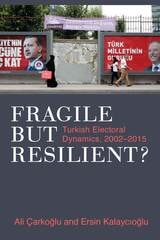
Fragile but Resilient?
Turkish Electoral Dynamics, 2002-2015Ali Çarkoglu and Ersin Kalaycioglu
University of Michigan Press, 2021
Ersin Kalaycıoğlu and Ali Çarkoğlu, who conducted surveys comparable to the American National Election Survey for the 2002 and 2015 national elections in Turkey, chart the dynamics that brought the pro-Islamist conservative Justice and Development Party (Adalet ve Kalkınma Partisi-AKP) to power in 2002, and that continue to influence electoral politics. The authors trace the uneven course of democratization in Turkey, as revealed through elections, since the first competitive, multi-party elections in 1950. Since the market liberalization reforms of 1980, Turkey has been rapidly evolving from a closed, agricultural, comparatively underdeveloped polity into an open and industrial state primarily integrated with the global economy. Kalaycıoğlu and Çarkoğlu analyze different dimensions of five elections surveys in 2002-2015 period to show how the consequent socio-economic changes and traditional socio-cultural divisions have affected elections, political parties, and individual voters. The authors conclude that the historical-cultural divide between rural, peripheral, conservative groups and more urban, centrist, and modernized groups not only persists but shapes elections more than ever. This book not only provides an original comprehensive and critical evaluation of the Turkish electoral and party politics, it also offers a case study of voting behavior in a state undergoing both democratization and market liberalization in a rapidly changing and volatile international environment.
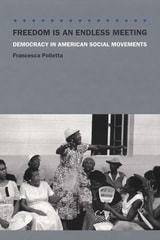
Freedom Is an Endless Meeting
Democracy in American Social MovementsFrancesca Polletta
University of Chicago Press, 2002
Polletta traces the history of democracy in early labor struggles and pre-World War II pacifism, in the civil rights, new left, and women's liberation movements of the sixties and seventies, and in today's faith-based organizing and anti-corporate globalization campaigns. In the process, she uncovers neglected sources of democratic inspiration—Depression-era labor educators and Mississippi voting registration workers, among them—as well as practical strategies of social protest. But Freedom Is an Endless Meeting also highlights the obstacles that arise when activists model their democracies after familiar nonpolitical relationships such as friendship, tutelage, and religious fellowship. Doing so has brought into their deliberations the trust, respect, and caring typical of those relationships. But it has also fostered values that run counter to democracy, such as exclusivity and an aversion to rules, and these have been the fault lines around which participatory democracies have often splintered. Indeed, Polletta attributes the fragility of the form less to its basic inefficiency or inequity than to the gaps between activists' democratic commitments and the cultural models on which they have depended to enact those commitments. The challenge, she concludes, is to forge new kinds of democratic relationships, ones that balance trust with accountability, respect with openness to disagreement, and caring with inclusiveness.
For anyone concerned about the prospects for democracy in America, Freedom Is an Endless Meeting will offer abundant historical, theoretical, and practical insights.
"This is an excellent study of activist politics in the United States over the past century. . . . Assiduously researched, impressively informed by a great number of thoughtful interviews with key members of American social movements, and deeply engaged with its subject matter, the book is likely to become a key text in the study of grass-roots democracy in America."—Kate Fullbrook, Times Literary Supplement
"Polletta's portrayal challenges the common assumption that morality and strategy are incompatible, that those who aim at winning must compromise principle while those who insist on morality are destined to be ineffective. . . . Rather than dwell on trying to explain the decline of 60s movements, Polletta shows how participatory democracy has become the guiding framework for many of today's activists."—Richard Flacks, Los Angeles Times Book Review
"In Freedom Is an Endless Meeting, Francesca Polletta has produced a remarkable work of historical sociology. . . . She provides the fullest theoretical work of historical sociology. . . . She provides the fullest theoretical picture of participatory democracy, rich with nuance, ambiguity, and irony, that this reviewer has yet seen. . . . This wise book should be studied closely by both academics and by social change activists."—Stewart Burns, Journal of American History
From Voice to Influence
Understanding Citizenship in a Digital AgeEdited by Danielle Allen and Jennifer S. Light
University of Chicago Press, 2015
With From Voice to Influence, Danielle Allen and Jennifer S. Light have brought together a stellar group of political and social theorists, social scientists, and media analysts to explore this transformation. Threading through the contributions is the notion of egalitarian participatory democracy, and among the topics discussed are immigration rights activism, the participatory potential of hip hop culture, and the porous boundary between public and private space on social media. The opportunities presented for political efficacy through digital media to people who otherwise might not be easily heard also raise a host of questions about how to define “good participation:” Does the ease with which one can now participate in online petitions or conversations about current events seduce some away from serious civic activities into “slacktivism?”
Drawing on a diverse body of theory, from Hannah Arendt to Anthony Appiah, From Voice to Influence offers a range of distinctive visions for a political ethics to guide citizens in a digitally connected world.