Results by title
88 books match the query 'Population' and 5 start with f

Faith In The Future
Healthcare, Aging and the Role of ReligionHarold Koenig
Templeton Press, 2012
After an interview in Newsweek about his book Spirituality in Patient Care and his research in religion and health, Dr. Harold Koenig became the international voice on spirituality, health, and aging. In this book, Faith in the Future, he is joined by two other experts on aging and human development. They present a compelling look at one of the most severe issues in today’s society: health care in America.
How will we provide quality healthcare to older adults needing it during the next thirty to fifty years? Who will provide this care? How will it be funded? How can we establish systems of care now to be in place as demographic and health-related economic pressures mount?
Alongside the sobering reality of our country’s challenges, there are reasons for optimism. Innovative programs created and maintained by volunteers and religious congregations are emerging as pivotal factors in meeting healthcare needs. Summarizing decades of scientific research and providing numerous inspirational examples and role models, the authors present practical steps that individuals and institutions may emulate for putting faith into action.
<
Family and Farm in Pre-Famine Ireland
The Parish of KillashandraKevin O'Neill
University of Wisconsin Press, 1985
Now available in paperback, Kevin O’Neill’s highly praised study of rural Ireland in the years leading up to the "Great Hunger" of the 1840s explicates the social, economic, and demographic conditions of the era. He argues that overpopulation and deprivation were inextricably linked to a third variable—the rapid economic development of rural Ireland that was shaped by British interests.

Fertile Matters
The Politics of Mexican-Origin Women's ReproductionBy Elena R. Gutiérrez
University of Texas Press, 2008
While the stereotype of the persistently pregnant Mexican-origin woman is longstanding, in the past fifteen years her reproduction has been targeted as a major social problem for the United States. Due to fear-fueled news reports and public perceptions about the changing composition of the nation's racial and ethnic makeup—the so-called Latinization of America—the reproduction of Mexican immigrant women has become a central theme in contemporary U. S. politics since the early 1990s.
In this exploration, Elena R. Gutiérrez considers these public stereotypes of Mexican American and Mexican immigrant women as "hyper-fertile baby machines" who "breed like rabbits." She draws on social constructionist perspectives to examine the historical and sociopolitical evolution of these racial ideologies, and the related beliefs that Mexican-origin families are unduly large and that Mexican American and Mexican immigrant women do not use birth control.
Using the coercive sterilization of Mexican-origin women in Los Angeles as a case study, Gutiérrez opens a dialogue on the racial politics of reproduction, and how they have developed for women of Mexican origin in the United States. She illustrates how the ways we talk and think about reproduction are part of a system of racial domination that shapes social policy and affects individual women's lives.
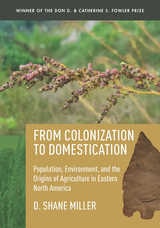
From Colonization to Domestication
Population, Environment, and the Origins of Agriculture in Eastern North AmericaD. Shane Miller
University of Utah Press, 2018
Eastern North America is one of only a handful of places in the world where people first discovered how to domesticate plants. In this book, anthropologist Shane Miller uses two common, although unconventional, sources of archaeological data—stone tools and the distribution of archaeological sites—to trace subsistence decisions from the initial colonization of the American Southeast at the end of the last Ice Age to the appearance of indigenous domesticated plants roughly 5,000 years ago.
Miller argues that the origins of plant domestication lie within the context of a boom/bust cycle that culminated in the mid-Holocene, when hunter-gatherers were able to intensively exploit shellfish, deer, oak, and hickory. After this resource “boom” ended, some groups shifted to other plants in place of oak and hickory, which included the suite of plants that were later domesticated. Accompanying these subsistence trends is evidence for increasing population pressure and declining returns from hunting. Miller contends, however, that the appearance of domesticated plants in eastern North America, rather than simply being an example of necessity as the mother of invention, is the result of individuals adjusting to periods of both abundance and shortfall driven by climate change.

From Many Strands
Ethnic and Racial Groups in Contemporary AmericaStanley Lieberson
Russell Sage Foundation, 1988