Results by title
102 books match the query 'Postmodernism' and 4 start with f

Feminism and Postmodernism
Margaret Ferguson and Jennifer Wicke, eds.
Duke University Press, 1994
This collection of essays explores the significant agreements and tensions between contemporary feminist and postmodern theories and practices. Having brought enormous changes to conceptions of the body, identity, and the media, postmodernity compels the rethinking of many feminist categories, including female experience, the self, and the notion that "the personal is political." Feminist analysis has been equally important, though not always equally acknowledged, as a force within postmodernism. Feminist writings on subjectivity, master narratives, and the socioeconomic underpinnings of the master narrative of theory itself have been particularly influential. This volume traces the crossings and mutual interrogations of these two traditions into the arenas of cultural production, legal discourse, and philosophical thought.
Multidisciplinary and international in their collective focus, the essays range from a study of Madonna as an Italian American woman who is revising the cultural meanings of an ethnic feminism to a unique interview with Mairead Keane, the national head of the Women’s Department of the Irish political party Sinn Fein. Turning the prism of postmodern feminism onto such diverse cultural objects as literary and literary critical texts, contemporary film, and music, these essays intervene in debates regarding technology, sexuality, and politics. Challenging modern feminisms to articulate their inescapable relation to postmodern society, this expanded edition of a special issue of boundary 2 also explores ways in which feminism can work as the cutting edge of a global postmodernism.
Multidisciplinary and international in their collective focus, the essays range from a study of Madonna as an Italian American woman who is revising the cultural meanings of an ethnic feminism to a unique interview with Mairead Keane, the national head of the Women’s Department of the Irish political party Sinn Fein. Turning the prism of postmodern feminism onto such diverse cultural objects as literary and literary critical texts, contemporary film, and music, these essays intervene in debates regarding technology, sexuality, and politics. Challenging modern feminisms to articulate their inescapable relation to postmodern society, this expanded edition of a special issue of boundary 2 also explores ways in which feminism can work as the cutting edge of a global postmodernism.
Contributors. Salwa Bakr, Claire Detels, Margaret Ferguson, Carla Freccero, Marjorie Garber, Barbara Harlow, Laura E. Lyons, Anne McClintock, Toril Moi, Linda Nicholson, Mary Poovey, Andrew Ross, David Simpson, Kathyrn Bond Stockton, Jennifer Wicke
[more]
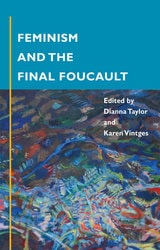
Feminism and the Final Foucault
Edited by Dianna Taylor and Karen Vintges
University of Illinois Press, 2004
Feminism and the Final Foucault is the first systematic offering of contemporary, international feminist perspectives on the later work of philosopher Michel Foucault.
Rather than simply debating the merits or limitations of Foucault's later work, the essays in this collection examine women's historical self-practices, conceive of feminism as a shared ethos, and consider the political significance of this conceptualization in order to elucidate, experiment with, and put into practice the conceptual "tools" that Foucault offers for feminist ethics and politics. The volume illustrates the ways in which Foucault's later thinking on ethics as "care of the self" can reintroduce a number of issues and themes that feminists jettisoned in the wake of postmodernism, including consciousness raising, feminist therapy, the subject woman, identity politics, and feminist agency.
Taken as a whole, the diversity of feminist viewpoints presented provide important new insights into "the final Foucault," and thus serve as a productive intervention in current Foucault scholarship.
[more]

Fiction, Crime, and Empire
CLUES TO MODERNITY AND POSTMODERNISMJon Thompson
University of Illinois Press, 1993
[more]
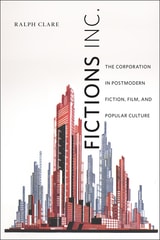
Fictions Inc.
The Corporation in Postmodern Fiction, Film, and Popular CultureClare, Ralph
Rutgers University Press, 2014
Fictions Inc. explores how depictions of the corporation in American literature, film, and popular culture have changed over time. Beginning with perhaps the most famous depiction of a corporation—Frank Norris’s The Octopus—Ralph Clare traces this figure as it shifts from monster to man, from force to “individual,” and from American industry to multinational “Other.” Clare examines a variety of texts that span the second half of the twentieth century and beyond, including novels by Thomas Pynchon, William Gaddis, Don DeLillo, Richard Powers, and Joshua Ferris; films such as Network, Ghostbusters, Gung Ho, Office Space, and Michael Clayton; and assorted artifacts of contemporary media such as television’s The Office and the comic strips Life Is Hell and Dilbert.
Paying particular attention to the rise of neoliberalism, the emergence of biopolitics, and the legal status of “corporate bodies,” Fictions Inc. shows that representations of corporations have come to serve, whether directly or indirectly, as symbols for larger economic concerns often too vast or complex to comprehend. Whether demonized or lionized, the corporation embodies American anxieties about these current conditions and ongoing fears about the viability of a capitalist system.
[more]