214 books match the query 'Presidents & Heads of State' and 7 start with f
cover of First Lady from Plains

First Lady from Plains

Rosalynn Carter

University of Arkansas Press, 1994
First Lady from Plains, first published in 1984, is Rosalynn’s Carter’s autobiography, covering her life from her childhood in Plains, Georgia, through her time as First Lady. It is “a readable, lively and revealing account of the Carters and their remarkable journey from rural Georgia to the White House in a span of ten years” (The New York Times).
[more]
cover of Forbes Burnham: The Life and Times of the Comrade Leader

Forbes Burnham

The Life and Times of the Comrade Leader

Linden F. Lewis

Rutgers University Press, 2024

It is virtually impossible to understand the history of modern Guyana without understanding the role played by Forbes Burnham. As premier of British Guiana, he led the country to independence in 1966 and spent two decades as its head of state until his death in 1985. An intensely charismatic politician, Burnham helped steer a new course for the former colony, but he was also a quintessential strongman leader, venerated by some of his citizens yet feared and despised by others.
 
Forbes Burnham: The Life and Times of the Comrade Leader is the first political biography of this complex and influential figure. It charts how the political party he founded, the People’s National Congress, combined nationalist rhetoric, socialist policies, and Pan-Africanist philosophies. It also explores how, in a country already deeply divided between the descendants of African slaves and Indian indentured servants, Burnham consolidated political power by intensifying ethnic polarizations. Drawing from historical archives as well as new interviews with the people who knew Burnham best, sociologist Linden F. Lewis examines how his dictatorial tendencies coexisted with his progressive convictions. Forbes Burnham is a compelling study of the nature of postcolonial leadership and its pitfalls.
 
[more]
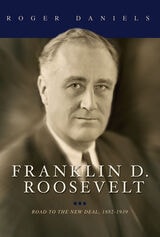
cover of Franklin D. Roosevelt: Road to the New Deal, 1882-1939

Franklin D. Roosevelt

Road to the New Deal, 1882-1939

Roger Daniels

University of Illinois Press, 2015
Franklin D. Roosevelt, consensus choice as one of three great presidents, led the American people through the two major crises of modern times. The first volume of an epic two-part biography, Franklin D. Roosevelt: Road to the New Deal, 1882-1939 presents FDR from a privileged Hyde Park childhood through his leadership in the Great Depression to the ominous buildup to global war. Roger Daniels revisits the sources and closely examines Roosevelt's own words and deeds to create a twenty-first century analysis of how Roosevelt forged the modern presidency. Daniels's close analysis yields new insights into the expansion of Roosevelt's economic views; FDR's steady mastery of the complexities of federal administrative practices and possibilities; the ways the press and presidential handlers treated questions surrounding his health; and his genius for channeling the lessons learned from an unprecedented collection of scholars and experts into bold political action. Revelatory and nuanced, Franklin D. Roosevelt: Road to the New Deal, 1882-1939 reappraises the rise of a political titan and his impact on the country he remade.
[more]
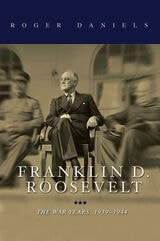
cover of Franklin D. Roosevelt: The War Years, 1939-1945

Franklin D. Roosevelt

The War Years, 1939-1945

Roger Daniels

University of Illinois Press, 2016
Having guided the nation through the worst economic crisis in its history, Franklin Delano Roosevelt by 1939 was turning his attention to a world on the brink of war. The second part of Roger Daniels's biography focuses on FDR's growing mastery in foreign affairs. Relying on FDR's own words to the American people and eyewitness accounts of the man and his accomplishments, Daniels reveals a chief executive orchestrating an immense wartime effort. Roosevelt had effective command of military and diplomatic information and unprecedented power over strategic military and diplomatic affairs. He simultaneously created an arsenal of democracy that armed the Allies while inventing the United Nations intended to ensure a lasting postwar peace. FDR achieved these aims while expanding general prosperity, limiting inflation, and continuing liberal reform despite an increasingly conservative and often hostile Congress. Although fate robbed him of the chance to see the victory he had never doubted, events in 1944 assured him that the victory he had done so much to bring about would not be long delayed. A compelling reconsideration of Roosevelt the president and campaigner, The War Years, 1939-1945 provides new views and vivid insights about a towering figure--and six years that changed the world.
[more]
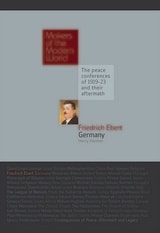
cover of Friedrich Ebert: Germany

Friedrich Ebert

Germany

Harry Harmer

Haus Publishing, 2009

On 9 November 1918 Ebert became Imperial Chancellor as revolution broke out in Berlin. He opposed the radical left, declaring, 'Without democracy there is no freedom. Violence, no matter who is using it, is always reactionary', but he compromised Weimar democracy by his dependence on the army command and his use of the para-military Freikorps against the left. Ebert headed a joint SPD-USPD government until elections were held to a National Constituent Assembly in January 1919. Ebert became president of the new Weimar Republic (Germany's first democratically elected head of state) and retained office in a turbulent period in German politics. There were arguments among the Allies over how Germany should be treated, as France, Britain and the United States prioritised different objectives. In May 1919, the terms of the Treaty - on reparations, war guilt clause, loss of territories in Europe and colonies, limitations on armed forces - were presented to German representatives, precipitating opposition in government and the Armed Forces, and heated discussion in Cabinet. He continued as President until 1925, forced to confront the issues that arose from the Treaty and its political and economic consequences. After his death came the unravelling of the Treaty and the book examines how much of a part it played in creating the circumstances of the Second World War.
[more]
cover of From the Sultan to Atatürk: Turkey

From the Sultan to Atatürk

Turkey

Andrew Mango

Haus Publishing, 2009

World War I sounded the death knell of empires. The forces of disintegration affected several empires simultaneously. To that extent they were impersonal. But prudent statesmen could delay the death of empires, rulers such as Emperor Franz Josef II of Austria-Hungary and the Ottoman Sultan Abdülhamid II. Adventurous rulers - Kaiser Wilhelm of Germany and Enver Pasha in the Ottoman Empire - hastened it. Enver's decision to enter the war on the side of Germany destroyed the Ottoman state. It may have been doomed in any case, but he was the agent of its doom. The last Sultan Mehmet VI Vahdettin thought he could salvage the Ottoman state in something like its old form. But Vahdettin and his ministers could not succeed because the victorious Allies had decided on the final partition of the Ottoman state. The chief proponent of partition was Lloyd George, heir to the Turcophobe tradition of British liberals, who fell under the spell of the Greek irredentist politician Venizelos. With these two in the lead, the Allies sought to impose partition on the Sultan's state. When the Sultan sent his emissaries to the Paris peace conference they could not win a reprieve. The Treaty of Sèvres which the Sultan's government signed put an end to Ottoman independence. The Treaty of Sèvres was not ratified. Turkish nationalists, with military officers in the lead, defied the Allies, who promptly broke ranks, each one trying to win concessions for himself at the expense of the others. Mustafa Kemal emerged as the leader of the military resistance. Diplomacy allowed Mustafa Kemal to isolate his people's enemies: Greek and Armenian irredentists. Having done so, he defeated them by force of arms. In effect, the defeat of the Ottoman empire in the First World War was followed by the Turks' victory in two separate wars: a brief military campaign against the Armenians and a long one against the Greeks. Lausanne - where General Ismet succeeded in securing peace on Turkey's terms - was the founding charter of the modern Turkish nation state. But more than that it showed that empires could no longer rule peoples against their wishes. This need not be disastrous: Mustafa Kemal demonstrated that the interests of developed countries were compatible with those of developing ones. He fought the West in order to become like it. Where his domestic critics wanted to go on defying the West, Mustafa Kemal saw that his country could fare best in cooperation with the West.
[more]
cover of Félix Houphouët-Boigny

Félix Houphouët-Boigny

Marco Wyss

Ohio University Press, 0

Félix Houphouët-Boigny, who ruled Côte d’Ivoire from independence in 1960 until his death in 1993, remains one of the most influential and controversial figures in modern African history. Revered by some as the “old sage” who transformed his country into an economic powerhouse and a haven of stability during the Cold War and reviled by others as a neocolonial collaborator whose policies sowed the seeds of later crisis, Houphouët-Boigny left a legacy that continues to shape debates about postcolonial governance and African international relations. This first English-language biography offers a comprehensive and nuanced portrait of Houphouët-Boigny’s life and career. It traces his journey from Baoulé nobility and early prominence in colonial politics to his emergence as a leading African statesman after World War II. The book examines his shifting ideological positions—championing France’s imperial project, then embracing African nationalism during the collapse of the French Community—and his pivotal role in negotiating Côte d’Ivoire’s postcolonial relationship with France. Houphouët-Boigny consolidated domestic power into a de facto one-party state, furthering his increasingly authoritarian tendencies and his efforts to modernize Côte d’Ivoire through economic development and grand architectural projects. Beyond domestic issues, the biography explores Houphouët-Boigny’s ambitions on the continental stage. It details his Cold War maneuvers, often in partnership with France, as he pursued regional dominance against figures like Kwame Nkrumah, supported Moïse Tshombe in the Congo, aided Biafra during the Nigerian Civil War, and even engaged with apartheid South Africa. By situating Houphouët-Boigny within the broader dynamics of Françafrique—the enduring neocolonial entanglement between France and its former African colonies—this biography sheds light on the complexities of postcolonial rule. It offers essential insights into the political, economic, and diplomatic forces that shaped Africa in the second half of the twentieth century and that continue to resonate today.

[more]