Results by title
88 books match the query 'Prisoners' and 6 start with f
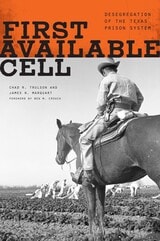
First Available Cell
Desegregation of the Texas Prison SystemBy Chad R. Trulson and James W. Marquart
University of Texas Press, 2009
Decades after the U.S. Supreme Court and certain governmental actions struck down racial segregation in the larger society, American prison administrators still boldly adhered to discriminatory practices. Not until 1975 did legislation prohibit racial segregation and discrimination in Texas prisons. However, vestiges of this practice endured behind prison walls. Charting the transformation from segregation to desegregation in Texas prisons—which resulted in Texas prisons becoming one of the most desegregated places in America—First Available Cell chronicles the pivotal steps in the process, including prison director George J. Beto's 1965 decision to allow inmates of different races to co-exist in the same prison setting, defying Southern norms.
The authors also clarify the significant impetus for change that emerged in 1972, when a Texas inmate filed a lawsuit alleging racial segregation and discrimination in the Texas Department of Corrections. Perhaps surprisingly, a multiracial group of prisoners sided with the TDC, fearing that desegregated housing would unleash racial violence. Members of the security staff also feared and predicted severe racial violence. Nearly two decades after the 1972 lawsuit, one vestige of segregation remained in place: the double cell. Revealing the aftermath of racial desegregation within that 9 x 5 foot space, First Available Cell tells the story of one of the greatest social experiments with racial desegregation in American history.
Forced Passages
Imprisoned Radical Intellectuals and the U.S. Prison RegimeDylan Rodríguez
University of Minnesota Press, 2006
In Forced Passages, Dylan Rodríguez argues that the cultural production of such imprisoned intellectuals as Mumia Abu-Jamal, Angela Davis, Leonard Peltier, George Jackson, José Solis Jordan, Ramsey Muniz, Viet Mike Ngo, and Marilyn Buck should be understood as a social and intellectual movement in and of itself, unique in context and substance. Rodríguez engages with a wide range of texts, including correspondence, memoirs, essays, poetry, communiqués, visual art, and legal writing, drawing on published works by widely recognized figures and by individuals outside the public’s field of political vision or concern. Throughout, Rodríguez focuses on the conditions under which imprisoned intellectuals live and work, and he explores how incarceration shapes the ways in which insurgent knowledge is created, disseminated, and received.
More than a series of close readings of prison literature, Forced Passages identifies and traces the discrete lineage of radical prison thought since the 1970s, one formed by the logic of state violence and by the endemic racism of the criminal justice system.
Dylan Rodríguez is assistant professor of ethnic studies at the University of California, Riverside.
Fourth City
Essays from the Prison in AmericaEdited by Doran Larson
Michigan State University Press, 2014
Freeman's Challenge
The Murder That Shook America's Original Prison for ProfitRobin Bernstein
University of Chicago Press, 2024
An award-winning historian tells a gripping, morally complicated story of murder, greed, race, and the true origins of prison for profit.
In the early nineteenth century, as slavery gradually ended in the North, a village in New York State invented a new form of unfreedom: the profit-driven prison. Uniting incarceration and capitalism, the village of Auburn built a prison that enclosed industrial factories. There, “slaves of the state” were leased to private companies. The prisoners earned no wages, yet they manufactured furniture, animal harnesses, carpets, and combs, which consumers bought throughout the North. Then one young man challenged the system.
In Freeman’s Challenge, Robin Bernstein tells the story of an Afro-Native teenager named William Freeman who was convicted of a horse theft he insisted he did not commit and sentenced to five years of hard labor in Auburn’s prison. Incensed at being forced to work without pay, Freeman demanded wages. His challenge triggered violence: first against him, then by him. Freeman committed a murder that terrified and bewildered white America. And white America struck back—with aftereffects that reverberate into our lives today in the persistent myth of inherent Black criminality. William Freeman’s unforgettable story reveals how the North invented prison for profit half a century before the Thirteenth Amendment outlawed slavery “except as a punishment for crime”—and how Frederick Douglass, Harriet Tubman, and other African Americans invented strategies of resilience and resistance in a city dominated by a citadel of unfreedom.
Through one Black man, his family, and his city, Bernstein tells an explosive, moving story about the entangled origins of prison for profit and anti-Black racism.
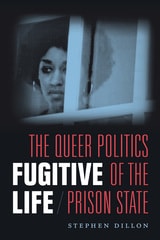
Fugitive Life
The Queer Politics of the Prison StateStephen Dillon
Duke University Press, 2018
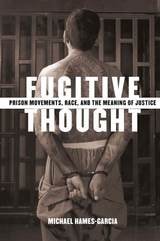
Fugitive Thought
Prison Movements, Race, And The Meaning Of JusticeMichael Hames-Garcia
University of Minnesota Press, 2004
Looks to the philosophy and experience of prisoners to reinvigorate our concepts of justice, solidarity, and freedom
In Fugitive Thought, Michael Hames-García argues that writings by prisoners are instances of practical social theory that seek to transform the world. Unlike other authors who have studied prisons or legal theory, Hames-García views prisoners as political and social thinkers whose ideas are as valuable as those of lawyers and philosophers.
As key moral terms like “justice,” “solidarity,” and “freedom” have come under suspicion in the post–Civil Rights era, political discussions on the Left have reached an impasse. Fugitive Thought reexamines and reinvigorates these concepts through a fresh approach to philosophies of justice and freedom, combining the study of legal theory and of prison literature to show how the critiques and moral visions of dissidents and participants in prison movements can contribute to the shaping and realization of workable ethical conceptions. Fugitive Thought focuses on writings by black and Latina/o lawyers and prisoners to flesh out the philosophical underpinnings of ethical claims within legal theory and prison activism.