Results by title
57 books match the query 'Realism in literature' and 2 start with f
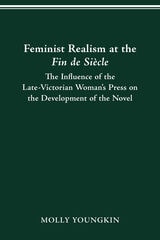
FEMINIST REALISM AT THE FIN DE SIÈCLE
The Influence of the Late-Victorian Woman’s Press on the Development of the NovelMolly Youngkin
The Ohio State University Press, 2007
Molly Youngkin takes on a major literary problem of the turn-of-the-century: Was the transition from the Victorian novel to the modern novel enabled by antirealist or realist narrative strategies? To answer this question, Youngkin analyzes book reviews that appeared in two prominent feminist periodicals circulated during the late-Victorian era—Shafts and The Woman’s Herald.
Through reviews of the works of important male and female authors of the decade—Thomas Hardy, Sarah Grand, George Gissing, Mona Caird, George Meredith, Ménie Dowie, George Moore, and Henrietta Stannard—these periodicals developed a feminist realist aesthetic that drew on three aspects of woman’s agency (consciousness, spoken word, and action) and emphasized corresponding narrative strategies (internal perspective, dialogue, and description of characters’ actions). Still, these periodicals privileged consciousness over spoken word and action and, by doing so, encouraged authors to push the boundaries of traditional realism and anticipate the modernist aesthetic.
By acknowledging the role of the woman’s press in the development of the novel, this book revises our understanding of the transition from Victorianism to modernism, which often is characterized as antirealist. Late-Victorian authors working within the realist tradition also contributed to this transition, particularly through their engagement with feminist realism. Youngkin deftly illustrates this transition and in so doing proves that it cannot be attributed to antirealist narrative strategies alone.
[more]
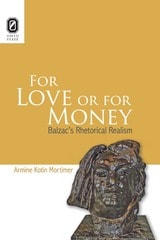
For Love or for Money
Balzac's Rhetorical RealismArmine Kotin Mortimer
The Ohio State University Press, 2011
Everyone agrees that Balzac is a realistic writer, but what do we actually mean when we say that? This book examines the richness and variety of Balzac’s approaches to realism, employing several different interpretive methods. Taking love and money as the “Prime Movers” of the world of La Comédie humaine, twenty-one chapters provide detailed analyses of the many strategies by which the writing forges the powerful impression of reality, the construction we famously think of as Balzacian realism. Each chapter sets the methods and aims of its analysis, with particular attention to the language that conveys the sense of reality. Plots, devices, or interpretive systems (including genealogies) function as images or reflections of how the novels make their meanings. The analyses converge on the central point: how did Balzac invent realism? No less than this fundamental question lies behind the interpretations this book provides, a question to which the conclusion provides a full answer.
A major book in English devoted entirely to Balzac was overdue. Here is the American voice of Balzac studies, an engaging, insightful, and revealing excursion among the masterworks of one of the most important authors of all time.
[more]