Results by title
92 books match the query 'Regimental histories' and 5 start with f
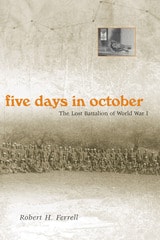
Five Days in October
The Lost Battalion of World War IRobert H. Ferrell
University of Missouri Press, 2005
During American participation in World War I, many events caught the public’s attention, but none so much as the plight of the Lost Battalion. Comprising some five hundred men of the Seventy-seventh Division, the so-called battalion was entrapped on the side of a ravine in the Argonne Forest by German forces from October 2 to 7, 1918. The men’s courage under siege in the midst of rifle, machine-gun, mortar, and artillery fire (coming both day and night), with nothing to eat after the morning of the first day save grass and roots, and with water dangerous to obtain, has gone down in American history as comparable in heroism to the defense of the Alamo and the stand at the Little Big Horn of the troops of General George A. Custer.
Now, in Five Days in October, historian Robert H. Ferrell presents new material—previously unavailable—about what really happened during those days in the forest. Despite the description of them as a lost battalion, the men were neither lost nor a battalion. The name was coined by a New York newspaper editor who, upon learning that a sizable body of troops had been surrounded, thought up the notion of a Lost Battalion—it possessed a ring sure to catch the attention of readers.
The trapped men actually belonged to companies from two battalions of the Seventy-seventh, and their exact placement was well known, reported by runners at the outset of the action and by six carrier pigeons released by their commander, Major Charles W. Whittlesey, during the five days his men were there. The causes of the entrapment were several, including command failures and tactical errors. The men had been sent ahead of the main division line without attention to flanks, and because of that failure, they were surrounded. Thus began a siege that took the lives of many men, leading to the collapse of the colonel of the 308th Infantry Regiment and, many believe, to the suicide of Major Whittlesey three years later.
This book grew out of Ferrell’s discovery of new material in the U.S. Army Military History Institute at the Army War College from the papers of General Hugh A. Drum and in the National Archives in College Park, Maryland. The Drum papers contain the court-martial record of the lieutenant of a machine-gun unit attached to the battalions, who advised Major Whittlesey to surrender, while the Seventy-seventh Division files contain full accounts of the taut relations between the Lost Battalion’s brigade commander and the Seventy-seventh’s division commander. By including this material, Ferrell gives a new accounting of this intriguing affair. Five Days in October will be welcomed by all those interested in a fuller understanding of the story of the Lost Battalion.
[more]
For Duty and Destiny
The Life and Civil War Diary of William Taylor Stott, Hoosier Soldier and EducatorLloyd A. Hunter
Indiana Historical Society Press, 2011
William Taylor Stott was a native Hoosier and an 1861 graduate of Franklin College, who later became the president who took the college from virtual bankruptcy in 1872 to its place as a leading liberal arts institution in Indiana. The story of Franklin College is the story of W. T. Stott, yet his influence was not confined to the school’s parameters. Stott was an inspirational and intellectual force in the Indiana Baptist community, and a foremost champion of small denominational colleges and of higher education in general. He also fought in the Eighteenth Indiana Volunteer Infantry during the Civil War, rising from private to captain by 1863. Stott’s diary reveals a soldier who was also a scholar.
[more]
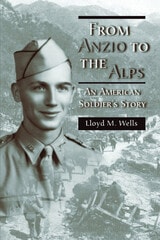
From Anzio to the Alps
An American Soldier's StoryLloyd M. Wells
University of Missouri Press, 2019
This compelling work is Lloyd M. Wells’s firsthand account of World War II based on a journal he kept during the war, letters he sent home, and personal records, as well as recollections of people and events.
In June 1941, the twenty-one-year-old Wells was drafted into the army. He was commissioned second lieutenant after he attended O.C.S. and was later promoted to first lieutenant with the First Armored Division. He saw action in North Africa, Italy, and Germany and was awarded the Combat Infantry Badge, the Purple Heart, and the Bronze Star.
Wells offers the reader information that has never before been provided. He tells exactly what happened to 2/7 Queens on the night of February 21, 1944, when the troops came up to “the caves” at Anzio. He also depicts what happened during the last offensive in Italy and what armored infantry troops experienced on the perimeter of the attack. This book, however, is not just a story of battle actions. It is a personal story about the “old Army” and how young soldiers were transformed by it during one of the greatest upheavals in world history.
Wells’s goal in writing this book was to leave behind “an account of a simpler time and of the funny, sad, terrorizing, and tender moments of a war which, with the death of each man or woman who lived through it, recedes just a little bit further into the nation’s past.” He accomplished that and so much more.
[more]
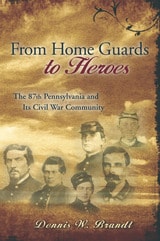
From Home Guards to Heroes
The 87th Pennsylvania and Its Civil War CommunityDennis W. Brandt
University of Missouri Press, 2007
The soldiers of the 87th Pennsylvania Infantry fought in the Overland campaign under Grant and in the Shenandoah valley under Sheridan, notably at the Battle of Monocacy. But as Dennis Brandt reveals in From Home Guards to Heroes, their real story takes place beyond the battlefield. The 87th drew its men from the Scotch-Irish and German populations of York and Adams counties in south-central Pennsylvania—a region with closer ties to Baltimore than to Philadelphia—where some citizens shared Marylanders’ southern views on race while others aided the Underground Railroad.
Brandt’s unique regimental history investigates why these “boys from York” enlisted and why some deserted, the ways in which soldiers reflected their home communities, and the area’s attitudes toward the war both before and after hostilities broke out. Brandt takes a humanistic approach to the Civil War, revealing the more personal aspects of the struggle in a book that focuses on the soldiers themselves.
Using their own words to describe action both on and off the battlefield, he sheds light on the lives of ordinary men: the comparative values of farm and city boys, their motives and concerns, the effect of battle on soldiers and their families, and the suffering that veterans took to the grave. Brandt also looks at soldiers’ racial views, illuminating their deepest worries about the war, and at community politics and problems of discipline surrounding this ideologically divided unit.
Grounded in more than a decade of research into nearly two thousand military records, this is one of the few regimental histories based on more than one thousand pension records for the entire regiment, plus nearly eight hundred additional record sets for other area soldiers. Brandt tapped regional newspapers and a cache of unpublished letters and diaries—some from private collections not previously known—to provide an invaluable account of Civil War sensibilities in a northern area bordering a slave state.
From Home Guards to Heroes is a book about war in which humanity rather than troop movement takes center stage. Engagingly written for a wide audience and meticulously researched, it offers a distinctive image of a community and the intimate lives of the men it sent off to fight—and a story that will intrigue any Civil War aficionado.
[more]
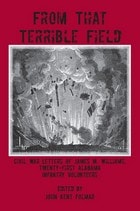
From That Terrible Field
Civil War Letters of James M. Williams, 21st Alabama Infantry VolunteersJames M. Williams
University of Alabama Press, 1981
“The well-written and candid letters of a reasonably articulate Southern officer, who paints a lucid picture of everyday life in the Confederate army in a little-known theater… Williams’s letters, personally written and shot through with his sharp sense of humor and folksy artwork, provide an excellent account of a long neglected theater of the American Civil War.” – Western Pennsylvania History
[more]