Results by title
123 books match the query 'Religious life' and 8 start with f
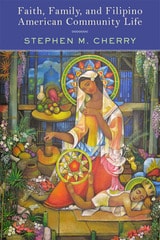
Faith, Family, and Filipino American Community Life
Cherry, Stephen M
Rutgers University Press, 2014
Stephen M. Cherry draws upon a rich set of ethnographic and survey data, collected over a six-year period, to explore the roles that Catholicism and family play in shaping Filipino American community life. From the planning and construction of community centers, to volunteering at health fairs or protesting against abortion, this book illustrates the powerful ways these forces structure and animate not only how first-generation Filipino Americans think and feel about their community, but how they are compelled to engage it over issues deemed important to the sanctity of the family.
Revealing more than intimate accounts of Filipino American lives, Cherry offers a glimpse of the often hidden but vital relationship between religion and community in the lives of new immigrants, and allows speculation on the broader impact of Filipino immigration on the nation. The Filipino American community is the second-largest immigrant community in the United States, and the Philippines is the second-largest source of Catholic immigration to this country. This ground-breaking study outlines how first-generation Filipino Americans have the potential to reshape American Catholicism and are already having an impact on American civic life through the engagement of their faith.

Female Piety and the Invention of American Puritanism
Bryce Traister
The Ohio State University Press, 2016
Uncovering the feminine interiority of New England Protestantism, Female Piety and the Invention of American Puritanism positions itself against prevalent historical arguments about the rise of secularism in the modern West. Traister demonstrates that female spirituality became a principal vehicle through which Puritan identity became both absorbed within and foundational for pre-national secular culture. Engaging broadly with debates about religion and secularization, national origins and transnational unsettlements, and gender and cultural authority, this is a foundational reconsideration both of American Puritanism itself and of “American Puritanism” as it has been understood in relation to secular modernity.
Filled with the Spirit
Sexuality, Gender, and Radical Inclusivity in a Black Pentecostal Church CoalitionEllen Lewin
University of Chicago Press, 2018
In Filled with the Spirit, Ellen Lewin gives us a deeply empathetic ethnography of the worship and community central to TFAM, telling the story of how the doctrine of radical inclusivity has expanded beyond those it originally sought to serve to encompass people of all races, genders, sexualities, and religious backgrounds. Lewin examines the seemingly paradoxical relationship between TFAM and traditional black churches, focusing on how congregations and individual members reclaim the worship practices of these churches and simultaneously challenge their authority. The book looks closely at how TFAM worship is legitimated and enhanced by its use of gospel music and considers the images of food and African American culture that are central to liturgical imagery, as well as how understandings of personal authenticity tie into the desire to be filled with the Holy Spirit. Throughout, Lewin takes up what has been mostly missing from our discussions of race, gender, and sexuality—close attention to spirituality and faith.
Finding Faith
The Spiritual Quest of the Post-Boomer GenerationFlory, Richard
Rutgers University Press, 2008
Just as the formative experiences of Baby Boomers were colored by such things as the war in Vietnam, the 1960s, and a dramatic increase in their opportunities for individual expression, so Post-Boomers have grown up in less structured households with working (often divorced) parents. These childhood experiences leave them craving authentic spiritual experience, rather than entertainment, and also cause them to question institutions. Flory and Miller develop a typology that captures four current approaches to the Christian faith and argue that this generation represents a new religious orientation of "expressive communalism," in which they seek spiritual experience and fulfillment in community and through various expressive forms of spirituality, both private and public.
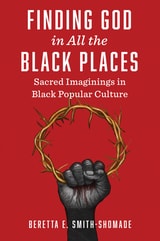
Finding God in All the Black Places
Sacred Imaginings in Black Popular CultureBeretta E. Smith-Shomade
Rutgers University Press, 2025
https://manifold.ecds.emory.edu/projects/finding-god-in-all-the-black-places
(https://dhjhkxawhe8q4.cloudfront.net/rup-wp-v2/wp-content/uploads/2025/01/28132142/9781978839809.pdf)
In Finding God in All the Black Places, Beretta E. Smith-Shomade contends that Black spirituality and Black church religiosity are the critical crux of Black popular culture. She argues that cultural, community, and social support live within the Black church and that spirit, art, and progress are deeply entwined and seal this connection. Including the work of artists such as Mary J. Blige, D’Angelo, Erykah Badu, Prince, Spike Lee, and Oprah Winfrey, the book examines contemporary Black television, film, music and digital culture to demonstrate the role, impact, and dominance of spirituality and religion in Black popular culture. Smith-Shomade believes that acknowledging and comprehending the foundations of Black spirituality and Black church religiosity within Black popular culture provide a way for viewers, listeners, and users not only to endure but also to revitalize.
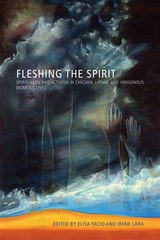
Fleshing the Spirit
Spirituality and Activism in Chicana, Latina, and Indigenous Women’s LivesEdited by Elisa Facio and Irene Lara
University of Arizona Press, 2014
The anthology incorporates different genres of writing—such as poetry, testimonials, critical essays, and historical analysis—and stimulates the reader to engage spirituality in a critical, personal, and creative way. This interdisciplinary work is the first that attempts to theorize the radical interconnection between women of color, spirituality, and social activism. Before transformative political work can be done, the authors say in multiple ways, we must recognize that our spiritual need is a desire to more fully understand our relations with others. Conflict experienced on many levels sometimes severs those relations, separating us from others along racial, class, gender, sexual, national, or other socially constructed lines.
Fleshing the Spirit offers a spiritual journey of healing, health, and human revolution. The book’s open invitation to engage in critical dialogue and social activism—with the spirit and spirituality at the forefront—illuminates the way to social change and the ability to live in harmony with life’s universal energies.
Contributors
Volume Editors
Elisa Facio
Irene Lara
Chapter Authors
Angelita Borbón
Norma E. Cantú
Berenice Dimas
C. Alejandra Elenes
Alicia Enciso Litschi
Oliva M. Espín
Maria Figueroa
Patrisia Gonzales
Inés Hernández- Avila
Rosa María Hernández Juárez
Cinthya Martinez
Lara Medina
Felicia Montes
Sarahi Nuñez- Mejia
Laura E. Pérez
Brenda Sendejo
Inés Talamantez
Michelle Téllez
Beatriz Villegas
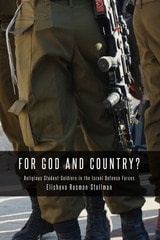
For God and Country?
Religious Student-Soldiers in the Israel Defense ForcesBy Elisheva Rosman-Stollman
University of Texas Press, 2014
In many modern armies the religious soldier is suspect. Civilians and officers alike wonder if such a soldier might represent a potential fifth column. This concern is especially prominent in the public discourse over the presence of religious Orthodox Jews serving in the Israel Defense Forces. Will they obey their commanding officer or their rabbi? With research collected over almost a decade, including hundreds of hours of interviews, Elisheva Rosman examines this question of loyalties and reveals how religious soldiers negotiate a place for themselves in an institution whose goals and norms sometimes conflict with those of Orthodox Judaism.
For God and Country? focuses on the pre-service study programs available to religious conscripts. Many journalists and scholars in Israel are suspicious of the student-soldiers who participate in these programs, but in fact, as Rosman’s research demonstrates, the pre-service study programs serve as mediating structures between the demands of Religious Zionism and the demands of the Israel Defense Forces and do not encourage their students to disobey orders. This was especially apparent during the disengagement from Gaza in 2005. Many in Israeli society predicted student-soldiers would defy their orders, per the instruction of their religious leaders, but this did not happen as expected. In high profile cases such as this and in matters encountered daily by religious soldiers—the mixing of the sexes, for instance—Rosman has discovered that the pre-service study programs can successfully serve as agents of civil society, both able to curb the military’s efforts to meddle in civilian affairs and vice versa.
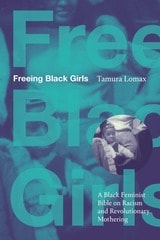
Freeing Black Girls
A Black Feminist Bible on Racism and Revolutionary MotheringTamura Lomax
Duke University Press, 2025