Results by title
436 books match the query 'Renaissance' and 13 start with f
Fables of Power
Aesopian Writing and Political HistoryAnnabel Patterson
Duke University Press, 1991
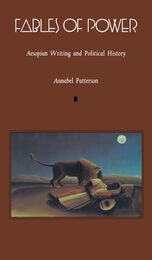
Patterson begins with an analysis of the legendary Life of Aesop, its cultural history and philosophical implications, a topic that involves such widely separated figures as La Fontaine, Hegel, and Vygotsky. The myth’s origin is recovered here in the saving myth of Aesop the Ethiopian, black, ugly, who began as a slave but become both free and influential, a source of political wisdom. She then traces the early modern history of the fable from Caxton, Lydgate, and Henryson through the eighteenth century, focusing on such figures as Spenser, Sidney, Lyly, Shakespeare, and Milton, as well as the lesser-known John Ogilby, Sir Roger L’Estrange, and Samuel Croxall.
Patterson discusses the famous fable of The Belly and the Members, which, because it articulated in symbolic terms some of the most intransigent problems in political philosophy and practice, was still going strong as a symbolic text in the mid-nineteenth century, where it was focused on industrial relations by Karl Marx and by George Eliot against electoral reform.
Faithful Translators
Authorship, Gender, and Religion in Early Modern EnglandJaime Goodrich
Northwestern University Press, 2014
Fashioning Femininity and English Renaissance Drama
Karen Newman
University of Chicago Press, 1991
Through the critical lens of poststructuralism, Newman reads anatomies, conduct and domesticity handbooks, sermons, homilies, ballads, and court cases to delineate the ideologies of femininity they represented and produced. Arguing that drama, as spectacle, provides a peculiarly useful locus for analyzing the management of femininity, Newman considers the culture of early modern London to reveal how female subjectivity was fashioned and staged in the plays of Shakespeare, Jonson, and others.
Feeling Faint
Affect and Consciousness in the RenaissanceGiulio J. Pertile
Northwestern University Press, 2019
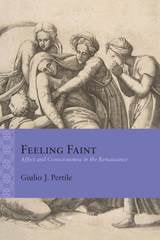
Such a phenomenon, subsequently obscured by the Enlightenment identification of consciousness and personal identity, is what we discover in scenes of swooning from the Renaissance: consciousness without self, consciousness reconceived as what Fredric Jameson calls "a registering apparatus for transformed states of being." Where the early modern period has often been seen in terms of the rise of self-aware subjectivity, Feeling Faint argues that swoons, faints, and trances allow us to conceive of Renaissance subjectivity in a different guise: as the capacity of the senses and passions to experience, regulate, and respond to their own activity without the intervention of first-person awareness.
In readings of Renaissance authors ranging from Montaigne to Shakespeare, Pertile shows how self-loss affords embodied consciousness an experience of itself in a moment of intimate vitality which precedes awareness of specific objects or thoughts—an experience with which we are all familiar, and yet which is tantalizingly difficult to pin down.
Fictions of God
English Renaissance Literature and the Invention of the Biblical NarratorRaphael Magarik
University of Chicago Press, 2025
We often identify secularization's characteristic literary form as the modern novel: out with divine scripture, in with human fictions. In Fictions of God, Raphael Magarik argues that this story overlooks the cultural upheavals of the Protestant Reformation. Early reformers imagined a Bible that was neither infallible nor inerrant but fictional, composed by a divine counterfactual: God crafted the text, they said, as if it had been written by the prophets. Early modern Protestants now found in their Bibles not a source of foundational truths but a model for unreliable narration, even fiction.
Fictions of God traces how this approach to literature passed from biblical commentators to poets like Abraham Cowley, John Milton, and Lucy Hutchinson amid the violent emergence of a new religious and political order—long before the eighteenth-century rise of the English novel. The result is a transformative account of the Reformation’s effect on imaginative literature and the secularization of the Bible itself.
Florentine Essays
Selected Writings of Marvin B. BeckerMarvin B. Becker
University of Michigan Press, 2002
In the capital of humanism, he initiated what was to be a lifelong examination of the Western civil tradition. In Florence he could study the interplay of ideas and action in what he was to call the "public world." The rise of this world out of the private, feudal and corporate structures of the medieval commune, its functioning and its eventual subversion by the authoritarian structures of the early modern state were, he thought, valuable information for modern political cultures. In the 1950s and 1960s, Becker produced approximately twenty papers dealing with a wide variety of themes and issues raised by the work of other scholars such as Davidson, Salvemini, Ottokar, Panella, Rodolico, Barbadoro, Baron, and others. He also introduced his own formulations on a range of subjects including the political role of Florence's minor guilds, usury, taxation, public debt, popular heresy, church-state relations, the city's chroniclers, the influence of "new men" upon Florentine government and changing mentalities.
These papers, in their originality, their richness of documentation and their suggestiveness, are still relevant for current scholarship. The editors of this volume have chosen the papers for the convenience of readers who may know Becker only through his books, or from the myriad of footnotes of other scholars who have drawn so much from his work. This volume will be of interest to scholars, students, and others interested in Renaissance history, whether it be social or political.
Marvin B. Becker is Professor Emeritus in the Department of History, University of Michigan. James Banker is Professor of History, North Carolina State University. Carol Lansing is Professor of History, University of California, Santa Barbara.
Forbidden Knowledge
Medicine, Science, and Censorship in Early Modern ItalyHannah Marcus
University of Chicago Press, 2020
Forbidden Knowledge explores the censorship of medical books from their proliferation in print through the prohibitions placed on them during the Counter-Reformation. How and why did books banned in Italy in the sixteenth century end up back on library shelves in the seventeenth? Historian Hannah Marcus uncovers how early modern physicians evaluated the utility of banned books and facilitated their continued circulation in conversation with Catholic authorities.
Through extensive archival research, Marcus highlights how talk of scientific utility, once thought to have begun during the Scientific Revolution, in fact, began earlier, emerging from ecclesiastical censorship and the desire to continue to use banned medical books. What’s more, this censorship in medicine, which preceded the Copernican debate in astronomy by sixty years, has had a lasting impact on how we talk about new and controversial developments in scientific knowledge. Beautiful illustrations accompany this masterful, timely book about the interplay between efforts at intellectual control and the utility of knowledge.
Forms of Association
Making Publics in Early Modern EuropePaul Yachnin
University of Massachusetts Press, 2015
In today's connected and interactive world, it is hard to imagine a time when cultural and intellectual interests did not lead people to associate with others who shared similar views and preoccupations. In this volume of essays, fifteen scholars explore how these kinds of relationships began to transform early modern European culture.
Forms of Association grows out of the “Making Publics: Media, Markets, and Association in Early Modern Europe” (MaPs) project, funded by the Social Sciences and Humanities Research Council of Canada. This scholarly initiative convened an interdisciplinary research team to consider how “publics”—new forms of association built on the shared interests of individuals—developed in Europe from 1500 to 1700. Drawing on a wide array of texts and histories, including the plays of Shakespeare, the legend of Robin Hood, paintings, and music as well as English gossip about France, the contributors develop a historical account of what publics were in early modern Europe. This collaborative study provides a dynamic way of understanding the political dimensions of artistic and intellectual works and opens the way toward a new history of early modernity.
Until his death in 2008, the great Renaissance scholar Richard Helgerson was a key participant in the MaPs project. The scholars featured in this volume originally met in Montreal to engage in a critical, commemorative conversation about Helgerson's work, the issues and questions coming out of the MaPs project, and how Helgerson's thinking advanced and could in turn be advanced by MaPs. This collection represents the fruits of that conversation.

Four Shakespearean Period Pieces
Margreta de Grazia
University of Chicago Press, 2021
Yet recent theoretical work has called for their reappraisal. Anachronisms, previously condemned as errors in the order of time, are being hailed as alternatives to that order. Conversely chronology and periods, its mainstays, are now charged with having distorted the past they have been entrusted to represent, and secularization, once considered the driving force of the modern era, no longer holds sway over the past or the present.
In light of this reappraisal, can Shakespeare studies continue unshaken? This is the question Four Shakespearean Period Pieces takes up, devoting a chapter to each term: on the rise of anachronism, the chronologizing of the canon, the staging of plays “in period,” and the use of Shakespeare in modernity’s secularizing project.
To read these chapters is to come away newly alert to how these fraught concepts have served to regulate the canon’s afterlife. Margreta de Grazia does not entirely abandon them but deftly works around and against them to offer fresh insights on the reading, editing, and staging of the author at the heart of our literary canon.
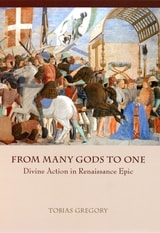
From Many Gods to One
Divine Action in Renaissance EpicTobias Gregory
University of Chicago Press, 2006
Epic poets of the Renaissance looked to emulate the poems of Greco-Roman antiquity, but doing so presented a dilemma: what to do about the gods? Divine intervention plays a major part in the epics of Homer and Virgil—indeed, quarrels within the family of Olympian gods are essential to the narrative structure of those poems—yet poets of the Renaissance recognized that the cantankerous Olympians could not be imitated too closely. The divine action of their classical models had to be transformed to accord with contemporary tastes and Christian belief.
From Many Gods to One offers the first comparative study of poetic approaches to the problem of epic divine action. Through readings of Petrarch, Vida, Ariosto, Tasso, and Milton, Tobias Gregorydescribes the narrative and ideological consequences of the epic’s turn from pagan to Christian. Drawing on scholarship in several disciplines—religious studies, classics, history, and philosophy, as well as literature—From Many Gods to One sheds new light on two subjects of enduring importance in Renaissance studies: the precarious balance between classical literary models and Christian religious norms and the role of religion in drawing lines between allies and others.
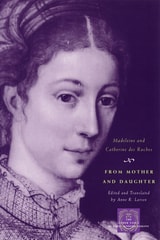
From Mother and Daughter
Poems, Dialogues, and Letters of Les Dames des RochesMadeleine and Catherine des Roches
University of Chicago Press, 2006
Madeleine and Catherine spent their entire lives in civil war–torn Poitiers, where a siege of the city, vandalism, and desecration of churches fueled their political and religious commentary. Members of an elite literary circle that would inspire salon culture during the next century, the Dames des Roches addressed the issues of the day, including the ravages of religious civil wars, the weak monarchy, education for women, marriage and the family, violence against women, and the status of women intellectuals. Through their collaborative engagement in shared public discourse, both mother and daughter were models of moral, political, and literary agency.
From Renaissance to Baroque
Essays on Literature and ArtLouis L. Martz
University of Missouri Press, 1991
Distinguished critic and scholar Louis L. Martz refreshingly addresses some of the central concerns in current studies of English poetry from the sixteenth and seventeenth centuries, exploring the context of religious controversy within which this poetry developed and the relationship of poetry to the visual arts.
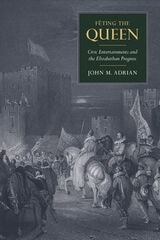
Fêting the Queen
Civic Entertainments and the Elizabethan ProgressJohn M Adrian
University of Massachusetts Press, 2021
While previous scholars have studied Elizabeth I and her visits to the homes of influential courtiers, Fêting the Queen places a new emphasis on the civic communities that hosted the monarch and their efforts to secure much needed support. Case studies of the cities of Oxford, Canterbury, Sandwich, Bristol, Worcester, and Norwich focus on the concepts of hospitality and space—including the intimate details of the built environment.