Results by title
53 books match the query 'Revolutionaries' and 3 start with f

Frantz Fanon
Philosopher of the BarricadesPeter Hudis
Pluto Press, 2015
With FranzFanon, Peter Hudis presents a penetrating critical biography of the activist’s life and work. Countering the prevailing belief that Fanon’s contributions to modern thought can be wholly defined by an advocacy of violence, Hudis presents his work instead as an integrated whole, showing that its nuances—and thus its importance—can only be appreciated in light of Fanon’s efforts to fuse philosophical theory and actual practice. By taking seriously Fanon’s philosophical and psychological contributions, as well as his political activism, Hudis presents a powerful and perceptive new view of the man and his achievement.
This brief, richly perceptive introduction to Fanon will give new force to his ideas, his life, and his example for people engaged in radical political theory and taking action against oppression around the world today.

From Jail to Jail
Mis Sea#83 Tpg#8Tan Malaka
Ohio University Press, 1991
From Jail to Jail is the political autobiography of Sutan Ibrahim gelar Tan Malaka, an enigmatic and colorful political thinker of twentieth-century Asia, who was one of the most influential figures of the Indonesian Revolution. Variously labeled a communist, Trotskyite, and nationalist, Tan Malaka managed to run afoul of nearly every political group and faction involved in the Indonesian struggle for independence. During his decades of political activity, he spent periods of exile and hiding in nearly every country in Southeast Asia. As a Marxist who was expelled from and became a bitter enemy of his country’s Communist Party and as a nationalist who was imprisoned and murdered by his own government’s forces as a danger to its anticolonial struggle, Tan Malaka was and continues to be soaked in contradiction and controversy.
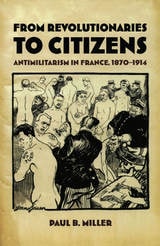
From Revolutionaries to Citizens
Antimilitarism in France, 1870–1914Paul B. Miller
Duke University Press, 2002
Although more general accounts of the Left’s “failure” to halt international war in August 1914 focus on its lack of unity or the decline of trade unionism, Miller contends that these explanations barely scratch the surface when it comes to interpreting the Left’s overwhelming acceptance of the war. By embedding his cultural analysis of antimilitarist propaganda into the larger political and diplomatic history of prewar Europe, he reveals the Left’s seemingly sudden transformation “from revolutionaries to citizens” as less a failure of resolve than a confession of commonality with the broader ideals of republican France. Examining sources ranging from police files and court records to German and British foreign office memos, Miller emphasizes the success of antimilitarism as a rallying cry against social and political inequities on behalf of ordinary citizens. Despite their keen awareness of the bloodletting that awaited Europe, he claims, antimilitarists ultimately accepted the war with Germany for the same reason they had pursued their own struggle within France: to address injustices and defend the rights of citizens in a democratic society.