Results by title
1095 books match the query 'Rhetoric' and 31 start with f
Facing the Center
Toward an Identity Politics of One-to-One MentoringHarry C. Denny
Utah State University Press, 2010
The face of the writing center, be it mainstream or marginal, majority or miority, orthodox or subversive, always has implications for teaching and learning. Facing the Center will extend current research in writing center theory to bring it in touch with theories now common in cultural studies curricula. Denny takes up issues of power, agency, language, and meaning, and pushes his readers to ask how they themselves, or the centers in which they work, might be perpetuating cultures that undermine inclusive, progressive education.
Faculty Writing Support
Emerging Research from Rhetoric and Composition StudiesJaclyn Wells
University Press of Colorado, 2025
Failing Sideways
Queer Possibilities for Writing AssessmentStephanie West-Puckett
Utah State University Press, 2023
A failure-oriented assessment model unsettles some of the most common practices, like rubrics and portfolios, and challenges many deeply held assumptions about validity and reliability in order to ask what could happen if assessment was oriented toward possibility and potential. Working to engage a more capacious writing construct, the authors propose queer validity inquiry (QVI) as a model for assessment that values failure, affect, identity, and materiality. These overlapping lenses help teachers honor parts of writing and learning that writing studies faculty have struggled to hold onto in a world overly focused on quickness and efficiency in schools.
Through programmatic and classroom examples, Failing Sideways privileges what is valued in the classroom but traditionally ignored in assessments. Reimagining what matters in the teaching and learning of writing and using assessment data differently, this book demonstrates what writing can be and could do in a more diverse and just world.
Faithful Deliberation
Rhetorical Invention, Evangelicalism, and #MeToo ReckoningsT J Geiger II
University of Alabama Press, 2022
Investigates the rhetorical practices used by contemporary evangelical Christian women to confront theological and cultural issues that stymie deliberation within their communities
While often perceived as an insular enclave with a high level of in-group agreement about political and social issues, predominantly white evangelicalism includes prominent voices urging deliberation about appropriate responses to sexual abuse, domestic violence, and the discourses surrounding these traumas. In Faithful Deliberation: Rhetorical Invention, Evangelicalism, and #MeToo Reckonings, T J Geiger II examines theologically reflective rhetorical invention that reconfigures trauma-minimizing commonplaces in order to facilitate community-internal deliberation.
Resting at the intersection of feminist rhetorical studies and religious rhetorics, this book contains four related theological-rhetorical case studies that consider how figures such as Beth Moore, Jen Hatmaker, Rachael Denhollander, Karen Swallow Prior, and others engaged in rhetorical invention. Each juxtaposes differing approaches to contending with rape, domestic violence, sexual abuse, and other traumas. Each case contrasts an approach based on appeals to highly circumscribed understandings of grace, purity, and other denomination-specific traditions and values with approaches rooted in those same traditions and values, but with an eye toward community transformation, healing through justice, and reinvigorated forms of forgiveness. Geiger skillfully argues that this faithful deliberation involves practices of thinking, reflecting, storytelling, and acting within a tightly bounded community that can foster change through a recommitment to core values.
These rhetorical practices exemplify the kind of inventive listening deliberative discourse requires, point to the sort of healing they may promote in response to trauma and trauma discourses, and occur within a range of genres including social media posts, blog entries, published interviews, victim impact statements, and petitions. This study of invention for evangelical-to-other-evangelical deliberative discourse contributes to rhetorical studies by demonstrating the civic and social possibilities of rhetoric within religious enclaves. By locating the case studies as recent moments in longer US public and evangelical histories of activism, deliberative practice, and politics, Faithful Deliberation brings into focus how enclaves and the dominant public sphere interact.
False Starts
The Rhetoric of Failure and the Making of American ModernismDavid M. Ball
Northwestern University Press, 2014
Fanatical Schemes
Proslavery Rhetoric and the Tragedy of ConsensusPatricia Roberts-Miller
University of Alabama Press, 2009
Fascist Virilities
Rhetoric, Ideology, and Social Fantasy in ItalyBarbara Spackman
University of Minnesota Press, 1996
Fear and the First Amendment
Controversial Cases of the Roberts CourtKevin A. Johnson and Craig R. Smith
University of Alabama Press, 2024
DISTINGUISHED PUBLICATION AWARD FOR THE NATIONAL COMMUNICATION ASSOCIATION'S COMMUNICATION AND LAW DIVISION
The First Amendment: protected by law, threatened by fear in the Roberts Supreme Court.
In Fear and the First Amendment: Controversial Cases of the Roberts Court, Kevin A. Johnson and Craig R. Smith offer a deeply considered examination of the ways fear figures in First Amendment questions. Bringing together literature on theories of fear in rhetorical and philosophical traditions, Johnson and Smith focus on the rulings from the Roberts Court, which form a pivotal era of dramatic precedents. Each chapter analyzes one or more First Amendment cases and a variety of related fears—whether evidentiary or not—that pertain to a given case.
These cases include Morse v. Frederick, which takes up the competing fears of school administrators’ loss of authority and students’ loss of free speech rights. The authors touch on corporate funding of elections in Citizens United v. Federal Elections Commission, from the fear of corporate influence on electoral politics to corporate fears of alienating their consumers by backing political candidates. They explore religious freedom and fears of homosexuality in Christian Legal Society v. Martinez. Similarly, in Snyder v. Phelps, the authors delve further into fears of God, death, emotional distress, failing as a parent, and losing one’s reputation. Next, they investigate parents’ anxieties about violence in video games in Brown v. Entertainment Merchants Association. Finally, Johnson and Smith examine the role of fear in indecent, obscene, and graphic communication in three cases: FCC v. Fox Television Stations, Ashcroft v. American Civil Liberties Union, and United States v. Stevens.
Together these cases reveal fear to be an endemic factor in the rhetoric of First Amendment cases. This fascinating and original work will appeal to current legal practitioners and students of law, rhetoric, philosophy, and the First Amendment.
Feminism Beyond Modernism
Elizabeth Flynn
Southern Illinois University Press, 2002
Misunderstanding and denigration of postmodern feminism are widespread. Elizabeth Flynn’s Feminism Beyond Modernism comes to its defense in a cogent and astute manner by first distinguishing between postmodern and antimodern feminisms and then reclaiming postmodern feminism by reconfiguring its relationship to modernism.
Too often postmodern feminism is unfairly identified as opposed to modernism and associated with subjectivism and relativism. Flynnaddresses these problems by provisionally defining postmodern feminism as problematizing and critiquing modernism without directly opposing it. Flynn also suggests that feminist traditions that reject modernism, such as radical and cultural feminisms, are antimodern rather than postmodern.
In this interdisciplinary study, Flynn defines feminist traditions broadly, situating her discussions within the contexts of literary studies and rhetoric and composition while simultaneously exploring the troubled relationship between these fields. Departing from accepted definitions of modernism, Flynn distinguishes between aesthetic modernism and Enlightenment modernism and uses the work of John Locke, Sigmund Freud, Charlotte Perkins Gilman, Michel Foucault, Donna Haraway, and others as benchmarks for historical placement. In addition, rereadings of works by Virginia Woolf, Adrienne Rich, Alice Walker, Louise Rosenblatt, and others demonstrate the complex ways in which they respond to modernist pressures and tendencies. From this context, Flynn’s Feminism Beyond Modernism reconfigures feminist traditions by defining postmodern feminism as a critique of modernism rather than as an antimodern opponent.

Feminism and Affect at the Scene of Argument
Beyond the Trope of the Angry FeministAuthored by Barbara Tomlinson
Temple University Press, 2010
Are feminists really angry, unreasoning, man-haters who argue only from an emotional perspective as some claim? Does the incessant repetition of this trope make anti-feminism and misogyny a routine element in everyday speech? And does this repetition work towards delegitimizing feminist arguments and/or undermining feminist politics? How do skilled feminist writers deploy affect to advance feminist ideas? In Feminismand Affect at the Scene of Argument, Barbara Tomlinson addresses these questions, providing a lucid examination of the role of affect in feminist and antifeminist academic arguments.
Using case studies from controversies in socio-legal studies, musicology, and science studies, among other disciplines, Tomlinson examines the rhetorics of anger, contempt, betrayal, intensification, and ridicule. She employs a set of critical tools—feminist “socio-forensic” discursive analysis—that will prove indispensible for understanding and countering tropes like that of the angry feminist. Moreover, these tools will advance feminism, which, she argues, is generated in and by arguments with allies and antagonists.
In an era of debates that generate more heat than light, Feminism and Affectat the Scene of Argument offers a timely provocation for transforming the terms of reading and writing in scholarship and civic life.
Feminist Connections
Rhetoric and Activism across Time, Space, and PlaceEdited by Katherine Fredlund, Kerri Hauman, and Jessica Ouellette
University of Alabama Press, 2020
Tracing the rhetoric of feminist activism across generations, cultures, and movements.
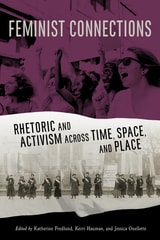
In 1917, Alice Paul and other suffragists famously picketed in front of the White House while holding banners with short, pithy sayings such as “Mr. President: How long must women wait for Liberty?” Their juxtaposition of this short phrase with the image of the White House (a symbol of liberty and justice) relies on the same rhetorical tactics as memes, a genre contemporary feminists use frequently to make arguments about reproductive rights, Black Lives Matter, sex-positivity, and more. Many such connections between feminists of different spaces, places, and eras have yet to be considered, let alone understood. Feminist Connections: Rhetoric and Activism across Time, Space, and Place reconsiders feminist rhetorical strategies as linked, intergenerational, and surprisingly consistent despite the emergence of new forms of media and intersectional considerations.
Contributors to this volume highlight continuities in feminist rhetorical practices that are often invisible to scholars, obscured by time, new media, and wildly different cultural, political, and social contexts. Thus, this collection takes a nonchronological approach to the study of feminist rhetoric, grouping chapters by rhetorical practice rather than time, content, or choice of media.
By connecting historical, contemporary, and future trajectories, this collection develops three feminist rhetorical frameworks: revisionary rhetorics, circulatory rhetorics, and response rhetorics. A theorization of these frameworks explains how feminist rhetorical practices (past and present) rely on similar but diverse methods to create change and fight oppression. Identifying these strategies not only helps us rethink feminist rhetoric from an academic perspective but also allows us to enact feminist activist rhetorics beyond the academy during a time in which feminist scholarship cannot afford to remain behind its hallowed yet insular walls.
Feminist Rhetorical Practices
New Horizons for Rhetoric, Composition, and Literacy StudiesJacqueline Jones Royster and Gesa E. Kirsch
Southern Illinois University Press, 2012
To contextualize a new and changed landscape for narratives in the history of rhetoric, Royster and Kirsch present four critical terms of engagement—critical imagination, strategic contemplation, social circulation, and globalization—as the foundation for a new analytical model for understanding, interpreting, and evaluating feminist rhetorical inquiry and the study and teaching of rhetoric in general. This model draws directly on the wealth of knowledge and understanding gained from feminist rhetorical practices, especially sensitivity toward meaningfully and respectfully rendering the work, lives, cultures, and traditions of historical and contemporary women in rhetorical scholarship.
Proposing ambitious new standards for viewing and valuing excellence in feminist rhetorical practice, Royster and Kirsch advocate an ethos of respect and humility in the analysis of communities and specific rhetorical performances neglected in rhetorical history, recasting rhetorical studies as a global phenomenon rather than a western one. They also reflect on their own personal and professional development as researchers as they highlight innovative feminist research over the past thirty years to articulate how feminist work is changing the field and pointing to the active participation of women in various discourse arenas and to the practices and genres they use.
Valuable to new and established scholars of rhetoric, Feminist Rhetorical Practice: New Horizons for Rhetoric, Composition, and Literacy Studies is essential for understanding the theoretical, methodological, and ethical impacts of feminist rhetorical studies on the wider field.
Winner, 2014 Winifred Bryan Horner Outstanding Book Award
Feminist Rhetorical Resilience
Elizabeth A. Flynn, Patricia Sotirin, and Ann Brady
Utah State University Press, 2012
Although it is well known in other fields, the concept of “resilience” has not been addressed explicitly by feminist rhetoricians. This collection develops it in readings of rhetorical situations across a range of social contexts and national cultures. Contributors demonstrate that resilience offers an important new conceptual frame for feminist rhetoric, with emphasis on agency, change, and hope in the daily lives of individuals or groups of individuals disempowered by social or material forces. Collectively, these chapters create a robust conception of resilience as a complex rhetorical process, redeeming it from its popular association with individual heroism through an important focus on relationality, community, and an ethics of connection. Resilience, in this volume, is a specifically rhetorical response to complicated forces in individual lives. Through it, Feminist Rhetorical Resilience widens the interpretive space within which rhetoricians can work.
Feminist Rhetorical Science Studies
Human Bodies, Posthumanist WorldsEdited by Amanda K. Booher and Julie Jung
Southern Illinois University Press, 2018
Each essay addresses a question: How can feminist rhetoricians of science engage responsibly with emerging theories of the posthuman? Some contributors respond with case studies in medical practice (fetal ultrasound; patient noncompliance), medical science (the neuroscience of sex differences), and health policy (drug trials of the U.S. Food and Drug Administration); others respond with a critical review of object-oriented ontology and a framework for researching women technical writers in the workplace. The contributed essays are in turn framed by a comprehensive introduction and a final chapter from the editors, who argue that a key contribution of feminist posthumanist rhetoric is that it rethinks the agencies of people, things, and practices in ways that can bring about more ethical human relations.
Individually the contributions offer as much variety as consensus on matters of methodology. Together they demonstrate how feminist posthumanist and materialist approaches to science expand our notions of what rhetoric is and does, yet they manage to do so without sacrificing what makes their inquiries distinctively rhetorical.

Fiction And Incarnation
Rhetoric, Theology, and Literature in the Middle AgesAlexandre Leupin
University of Minnesota Press, 2002
A fresh look at the relationship between theology and rhetoric.
Focusing on the Incarnation-the only dogma original to Christianity, in which God becomes man and history-this book offers a wide-ranging and theoretically sophisticated investigation of the relationship between Christian discourse and literature from Roman antiquity to the fourteenth century through a look at texts by Cicero, Quintilian, Martianus Capella, Tertullian, Saint Augustine, Alain of Lille, Guillaume de Machaut, and others.
Alexandre Leupin asks if it is possible to go beyond the dialectics of the Incarnated God and the Devil without harking back to the beautiful but partially obsolete truths of paganism and sophistry. Employing a method inspired by psychoanalysis, Leupin repudiates the sophistry and relativism of postmodern theory while calling into question old commonplaces that have been invalidated by modernity. He does so by attending to the larger and deeper structures hidden within the discourses of theology, rhetoric, literature, and psychoanalysis. The result is an innovative perspective on the Middle Ages, an original and promising view of the problems of Western literature in relation to theology and rhetoric. Alexandre Leupin is Gregorie Professor in French studies at Louisiana State University. He is the author of many books, including, in English translation, Barbarolexis: Medieval Literature and Sexuality (1989).David Laatsch is a Ph.D. candidate in the French department of Louisiana State University.
Field Of Dreams
edited by Peggy O'Neill, Angela Crow, and Larry Burton
Utah State University Press, 2002
One of the first collections to focus on independent writing programs, A Field of Dreams offers a complex picture of the experience of the stand-alone. Included here are narratives of individual programs from a wide range of institutions, exploring such issues as what institutional issues led to their independence, how independence solved or created administrative problems, how it changed the culture of the writing program and faculty sense of purpose, success, or failure.
Further chapters build larger ideas about the advantages and disadvantages of stand-alone status, covering labor issues, promotion/tenure issues, institutional politics, and others. A retrospective on the famous controversy at Minnesota is included, along with a look at the long-established independent programs at Harvard and Syracuse.
Finally, the book considers disciplinary questions raised by the growth of stand-alone programs. Authors here respond with critique and reflection to ideas raised by other chapters—do current independent models inadvertently diminish the influence of rhetoric and composition scholarship? Do they tend to ignore the outward movement of literacy toward technology? Can they be structured to enhance interdisciplinary or writing-across-the-curriculum efforts? Can independent programs play a more influential role in the university than they do from the English department?
Field Rhetoric
Ethnography, Ecology, and Engagement in the Places of PersuasionEdited by Candice Rai and Caroline Gottschalk Druschke
University of Alabama Press, 2018
A survey of the innovative scholarship emerging at the intersections of rhetoric, and fieldwork
A variety of research areas within rhetorical studies—including everyday and public rhetorics, space and place-based work, material and ecological approaches, environmental communication, technical communication, and critical and participatory action research, among others—have increasingly called for ethnographic fieldwork that grounds the study of rhetoric within the contexts of its use and circulation. Employing field methods more commonly used by ethnographers allows researchers to capture rhetoric in action and to observe the dynamic circumstances that shape persuasion in ordinary life.
Field Rhetoric: Ethnography, Ecology, and Engagement in the Places of Persuasion gathers new essays that describe and theorize this burgeoning transdisciplinary mode of field-based scholarship. Contributors document and support this ethnographic turn in rhetorical studies through sustained examination of the diverse trends, methods, tools, theories, practices, and possibilities for engaging in rhetorical field research.
This fascinating volume offers an introduction to these inquiries and serves as both a practical resource and theoretical foundation for scholars, teachers, and students interested in the intersection of rhetoric and field studies. Editors Candice Rai and Caroline Gottschalk Druschke have assembled scholars working in diverse field sites to map and initiate key debates on the practices, limitations, and value of rhetorical field methods and research. Working synthetically at the junction of rhetorical theory and field practices, the contributors to this collection build from myriad field-based cases to examine diverse theoretical and methodological considerations. The volume also serves as a useful reference for interdisciplinary qualitative researchers interested in doing research from a rhetorical or discursive perspective in various disciplines and fields, such as English, composition, communication, natural resources, geography, sociology, urban planning, anthropology, and more.
First Semester
Graduate Students, Teaching Writing, and the Challenge of Middle GroundJessica Restaino
Southern Illinois University Press, 2012
Jessica Restaino offers a snapshot of the first semester experiences of graduate student writing teachers as they navigate predetermined course syllabi and materials, the pressures of grading, the influences of foundational scholarship, and their own classroom authority. With rich qualitative data gathered from course observations, interviews, and correspondence, Restaino traces four graduate students’ first experiences as teachers at a large, public university. Yet the circumstances and situations she relates will ring familiar at widely varying institutions.
First Semester: Graduate Students, Teaching Writing, and the Challenge of Middle Ground presents a fresh and challenging theoretical approach to understanding and improving the preparation of graduate students for the writing classroom. Restaino uses a three-part theoretical construct—labor, action, and work, as defined in Hannah Arendt’s work of political philosophy, The Human Condition—as a lens for reading graduate students’ struggles to balance their new responsibilities as teachers with their concurrent roles as students. Arendt’s concepts serve as access points for analysis, raising important questions about graduate student writing teachers’ first classrooms and uncovering opportunities for improved support and preparation by university writing programs.
First Time Up
An Insider'S Guide For New Composition TeachersBrock Dethier
Utah State University Press, 2005
"First time up?"—an insider’s friendly question from 1960s counter-culture—perfectly captures the spirit of this book. A short, supportive, practical guide for the first-time college composition instructor, the book is upbeat, wise but friendly, casual but knowledgeable (like the voice that may have introduced you to certain other firsts). With an experiential focus rather than a theoretical one, First Time Up will be a strong addition to the newcomer’s professional library, and a great candidate for the TA practicum reading list.
Dethier, author of The Composition Instructor’s Survival Guide and From Dylan to Donne, directly addresses the common headaches, nightmares, and epiphanies of composition teaching—especially the ones that face the new teacher. And since legions of new college composition teachers are either graduate instructors (TAs) or adjuncts without a formal background in composition studies, he assumes these folks as his primary audience.
Dethier’s voice is casual, but it conveys concern, humor, experience, and reassurance to the first-timer. He addresses all major areas that graduate instructors or new adjuncts in a writing program are sure to face, from career anxiety to thoughts on grading and keeping good classroom records. Dethier’s own eclecticism is well-represented here, but he reviews with considerable deftness the value of contemporary scholarship to first-time writing instructors—many of whom will be impatient with high theory. Throughout the work, he affirms a humane, confident approach to teaching, along with a true affection for college students and for teachers just learning to deal with them.
Fitter, Happier
The Eugenic Strain in Twentieth-Century Cancer RhetoricLois Peters Agnew
University of Alabama Press, 0
A critical investigation into how eugenic logics quietly animated twentieth‑century cancer rhetoric, reshaping cultural narratives of health, risk, and human worth.
Fitter, Happier: The Eugenic Strain in Twentieth-Century Cancer Rhetoric is a thought-provoking exploration of the relationship between cancer rhetoric, American ideals, and eugenic influences in the twentieth century. This groundbreaking work delves into the paradoxical interplay between acknowledging the genuine threat of cancer and the ingrained American ethos of confidence and control.
Agnew’s meticulous research traces the topic’s historical context, unveiling how cancer discourses evolved from a hushed personal concern to a public issue thanks to the rise of cancer research centers and advocacy organizations. However, she unearths a troubling dimension to these discussions—subtle yet persistent eugenic ideologies that taint cancer arguments and advocacy groups. By dissecting prevailing cancer narratives, Agnew brings into focus how ideals rooted in eliminating imperfections and embracing progress converge with concerns for safeguarding societal fitness.
Fitter, Happier scrutinizes the military origins and metaphors that permeate government policies and medical research, the transformation of cancer’s association with melancholy into a rallying cry for a positive outlook, and the nuanced implications of prevention-focused dialogues. Reflecting on the varied experiences of actual cancer patients, Agnew resists the neat assimilation of these stories into a eugenic framework. Agnew’s insights prompt readers to contemplate the societal meanings of disease and disability as well as how language constructs our shared reality.

Flash Effect
Science and the Rhetorical Origins of Cold War AmericaDavid J. Tietge
Ohio University Press, 2002
The ways science and technology are portrayed in advertising, in the news, in our politics, and in the culture at large inform the way we respond to these particular facts of life. The better we are at recognizing the rhetorical intentions of the purveyors of information and promoters of mass culture, the more adept we become at responding intelligently to them.
Flash Effect, a startling book by David J. Tietge, documents the manner in which those at the highest levels of our political and cultural institutions conflated the rhetoric of science and technology with the rhetorics of religion and patriotism to express their policies for governance at the onset of the Cold War and to explain them to the American public.
Professor Tietge details our cultural attitudes about science in the early years of the Cold War, when on the heels of a great technological victory Americans were faced with the possibility of destruction by the very weapons that had saved them.
In Flash Effect we learn how, by symbolizing the scientist as both a father figure and a savior—and by celebrating the technological objects of his labor—the campaign to promote science took hold in the American consciousness. The products of that attitude are with us today more than ever.
Food, Feminisms, Rhetorics
Edited by Melissa A. Goldthwaite
Southern Illinois University Press, 2017
Contributors analyze messages about food and bodies—from what a person watches and reads to where that person shops—taken from sources mundane and literary, personal and cultural. This collection begins with analyses of the historical, cultural, and political implications of cookbooks and recipes; explores definitions of feminist food writing; and ends with a focus on bodies and cultures—both self-representations and representations of others for particular rhetorical purposes. The genres, objects, and practices contributors study are varied—from cookbooks to genre fiction, from blogs to food systems, from product packaging to paintings—but the overall message is the same: food and its associated practices are worthy of scholarly attention.
For the Sake of Argument
Practical Reasoning, Character, and the Ethics of BeliefEugene Garver
University of Chicago Press, 2004
Garver roots deliberation and persuasion in political friendship instead of a neutral, impersonal framework of justice. Through incisive readings of examples in modern legal and political history, from Brown v. Board of Education to the South African Truth and Reconciliation Commission, he demonstrates how acts of deliberation and persuasion foster friendship among individuals, leading to common action amid diversity. In an Aristotelian sense, there is a place for pathos and ethos in rational thought. Passion and character have as pivotal a role in practical reasoning as logic and language.
Foreign Policy Rhetorics in a Global Era
Concepts and Case StudiesAllison M. Prasch
Michigan State University Press, 2024
Among the cases researched in this collection are foreign policy rhetoric from Cold War foreign policy in Latin America, the rhetoric of Vladimir Putin’s Ukraine war messages, and the development challenges of the Ford Foundation and the Kenya Women Finance Trust, among many others.
Foundations for Sociorhetorical Exploration
A Rhetoric of Religious Antiquity ReaderVernon K. Robbins
SBL Press, 2016
Engaging resources for understanding the importance of bodies and spaces in producing and interpreting persuasive language
This volume collects essays that represent intellectual milestones that are informing sociorhetorical interpretation during the twenty-first century. The essays are arranged into five parts: (1) Topos; (2) Cultural Geography and Critical Spatiality; (3) Rhetorolects and Conceptual Blending; (4) Rhetography; and (5) Rhetorical Force.
Features:
- Tools for integrating multiple approaches to biblical interpretation
- Resources that emphasize the importance of language that prompts mental pictures in effective rhetoric
- Essays from classicists, rhetoricians, and biblical scholars

Franz Kafka
Narration, Rhetoric, and ReadingEdited by Jakob Lothe, Beatrice Sandberg, and Ronald Speirs
The Ohio State University Press, 2011
Franz Kafka: Narration, Rhetoric, and Reading presents essays by noted Kafka critics and by leading narratologists who explore Kafka’s original and innovative uses of narrative throughout his career. Collectively, these essays by Stanley Corngold, Anniken Greve, Gerhard Kurz, Jakob Lothe, J. Hillis Miller, Gerhard Neumann, James Phelan, Beatrice Sandberg, Ronald Speirs, and Benno Wagner examine a number of provocative questions that arise in narration and narratives in Kafka’s fiction. The arguments of the essays relate both to the peculiarities of Kafka’s story-telling and to general issues in narrative theory. They reflect, for example, the complexity of the issues surrounding the “somebody” doing the telling, the attitude of the narrator to what is told, the perceived purpose(s) of the telling, the implied or actual reader, the progression of events, and the progression of the telling. As the essays also demonstrate, Kafka’s narratives still present a considerable challenge to, as well as a great resource for, narrative theory and analysis.
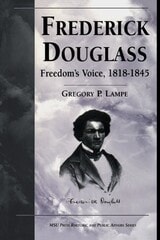
Frederick Douglass
Freedom's Voice, 1818-1845Gregory P. Lampe
Michigan State University Press, 1998
This work in the MSU Press Rhetoric and Public Affairs Series chronicles Frederick Douglass's preparation for a career in oratory, his emergence as an abolitionist lecturer in 1841, and his development and activities as a public speaker and reformer from 1841 to 1845. Lampe's meticulous scholarship overturns much of the conventional wisdom about this phase of Douglass's life and career uncovering new information about his experiences as a slave and as a fugitive; it provokes a deeper and richer understanding of this renowned orator's emergence as an important voice in the crusade to end slavery.
Contrary to conventional wisdom, Douglass was well prepared to become a full-time lecturer for the Massachusetts Anti-Slavery Society in 1841. His emergence as an eloquent voice from slavery was not as miraculous as scholars have led us to believe. Lampe begins by tracing Douglass's life as slave in Maryland and as fugitive in New Bedford, showing that experiences gained at this time in his life contributed powerfully to his understanding of rhetoric and to his development as an orator. An examination of his daily oratorical activities from the time of his emergence in Nantucket in 1841 until his departure for England in 1845 dispels many conventional beliefs surrounding this period, especially the belief that Douglass was under the wing of William Lloyd Garrison. Lampe's research shows that Douglass was much more outspoken and independent than previously thought and that at times he was in conflict with white abolitionists.
Included in this work is a complete itinerary of Douglass's oratorical activities, correcting errors and omissions in previously published works, as well as two newly discovered complete speech texts, never before published.

Friendship Fictions
The Rhetoric of Citizenship in the Liberal ImaginaryMichael A. Kaplan
University of Alabama Press, 2010
A criticism often leveled at liberal democratic culture is its emphasis on the individual over community and private life over civic participation. However, liberal democratic culture has a more complicated relationship to notions of citizenship. As Michael Kaplan shows, citizenship comprises a major theme of popular entertainment, especially Hollywood film, and often takes the form of friendship narratives; and this is no accident. Examining the representations of citizenship-as-friendship in four Hollywood films (The Big Chill, Thelma & Louise, Lost in Translation, and Smoke), Kaplan argues that critics have misunderstood some of liberal democracy’s most significant features: its resilience, its capacity for self-revision, and the cultural resonance of its model of citizenship.
From Liberation to Remediation
The Rhetoric of General EducationKelly Ritter
Utah State University Press, 2026
Kelly Ritter addresses how lawmakers, for-profit testing companies, and even universities fuel public misconceptions of what Gen Ed can provide for our democracy and the role that a broad-based college education plays in social uplift. Tracing the history of the public rhetoric that persuades parents and students to see these courses as a set of interchangeable precollege credits to gain (or game) by any means necessary, she examines how positive and negative public responses to the curricula affected the position of core subjects in US universities, focusing on first-year writing. She also explores the role local, state, and organizational politics played in Gen Ed’s positioning, including decisions related to race, social class, and educational attainment; the impact credit-by-exemption and seamless transfer had on the quality and import of Gen Ed programming in both high schools and colleges; and the perceived use-value of the courses themselves in the face of rising college costs. Finally, she considers which student populations have benefited from the denigration of Gen Ed’s value and which have been left behind.
Drawing on archival research and case studies, From Liberation to Remediation raises important questions about equity, access, and the role of General Education in US higher education’s future and demonstrates that recovering the original post-war democratizing principles and practices of Gen Ed is critical to the continuance of a literate, empathetic, and civic-minded democracy for the twenty-first century.
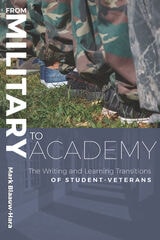
From Military to Academy
The Writing and Learning Transitions of Student-VeteransMark Blaauw-Hara
Utah State University Press, 2021
From Military to Academy is a detailed picture of how student-veterans may experience the shift to the college experience and academic writing. Grounding his research in the experiences of student-veterans at a community college, Blaauw-Hara integrates adult learning theory, threshold concepts, genre analysis, and student-veteran scholarship to help readers understand the challenges student-veterans experience and the strengths they bring as they enter the academic writing environment. Each chapter takes a different theoretical approach to frame student-veterans’ experiences, and Blaauw-Hara ends each chapter with specific, actionable pedagogical suggestions.
Composition studies scholars especially have demonstrated an ongoing interest in and commitment to understanding the experiences of student-veterans from military service to postsecondary education. From Military to Academy helps college writing faculty and writing program administrators understand and support the growing numbers of student-veterans who are making the transition to higher education.

From Small Talk to Microaggression
A History of ScaleMichael Lempert
University of Chicago Press, 2024
In this ambitious, wide-ranging book, anthropologist Michael Lempert offers a conceptual history that explores how, why, and with what effects we have come to think of interactions as “scaled.” Focusing on the sciences of interaction in midcentury America, Lempert traces how they harnessed diverse tools and media technologies, from dictation machines to 16mm film, to study communication “microscopically.” In looking closely, many hoped to transform interaction: to improve efficiency, grow democracy, curb racism, and much else. Yet their descent into a microworld created troubles, with some critics charging that these scientists couldn’t see the proverbial forest for the trees. Exploring talk therapy and group dynamics studies, social psychology and management science, conversation analysis, “micropolitics,” and more, Lempert shows how scale became a defining problem across the behavioral sciences.
Ultimately, he argues, if we learn how our objects of study have been scaled in advance, we can better understand how we think and interact with them—and with each other—across disciplinary and ideological divides. Even as once-fierce debates over micro and macro have largely subsided, Lempert shows how scale lives on and continues to affect the ethics and politics of language and communication today.