Results by title
64 books match the query 'Ritual' and 3 start with f

FEASTS OF HONOR
RITUAL AND CHANGE IN THE TORAJA HIGHLANDToby Alice Volkman
University of Illinois Press, 1985
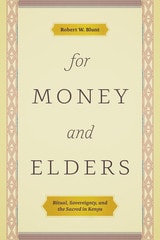
For Money and Elders
Ritual, Sovereignty, and the Sacred in KenyaRobert W. Blunt
University of Chicago Press, 2019
In For Money and Elders, Robert W. Blunt addresses these questions by turning to the political, economic, and religious signs in circulation in Kenya today. He examines how Kenyans attempt to make sense of political instability caused by the uncertainty of authority behind everything from currency to title deeds. When the symbolic order of a society is up for grabs, he shows, violence may seem like an expedient way to enforce the authority of signs. Drawing on fertile concepts of sovereignty, elderhood, counterfeiting, acephaly, and more, Blunt explores phenomena as diverse as the destabilization of ritual “oaths,” public anxieties about Satanism with the advent of democratic reform, and mistrust of official signs. The result is a fascinating glimpse into Kenya’s past and present and a penetrating reflection on meanings of violence in African politics.

Formations of Ritual
Colonial and Anthropological Discourses on the Sinhala YaktovilDavid Scott
University of Minnesota Press, 1994
Formations of Ritual was first published in 1994. Minnesota Archive Editions uses digital technology to make long-unavailable books once again accessible, and are published unaltered from the original University of Minnesota Press editions.
Yaktovil is an elaborate healing ceremony employed by Sinhalas in Sri Lanka to dispel the effects of the eyesight of a pantheon of malevolent supernatural figures known as yakku. Anthropology, traditionally, has articulated this ceremony with the concept metaphor of "demonism." Yet, as David Scott demonstrates in this provocative book, this use of "demonism" reveals more about the discourse of anthropology than it does about the ritual itself. His investigation of yaktovil and yakku within the Sinhala cosmology is also an inquiry into the ways in which anthropology, by ignoring the discursive history of the rituals, religions, and relationships it seeks to describe, tends to reproduce ideological-often, specifically colonial-objects.
To do this, Scott describes the discursive apparatus through which yakku are positioned in the moral universe of Sinhala, traces the appearance of yakku and yaktovil in Western discourse, evaluates the contribution of these figures and this ceremony in anthropology, and attempts to show how the larger anthropology of Buddhism, in which the anthropology of yaktovil is embedded, might be reconfigured. Finally, he offers a rereading of the ritual in terms of the historically selfconscious approach he proposes.The result points to a major rethinking of the historical nature not only of the objects, but also of the concepts through which they are constructed in anthropological discourse.David Scott teaches in the Department of Anthropology at the University of Chicago.