Results by title
95 books match the query 'Rivers' and 6 start with f
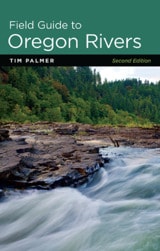
Field Guide to Oregon Rivers
Tim Palmer
Oregon State University Press, 2024
In this updated edition of his classic Field Guide to Oregon Rivers, Tim Palmer gives us an unprecedented reference, introducing the state’s waterways and offering outdoor enthusiasts and resource professionals an interpretive approach to an extraordinary network of streams. He begins with natural history—geology, climate, hydrology, plants, and wildlife—then profiles 111 Oregon rivers with notes about nature, fish, and conservation, followed by essential tips on where to see each river, hike along the shores, fish, and explore by canoe, kayak, and raft. Illustrations identify riparian plants and animals while more than 150 photographs showcase a magnificent rivers estate. This volume is an essential outdoor companion for Oregonians and visitors alike.
[more]
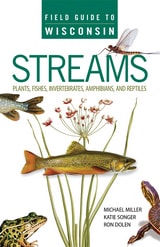
Field Guide to Wisconsin Streams
Plants, Fishes, Invertebrates, Amphibians, and ReptilesMichael A. Miller, Katie Songer, and Ron Dolen
University of Wisconsin Press, 2014
From bubbling spring-fed headwaters to quiet, marshy creeks and tannin-stained northern reaches, Wisconsin is home to 84,000 miles of streams. This guide is the ultimate companion for learning about the animals and plants in Wisconsin streams. A collaborative effort by dozens of biologists and ecologists, Field Guide toWisconsin Streams is accessible to anglers, teachers and students, amateur naturalists, and experienced scientists alike.
More than 1,000 images illustrate the species in this field guide. These images are augmented by detailed ecological and taxonomic notes, descriptions of look-alike species, and distribution maps. The guide identifies:
• more than 130 common plants
• all 120 fishes known to inhabit Wisconsin streams
• 8 crayfishes
• 50 mussels
• 10 amphibians
• 17 reptiles
• 70 families of insects
• other commonly found invertebrates.
Best Regional General Interest Books, selected by the American Association of School Librarians
Best Regional General Interest Books, selected by the Public Library Reviewers
[more]
Finding the River
An Environmental History of the ElwhaJeff Crane
Oregon State University Press, 2011
[more]
Flow
The Life and Times of Philadelphia's Schuylkill RiverBeth Kephart
Temple University Press, 2014
The Schuylkill River-the name in Dutch means "hidden creek"-courses many miles, turning through Philadelphia before it yields to the Delaware. "I am this wide. I am this deep. A tad voluptuous, but only in places," writes Beth Kephart, capturing the voice of this natural resource in Flow.
An award-winning author, Kephart's elegant, impressionistic story of the Schuylkill navigates the beating heart of this magnificent water source. Readers are invited to flow through time-from the colonial era and Ben Franklin's death through episodes of Yellow Fever and the Winter of 1872, when the river froze over-to the present day. Readers will feel the silt of the Schuylkill's banks, swim with its perch and catfish, and cruise-or scull-downstream, from Reading to Valley Forge to the Water Works outside center city.
Flow's lush narrative is peppered with lovely, black and white photographs and illustrations depicting the river's history, its people, and its gorgeous vistas. Written with wisdom and with awe for one of the oldest friends of all Philadelphians, Flow is a perfect book for reading while the ice melts, and for slipping in your bag for your own visit to the Schuylkill.
[more]
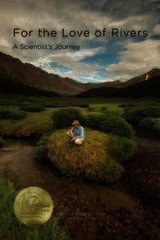
For the Love of Rivers
A Scientist's JourneyKurt D. Fausch
Oregon State University Press, 2015
Rivers and streams supply our water and capture our imaginations. We seek the more pristine ones to fish or paddle, to hike along or simply sit and watch. But what is it we are seeing? What is essential about streams and rivers for us as humans?
In For the Love of Rivers, stream ecologist Kurt Fausch draws readers across the reflective surface of streams to view and ponder what is beneath, and how they work. While celebrating their beauty and mystery, he uses his many years of experience as a field biologist to explain the underlying science connecting these aquatic ecosystems to their streamside forests and the organisms found there—including humans.
For the Love of Rivers introduces readers to the life and work of Shigeru Nakano, a pioneering river ecologist who inspired other scientists around the world with his innovative research on stream-forest connections. Fausch takes readers along as he journeys to Japan, where he awakens to an unfamiliar culture, to Nakano, and his research.
Nakano’s life was abruptly ended in a tragic field accident, and his death was deeply mourned. Fausch joins Japanese and American colleagues to continue Nakano’s research legacy, learn everything they can about the effects that humans have on rivers, fish, and their intricate links with riparian zones, and share this knowledge with others.
More than a book about stream ecology, For the Love of Rivers is a celebration of the interconnectedness of life. It is an authoritative and accessible look at the science of rivers and streams, but it also ponders the larger questions of why rivers are important to humans, why it is in our nature to want to be near them, and what we can do now to ensure the future of these essential ecosystems.
[more]
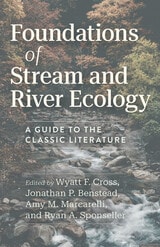
Foundations of Stream and River Ecology
A Guide to the Classic LiteratureEdited by Wyatt F. Cross, Jonathan P. Benstead, Amy M. Marcarelli, and Ryan A. Sponseller
University of Chicago Press, 2024
For students and practitioners, a comprehensive primer on the key literature in stream and river ecology.
The study of streams and rivers combines ecology, chemistry, hydrology, and geology to reveal the factors that control the biological diversity and functioning of these unique ecosystems. Although stream ecology is a relatively young discipline, foundational papers published over the past half century have shaped our current understanding of these ecosystems and have informed our efforts to manage and protect them. Organized by topics such as the physical template, community structure, food webs, ecosystem energetics, and nutrient dynamics, the chapters of this book offer summaries of the key literature, historical and contextual information, and insightful discussions of how past research has influenced present studies and may shape future work.
The study of streams and rivers combines ecology, chemistry, hydrology, and geology to reveal the factors that control the biological diversity and functioning of these unique ecosystems. Although stream ecology is a relatively young discipline, foundational papers published over the past half century have shaped our current understanding of these ecosystems and have informed our efforts to manage and protect them. Organized by topics such as the physical template, community structure, food webs, ecosystem energetics, and nutrient dynamics, the chapters of this book offer summaries of the key literature, historical and contextual information, and insightful discussions of how past research has influenced present studies and may shape future work.
[more]