Results by title
397 books match the query 'Rome' and 5 start with f
FEELING HISTORY
LUCAN, STOICISM, AND THE POETICS OF PASSIONFrancesca D’Alessandro Behr
The Ohio State University Press, 2007
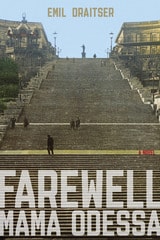
Farewell, Mama Odessa
A NovelEmil Draitser
Northwestern University Press, 2020
Set in the summer of 1979 at the height of the movement to free Soviet Jewry, Farewell, Mama Odessa is an autobiographical novel whose intertwined storylines follow a variety of people—dissidents, victims of ethnic discrimination, and black marketeers among them—as they bid farewell to their beloved hometown of Odessa, Ukraine, and make their way to the West. At the book’s center is Boris, a young writer thwarted by state censorship and antisemitism. With an Angora kitten for his companion and together with other émigrés, he puts the old country in his rear-view mirror and sets out on a journey that will take him to Bratislava, Vienna, Rome, and New York on his way to Los Angeles. Will Boris be able to rekindle his creative passion and inspiration in the West? Will other Jewish émigrés fit into the new society, so much different than the one they left behind? With humor and compassion, Farewell, Mama
Odessa describes the émigrés’ attempts at adjustment to the free world.
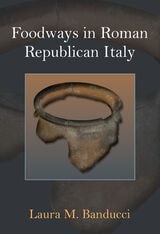
Foodways in Roman Republican Italy
Laura M. Banducci
University of Michigan Press, 2021
Foodways in Roman Republican Italy explores the production, preparation, and consumption of food and drink in Republican Italy to illuminate the nature of cultural change during this period. Traditionally, studies of the cultural effects of Roman contact and conquest have focused on observing changes in the public realm: that is, changing urban organization and landscape, and monumental construction. Foodways studies reach into the domestic realm: How do the daily behaviors of individuals express their personal identity, and How does this relate to changes and expressions of identity in broader society? Laura M. Banducci tracks through time the foodways of three sites in Etruria from about the third century BCE to the first century CE: Populonia, Musarna, and Cetamura del Chianti. All were established Etruscan sites that came under Roman political control over the course of the third and second centuries BCE. The book examines the morphology and use wear of ceramics used for cooking, preparing, and serving food in order to deduce cooking methods and the types of foods being prepared and consumed. Change in domestic behaviors was gradual and regionally varied, depending on local social and environmental conditions, shaping rather than responding to an explicitly “Roman” presence.
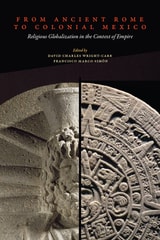
From Ancient Rome to Colonial Mexico
Religious Globalization in the Context of EmpireDavid Charles Wright-Carr
University Press of Colorado, 2023
An international team of specialists in classical scholarship and Mesoamerican studies engage in an interdisciplinary discussion involving ideas from history, anthropology, archaeology, art history, iconography, and philology. Key themes include the role of religion in processes of imperial domination; religion’s use as an instrument of resistance or the imposition, appropriation, incorporation, and adaptation of various elements of religious systems by hegemonic groups and subaltern peoples; the creative misunderstandings that can arise on the “middle ground”; and Christianity’s rejection of ritual violence and its use of this rejection as a pretext for inflicting other kinds of violence against peoples classified as “barbarian,” “pagan,” or “diabolical.”
From Ancient Rome to Colonial Mexico presents a sympathetic vantage point for discussing and attempting to decipher past processes of social communication in multicultural contexts of present-day realities. It will be significant for scholars and specialists in the history of religions, ethnohistory, classical antiquity, and Mesoamerican studies.
Publication supported, in part, by Spain’s Ministry of Economy and Competitiveness.
Contributors: Sergio Botta,Maria Celia Fontana Calvo, Martin Devecka, György Németh, Guilhem Olivier, Francisco Marco Simón, Paolo Taviani, Greg Woolf, David Charles Wright-Carr, Lorenzo Pérez Yarza
Translators: Emma Chesterman, Benjamin Adam Jerue, Layla Wright-Contreras
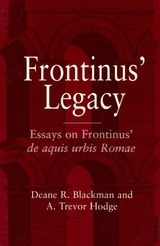
Frontinus' Legacy
Essays on Frontinus' de aquis urbis RomaeDeane R. Blackman and A. Trevor Hodge, Editors
University of Michigan Press, 2001