Results by title
149 books match the query 'Russia (Federation)' and 6 start with f
Farewell to Russia
Memories of When I Was KolaNikolai Prestia
Rutgers University Press, 2026
Growing up in 1990s Russia in a family marked by poverty, substance abuse, and neglect, Kola and his sister are eventually admitted into the orphanage system. Here, Kola comes face to face with a different but equally daunting challenge: navigating an unfamiliar and sometimes hostile world haunted by the absence of his mother. The ensuing journey, which eventually culminates in the adoption by an Italian family, alternates moments of both trauma and deliverance, while asking fundamental questions about our ability to reconcile ourselves with unfathomable loss.
Harrowing yet lyrical, Nikolai Prestia’s prize-winning 2021 novel is a testament to the duality of memory in its ability to both hurt and heal, and to the transformative power of those figures, adults and peers alike, who contribute to a child’s development. Translated into English as part of a collaboration between the author and a mother-daughter translator duo, the novel serves up a wrenching glimpse into the back stories that often precede the adoption of an older child.
Feeding the Russian Fur Trade
Provisionment of the Okhotsk Seaboard and the Kamchatka Peninsula, 1639–1856James R. Gibson
University of Wisconsin Press, 1969
James R. Gibson offers a detailed study that is both an account of this chapter of Russian history and a full examination of the changing geography of the Okhotsk Seaboard and the Kamchatka Peninsula over the course of two centuries.
Few Returned
Twenty-eight Days on the Russian Front, Winter 1942-1943Eugenio Corti, Translated by Peter Edward Levy, & Foreword by Carlo D'Este
University of Missouri Press, 1997
After World War II more than one hundred books appeared that dealt with the experience of the Italian army in Russia, and particularly the terrible winter retreat of 1942-1943. Few Returned (I piu' non ritornano) is the only one of these that is still regularly reissued in Italy.
Eugenio Corti, who was a twenty-one-year-old second lieutenant at the time, found himself, together with 30,000 Italians and a smaller contingent of Germans, encircled on the banks of the River Don by enemy forces who far outnumbered them. To break out of this encirclement, these men undertook a desperate march across the snow, with constant engagements and in temperatures ranging from -20 to -30 degrees Fahrenheit. Whereas supplies were air-dropped to the Germans, the predicament of the Italians was far more difficult: lacking gasoline, they were compelled to abandon their vehicles and to proceed without heavy arms, equipment, ammunition, or provisions. Even the wounded had to be abandoned, though it was well known that the soldiers of the Red Army"enraged by the brutality of the German invasion"killed all the enemy wounded who fell into their hands. After twenty-eight days of encirclement, only 4,000 of the 30,000 Italians made it out of the pocket.
Why is it that Corti's book, which was first published in 1947, continues after fifty years to be reprinted in Italy? Because, as Mario Apollonio of the University of Milan said, when the book first appeared: "It is a chronicle . . . but it is much more than that: behind the physical reality, there is the truth" about man at his most tragic hour. Apollonio adds: "The power of the writing immediately transforms the document into drama"; the result is a "novel-poem-drama-history." The philosopher Benedetto Croce found in Corti's book "the not infrequent gleam of human goodness and nobility." Few Returned is a classic of war literature that succeeds in bringing home the full hatefulness of war.
Eugenio Corti began writing his diary at a military hospital immediately after being repatriated from the Russian front. When in September 1943 Italy found itself cut in two by the Armistice, Corti, loyal to his officer's oath, joined up with what remained of the Italian army in the south and with those few troops participated in driving the Germans off Italian soil, fighting at the side of the British Eighth and the American Fifth Armies.

From Fear to Fraternity
A Russian Tale of Crime, Economy and ModernityPatricia Rawlinson
Pluto Press, 2010
The end of communism marked the re-emergence of a huge rise in organised crime across Russia and Eastern Europe. High-profile efforts to combat it have met with little success.
Patricia Rawlinson argues that burgeoning crime rates result not only from the failures of communism but also from the problems of free market economies.
Drawing on interviews with members of the Russian criminal underworld, the business community, journalists and the militia, she argues that organised crime provides us with a barometer of economic well-being, not just for Russia but for any market economy.
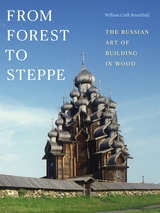
From Forest to Steppe
The Russian Art of Building in WoodWilliam Craft Brumfield
Duke University Press, 2025
In From Forest to Steppe, renowned scholar and photographer William Craft Brumfield offers a panoramic survey of Russia’s centuries-long heritage of wooden architecture. Lavishly illustrated with more than 400 color photographs, the volume links log-built barns, windmills, houses, and churches in the Far North; Buddhist shrines in the Transbaikal region; and eighteenth-century palaces on the outskirts of Moscow. Brumfield also takes readers to the estate houses of many Russian literary giants, from Chekhov and Tolstoy to Dostoevsky and Pushkin. Spanning thousands of photographed sites, five decades of field work, and seven time zones, Brumfield’s photographs offer compelling evidence of the adaptability of log construction and its ability to transcend class, cultural, and aesthetic boundaries.
In the decades since Brumfield began photographing Russian architecture, many of the buildings he has documented have been demolished or abandoned and left to rot at alarming rates. Brumfield observes a contradiction in contemporary Russia: It acknowledges the cultural importance of wooden buildings yet struggles to find and dedicate the resources and solutions needed to save them. A hymn and elegy to the long Russian practice of building with wood, From Forest to Steppe is an unparalleled look into one of the world’s most singular architectural traditions.
From Russia with Code
Programming Migrations in Post-Soviet TimesMario Biagioli and Vincent Antonin Lepinay, editors
Duke University Press, 2019
Contributors. Irina Antoschyuk, Mario Biagioli, Ksenia Ermoshina, Marina Fedorova, Andrey Indukaev, Alina Kontareva, Diana Kurkovsky, Vincent Lépinay, Alexandra Masalskaya, Daria Savchenko, Liubava Shatokhina, Alexandra Simonova, Ksenia Tatarchenko, Zinaida Vasilyeva, Dimitrii Zhikharevich