Results by title
67 books match the query 'Sea' and 3 start with f

Feral
Rewilding the Land, the Sea, and Human LifeGeorge Monbiot
University of Chicago Press, 2014
To be an environmentalist early in the twenty-first century is always to be defending, arguing, acknowledging the hurdles we face in our efforts to protect wild places and fight climate change. But let’s be honest: hedging has never inspired anyone.
So what if we stopped hedging? What if we grounded our efforts to solve environmental problems in hope instead, and let nature make our case for us? That’s what George Monbiot does in Feral, a lyrical, unabashedly romantic vision of how, by inviting nature back into our lives, we can simultaneously cure our “ecological boredom” and begin repairing centuries of environmental damage. Monbiot takes readers on an enchanting journey around the world to explore ecosystems that have been “rewilded”: freed from human intervention and allowed—in some cases for the first time in millennia—to resume their natural ecological processes. We share his awe, and wonder, as he kayaks among dolphins and seabirds off the coast of Wales and wanders the forests of Eastern Europe, where lynx and wolf packs are reclaiming their ancient hunting grounds. Through his eyes, we see environmental success—and begin to envision a future world where humans and nature are no longer separate and antagonistic, but are together part of a single, healing world.
Monbiot’s commitment is fierce, his passion infectious, his writing compelling. Readers willing to leave the confines of civilization and join him on his bewitching journey will emerge changed—and ready to change our world for the better.
[more]
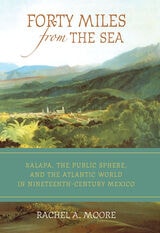
Forty Miles from the Sea
Xalapa, the Public Sphere, and the Atlantic World in Nineteenth-Century MexicoRachel A. Moore
University of Arizona Press, 2011
While the literature on Atlantic history is vast and flourishing, few studies have examined the importance of inland settlements to the survival of Atlantic ports. This book explores the symbiotic yet conflicted relationships that bound the Mexican cities of Xalapa and Veracruz to the larger Atlantic world and considers the impact these affiliations had on communication and, ultimately, the formation of national identity.
Over the course of the nineteenth century, despite its inland location, Xalapa became an important Atlantic community as it came to represent both a haven and a place of fortification for residents of Veracruz. Yellow fever, foreign invasion, and domestic discord drove thousands of residents of Veracruz, as well as foreign travelers, to seek refuge in Xalapa. At the same time, these adverse circumstances prompted the Mexican government to use Xalapa as a bulwark against threats originating in the Atlantic.
The influence of the Atlantic world thus stretched far into central Mexico, thanks to both the instability of the coastal region and the desire of government officials to “protect” central Mexico from volatile Atlantic imports. The boundaries established at Xalapa, however, encouraged goods, information, and people to collect in the city and thereby immerse the population in the developments of the Atlantic sphere. Thus, in seeking to protect the center of the country, government authorities more firmly situated Xalapa in the Atlantic world. This connection would be trumped by national affiliation only when native residents of Xalapa became more comfortable with their participation in the Mexican public sphere later in the nineteenth century.
The interdisciplinary and comparative nature of this study will make it appeal to those studying Atlantic history, including historians of Britain, the United States, Latin America, and Africa, as well as those studying communication, print culture, and postal history more broadly.
[more]
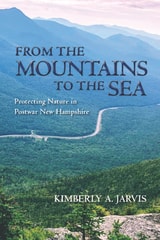
From the Mountains to the Sea
Protecting Nature in Postwar New HampshireKimberly A. Jarvis
University of Massachusetts Press, 2020
In the face of increasing pressures from business and government in the decades following World War II, New Hampshire residents banded together to preserve their most prized natural areas and defining geological features. From the Mountains to the Sea explores how history, memory, and tradition created a strong sense of place in the state that led citizen activists to protect Franconia Notch, Sandwich Notch, and the town of Durham on New Hampshire's seacoast from development in the last half of the twentieth century. These efforts led to the construction of a parkway instead of an interstate highway, prevented the building of an oil refinery, and saved Sandwich Notch from becoming a vacation community.
Shaped by New Hampshire's unique conservation focus on both resource use and preservation that developed during the first years of the twentieth century, as well as on the tradition of home rule in the state, the outcome of each campaign relied on the insight into, appreciation for, and dedication to protecting the historic and aesthetic values of these three places.
Shaped by New Hampshire's unique conservation focus on both resource use and preservation that developed during the first years of the twentieth century, as well as on the tradition of home rule in the state, the outcome of each campaign relied on the insight into, appreciation for, and dedication to protecting the historic and aesthetic values of these three places.
[more]