Results by title
200 books match the query 'Second Edition' and 6 start with f
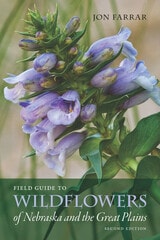
Field Guide to Wildflowers of Nebraska and the Great Plains
Second EditionJon Farrar
University of Iowa Press, 2012
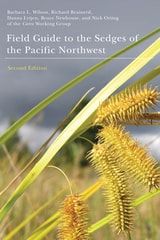
Field Guide to the Sedges of the Pacific Northwest
Second EditionBarbara J. Wilson, Richard Brainerd, Danny Lytjen, Bruce Newhouse, and Nick Otting of the Carex Working Group
Oregon State University Press, 2014
Sedges can be difficult to identify, with differences between species based on small, technical characters. This comprehensive guide contains identification keys, descriptions, more than 650 color photographs, and distribution maps for each species, providing users with helpful tools and tips for identifying the plants in this challenging group. Information about sedge ecology, habitat, management and restoration, ethnobotanical uses, and propagation enhances the guide’s utility.
Field Guide to the Sedges of the Pacific Northwest provides an invaluable resource for botanists, land managers, restoration ecologists, and plant enthusiasts. And, as the genus Carex becomes increasingly important amongst landscapers, nurseries, and gardeners, the guide will serve as a handy tool for choosing Northwest natives for the garden.
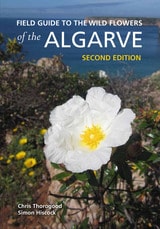
Field Guide to the Wild Flowers of the Algarve
Second EditionChris Thorogood and Simon Hiscock
Royal Botanic Gardens, Kew, 2019
This second edition is fully updated with new species and new findings. Information is provided on where and when to see plants with information on their habitat and vegetation types. Rare and unusual plants of the region are highlighted, including orchids and parasitic plants. The more than one thousand descriptions are accompanied throughout with over 650 stunning color photographs, 780 line drawings, and distribution maps.
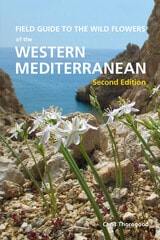
Field Guide to the Wild Flowers of the Western Mediterranean, Second Edition
Chris Thorogood
Royal Botanic Gardens, Kew, 2021
The western Mediterranean—running from Italy to Portugal and encompassing Corsica, Sardinia, the Balearic Islands, and coastal North Africa—is one of the most biodiverse regions in the world, home to more than 10,000 plant species. This updated edition of the Field Guide to the Wild Flowers of the Western Mediterranean is the most comprehensive plant identification guide to the area. Covering more than 2,500 plants, this accessible guide focuses on the most common and conspicuous species that occur in the area, with descriptions, color photographs, and illustrations throughout. The book also includes sections on where to find native plants in the wild, as well as a glossary of terms. An ideal companion for wildlife and plant enthusiasts, this guide will enable even the most botanically blind to reliably identify native flora in the sunny and coastal climes of the western Mediterranean.
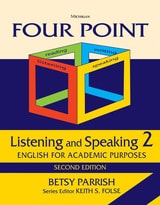
Four Point Listening and Speaking 2, Second Edition (No Audio)
English for Academic PurposesBetsy Parrish
University of Michigan Press, 2018
This version has the same content as 978-0-472-03535-9; it just is not packaged with the audio. The audio (MP3) files, available for download, must be purchased separately: 978-0-472-00362-4.
This product replaces 978-0-472-03535-9.
The Four Point series is designed for English language learners whose primary goal is to succeed in an academic setting.The series covers the four academic skills of reading, writing, listening, and speaking while providing reinforcement and systematic recycling of key vocabulary and further exposure to grammar issues. In order to participate in academic settings, English learners need focused activities to develop and then maintain their use of vocabulary and grammar. Each book in the series focuses heavily on vocabulary in particular, highlighting between 125-150 key vocabulary items including individual words, compound words, phrasal verbs, short phrases, idioms, metaphors, collocations, and longer set lexical phrases.
The 2nd Edition of Listening-Speaking 2 contains six lectures on the topic within a field of academic study: applied linguistics, geology, economics, history, health sciences, and engineering. The lectures range in length from 11 to 16 minutes in length. Audio files are sold separately. The exercises practice an array of important academic listening and speaking skills, including making presentations, and also reinforce vocabulary and reading and writing skills. Each unit includes activities based on the in-class interactions students will encounter in academic settings—including making impromptu and prepared presentations, debating, participating in group discussions. Toward this end, video scenes (available on the companion website) for each unit model student behavior when working in groups and incorporate key words and phrases typically used when working in groups. By addressing the breadth and depth of listening and speaking tasks required in academic settings, students will grow confident in areas that build the fluencies needed to succeed in their academic endeavors.
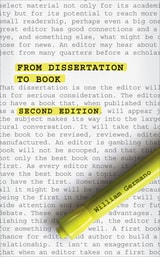
From Dissertation to Book, Second Edition
William Germano
University of Chicago Press, 2013
Since its publication in 2005, From Dissertation to Book has helped thousands of young academic authors get their books beyond the thesis committee and into the hands of interested publishers and general readers. Now revised and updated to reflect the evolution of scholarly publishing, this edition includes a new chapter arguing that the future of academic writing is in the hands of young scholars who must create work that meets the broader expectations of readers rather than the narrow requirements of academic committees.
At the heart of From Dissertation to Book is the idea that revising the dissertation is fundamentally a process of shifting its focus from the concerns of a narrow audience—a committee or advisors—to those of a broader scholarly audience that wants writing to be both informative and engaging. William Germano offers clear guidance on how to do this, with advice on such topics as rethinking the table of contents, taming runaway footnotes, shaping chapter length, and confronting the limitations of jargon, alongside helpful timetables for light or heavy revision.
Germano draws on his years of experience in both academia and publishing to show writers how to turn a dissertation into a book that an audience will actually enjoy, whether reading on a page or a screen. Germano also acknowledges that not all dissertations can or even should become books and explores other, often overlooked, options, such as turning them into journal articles or chapters in an edited work.
With clear directions, engaging examples, and an eye for the idiosyncrasies of academic writing, From Dissertation to Book reveals to recent PhDs the secrets of careful and thoughtful revision—a skill that will be truly invaluable as they add “author” to their curriculum vitae.