Results by title
53 books match the query 'Secondary' and 2 start with f
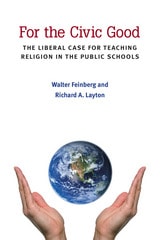
For the Civic Good
The Liberal Case for Teaching Religion in the Public SchoolsWalter Feinberg and Richard A. Layton
University of Michigan Press, 2014
Why teach about religion in public schools? What educational value can such courses potentially have for students?
In For the Civic Good, Walter Feinberg and Richard A. Layton offer an argument for the contribution of Bible and world religion electives. The authors argue that such courses can, if taught properly, promote an essential aim of public education: the construction of a civic public, where strangers engage with one another in building a common future. The humanities serve to awaken students to the significance of interpretive and analytic skills, and religion and Bible courses have the potential to add a reflective element to these skills. In so doing, students awaken to the fact of their own interpretive framework and how it influences their understanding of texts and practices. The argument of the book is developed by reports on the authors’ field research, a two-year period in which they observed religion courses taught in various public high schools throughout the country, from the “Bible Belt” to the suburban parkway. They document the problems in teaching religion courses in an educationally appropriate way, but also illustrate the argument for a humanities-based approach to religion by providing real classroom models of religion courses that advance the skills critical to the development of a civic public.
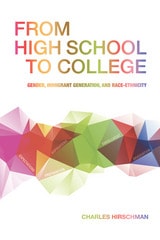
From High School to College
Gender, Immigrant Generation, and Race-EthnicityCharles Hirschman
Russell Sage Foundation, 2016
Today, over 75 percent of high school seniors aspire to graduate from college. However, only one-third of Americans hold a bachelor’s degree, and college graduation rates vary significantly by race/ethnicity and parental socioeconomic status. If most young adults aspire to obtain a college degree, why are these disparities so great? In From High School to College, Charles Hirschman analyzes the period between leaving high school and completing college for nearly 10,000 public and private school students across the Pacific Northwest.
Hirschman finds that although there are few gender, racial, or immigration-related disparities in students’ aspirations to attend and complete college, certain groups succeed at the highest rates. For example, he finds that women achieve better high school grades and report receiving more support and encouragement from family, peers, and educators. They tend to outperform men in terms of preparing for college, enrolling in college within a year of finishing high school, and completing a degree. Similarly, second-generation immigrants are better prepared for college than first-generation immigrants, in part because they do not have to face language barriers or learn how to navigate the American educational system.
Hirschman also documents that racial disparities in college graduation rates remain stark. In his sample, 35 percent of white students graduated from college within seven years of completing high school, compared to only 19 percent of black students and 18 percent of Hispanic students. Students’ socioeconomic origins—including parental education and employment, home ownership, and family structure—account for most of the college graduation gap between disadvantaged minorities and white students. Further, while a few Asian ethnic groups have achieved college completion rates on par with whites, such as Chinese and Koreans, others, whose socioeconomic origins more resemble those of black and Hispanic students, such as Filipinos and Cambodians, also lag behind in preparedness, enrollment, and graduation from college.
With a growing number of young adults seeking college degrees, understanding the barriers that different students encounter provides vital information for social scientists and educators. From High School to College illuminates how gender, immigration, and ethnicity influence the path to college graduation.