Results by title
105 books match the query 'Self' and 4 start with f
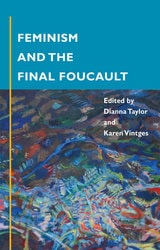
Feminism and the Final Foucault
Edited by Dianna Taylor and Karen Vintges
University of Illinois Press, 2004
Rather than simply debating the merits or limitations of Foucault's later work, the essays in this collection examine women's historical self-practices, conceive of feminism as a shared ethos, and consider the political significance of this conceptualization in order to elucidate, experiment with, and put into practice the conceptual "tools" that Foucault offers for feminist ethics and politics. The volume illustrates the ways in which Foucault's later thinking on ethics as "care of the self" can reintroduce a number of issues and themes that feminists jettisoned in the wake of postmodernism, including consciousness raising, feminist therapy, the subject woman, identity politics, and feminist agency.
Taken as a whole, the diversity of feminist viewpoints presented provide important new insights into "the final Foucault," and thus serve as a productive intervention in current Foucault scholarship.
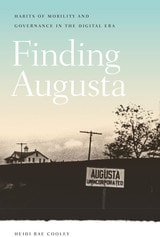
Finding Augusta
Habits of Mobility and Governance in the Digital EraHeidi Rae Cooley
Dartmouth College Press, 2014
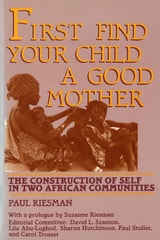
First Find Your Child a Good Mother
The Construction of Self in Two African CommunitiesRiesman, Paul
Rutgers University Press, 1992
Through a systematic comparison of the life circumstances, child-rearing practices, and personalities of the FulBe and their former slaves, the RiimaayBe, this book develops an alternative theory of the way personality is formed in the Fulani society of West Africa. Riesman discusses the different characters, economies, and life plans of adult men and women of both groups, focusing on their ideas about the value of relatives. He further presents detailed observations of child-rearing practices, and concludes that the FulBe and RiimaayBe do not differ in these practices. Contrasting Fulani and Western notions of parenting, he suggests that child-rearing practices are themselves irrelevant to the formation of adult personality, but that a people's ideas about the meaning of life, social relations, and the development of character are very important. Finally, Riesman outlines a sociocultural theory of personality and its formation, and uses this theory to make sense of the differences between FulBe and RiimaayBe.
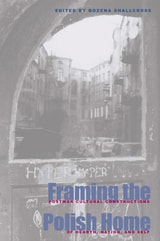
Framing the Polish Home
Postwar Cultural Constructions of Hearth, Nation, and SelfBozena Shallcross
Ohio University Press, 2002
As the subject of ideological, aesthetic, and existential manipulations, the Polish home and its representation is an ever-changing phenomenon that absorbs new tendencies and, at the same time, retains its centrality to Polish literature, whether written in Poland or abroad. Framing the Polish Home is a pioneering work that explores the idea of home as fundamental to the question of cultural and national identity within Poland's recent history and its tradition.
In this inaugural volume of the Polish and Polish-American Studies Series, the Polish home emerges in its rich verbal and visual representations and multiple material embodiments, as the discussion moves from the loss of the home during wartime to the Sovietized politics of housing and from the exilic strategies of having a home to the the idyllic evocation of the abodes of the past.
Although, as Bożena Shallcross notes in her introduction, “few concepts seem to have such universal appeal as the notion of the home,” this area of study is still seriously underdeveloped. In essays from sixteen scholars, Framing the Polish Home takes a significant step to correct that oversight, covering a broad range of issues pertinent to the discourse on the home and demonstrating the complexity of the home in Polish literature and culture.