87 books match the query 'Sexual minorities' and 4 start with f
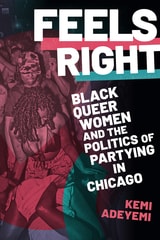
cover of Feels Right: Black Queer Women and the Politics of Partying in Chicago

Feels Right

Black Queer Women and the Politics of Partying in Chicago

Kemi Adeyemi

Duke University Press, 2022

In Feels Right Kemi Adeyemi presents an ethnography of how black queer women in Chicago use dance to assert their physical and affective rights to the city. Adeyemi stages the book in queer dance parties in gentrifying neighborhoods, where good feelings are good business. But feeling good is elusive for black queer women whose nightlives are undercut by white people, heterosexuality, neoliberal capitalism, burnout, and other buzzkills. Adeyemi documents how black queer women respond to these conditions: how they destroy DJ booths, argue with one another, dance slowly, and stop partying altogether. Their practices complicate our expectations that life at night, on the queer dance floor, or among black queer community simply feels good. Adeyemi’s framework of “feeling right” instead offers a closer, kinesthetic look at how black queer women adroitly manage feeling itself as a complex right they should be afforded in cities that violently structure their movements and energies. What emerges in Feels Right is a sensorial portrait of the critical, black queer geographies and collectivities that emerge in social dance settings and in the broader neoliberal city.

Duke University Press Scholars of Color First Book Award recipient
[more]
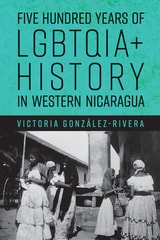
cover of Five Hundred Years of LGBTQIA+ History in Western Nicaragua

Five Hundred Years of LGBTQIA+ History in Western Nicaragua

Victoria González-Rivera

University of Arizona Press, 2024

This groundbreaking book reframes five hundred years of western Nicaraguan history by giving gender and sexuality the attention they deserve. Victoria González-Rivera decenters nationalist narratives of triumphant mestizaje and argues that western Nicaragua’s LGBTQIA+ history is a profoundly Indigenous one.

In this expansive history, González-Rivera documents connections between Indigeneity, local commerce, and femininity (cis and trans), demonstrating the long history of LGBTQIA+ Nicaraguans. She sheds light on historical events, such as Andres Caballero’s 1536 burning at the stake for sodomy. González-Rivera discusses how elite efforts after independence to “modernize” open-air markets led to increased surveillance of LGBTQIA+ working-class individuals. She also examines the 1960s and the Somoza dictatorship, when another wave of persecution emerged, targeting working-­class gay men and trans women, leading to a more stringent anti-sodomy law.

The centuries prior to the post-1990 political movement for greater LGBTQIA+ rights demonstrate that, far from being marginal, LGBTQIA+ Nicaraguans have been active in every area of society for hundreds of years.

[more]
cover of Fractal Repair: Queer Histories of Modern Jamaica

Fractal Repair

Queer Histories of Modern Jamaica

Matthew Chin

Duke University Press, 2024
In Fractal Repair, Matthew Chin investigates queerness in Jamaica from early colonial occupation to the present, critically responding to the island’s global reputation for extreme homophobia and anti-queer violence. Chin advances a theory and method of queer fractals to bring together genealogies of queer and Caribbean formation. Fractals—a kind of geometry in which patterns repeat but never exactly in the same way—make visible shifting accounts of Caribbean queerness in terms of race, gender, and sexual alterity. Drawing on this fractal orientation, Chin assembles and analyzes multigenre archives, ranging from mid-twentieth-century social science studies of the Caribbean to Jamaica’s National Dance Theatre Company to HIV/AIDS organizations, to write reparative histories of queerness. Chin’s proposal of a fractal politics of repair invests in the horizon of difference that repetition materializes, and it extends reparations discourses intent on overcoming the past and calculating economic compensation for survivors of violence.
 
[more]
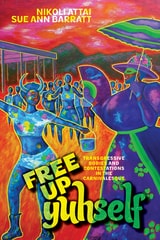
cover of Free Up Yuhself: Transgressive Bodies and Contestations in the Carnivalesque

Free Up Yuhself

Transgressive Bodies and Contestations in the Carnivalesque

Nikoli A. Attai

Rutgers University Press, 2025

Free Up Yuhself explores and theorizes what it means to embody and be empowered by the chaos of transgression, evaluating the implications for people who destabilize the Caribbean region’s dominant gender and sexuality politics within the Caribbean and the Caribbean diaspora. This book examines how people actively utilize the carnivalesque—spaces of festivity and places of excitement, the extraordinary, the ritualistic—to confront, negotiate, disrupt, and transgress normative trends, boundaries, and perspectives in the Caribbean and Caribbean diaspora communities. This book is particularly concerned with the ways that Caribbean people contest sexual and gendered expectations through their bodily performances across regional and diasporic festival spaces. Through illustrative, analytical, evaluative, and reflective chapters, the collection contemplates the themes of freedom, belonging, acceptance, and recognition as these affect the experience of people’s sense of being. The authors reflect on “freeing up” as a contentious politics, understanding that people have the capacity to enact their freedom through transgressive movements and performances that persistently grapple with notions of respectability, agency, empowerment, disruption, and the meanings and consequences of their varied social and political locations.

[more]