Results by title
86 books match the query 'Soul' and 3 start with f
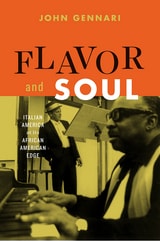
Flavor and Soul
Italian America at Its African American EdgeJohn Gennari
University of Chicago Press, 2017
In the United States, African American and Italian cultures have been intertwined for more than a hundred years. From as early as nineteenth-century African American opera star Thomas Bowers—“The Colored Mario”—all the way to hip-hop entrepreneur Puff Daddy dubbing himself “the Black Sinatra,” the affinity between black and Italian cultures runs deep and wide. Once you start looking, you’ll find these connections everywhere. Sinatra croons bel canto over the limousine swing of the Count Basie band. Snoop Dogg deftly tosses off the line “I’m Lucky Luciano ’bout to sing soprano.” Like the Brooklyn pizzeria and candy store in Spike Lee’s Do the Right Thing and Jungle Fever, or the basketball sidelines where Italian American coaches Rick Pitino and John Calipari mix it up with their African American players, black/Italian connections are a thing to behold—and to investigate.
In Flavor and Soul, John Gennari spotlights this affinity, calling it “the edge”—now smooth, sometimes serrated—between Italian American and African American culture. He argues that the edge is a space of mutual emulation and suspicion, a joyous cultural meeting sometimes darkened by violent collision. Through studies of music and sound, film and media, sports and foodways, Gennari shows how an Afro-Italian sensibility has nourished and vitalized American culture writ large, even as Italian Americans and African Americans have fought each other for urban space, recognition of overlapping histories of suffering and exclusion, and political and personal rispetto.
Thus, Flavor and Soul is a cultural contact zone—a piazza where people express deep feelings of joy and pleasure, wariness and distrust, amity and enmity. And it is only at such cultural edges, Gennari argues, that America can come to truly understand its racial and ethnic dynamics.
[more]
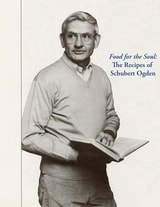
Food for the Soul
The Recipes of Schubert OgdenSchubert Ogden
Bridwell Press, 2022
Schubert Miles Ogden (1928-2019) was one of America’s preeminent theologians during the last fifty years and spent a significant part of his career at Perkins School of Theology (SMU). During this time he engaged with a broad range of topics and concerns in his writings and teachings, producing an extensive theological body of work. What many in that academic world did not know was that Ogden was also a formidable man in the kitchen, constantly experimenting, testing, and coming up with a variety of recipes, from the distinctly delicious German-style baked goods like stollen to Schubert’s Own Salmon Loaf. He even had a signature cocktail called the Minister Margarita. In this present volume titled Food for the Soul: The Recipes of Schubert Ogden we have the second book published under the new Bridwell Press imprint that brings to life a lesser-known aspect of Ogden’s dynamic life and world. Instead of the adventures of the great scholar’s theological works, in this book we have an element of joyful surprise in his gastronomical oeuvre, and maybe there is something new and illuminating to discover in that as well. This compilation will certainly find a warm and inviting home among both theologians and non-theologians alike, especially if you like to experiment with the never-ending nuances of food.
[more]
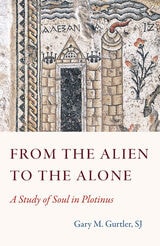
From the Alien to the Alone
A Study of Soul in PlotinusGary M. Gurtler, SJ
Catholic University of America Press, 2022
Plotinus is often accused of writing haphazardly, with little concern for the integral unity of a treatise. By analyzing each treatise as a whole, From the Alien to the Alone finds much evidence that he constructed them skillfully, with the parts working together in subtle ways. This insight was also key in translating several central passages by considering the flow of the argument as a whole to shed light on the difficulties in these passages as well as reveal the structure often latent in particular treatise. The volume also serves to clarify Plotinus’ rich use of images. Commentators, for instance, tend to take the images of light and warmth to explain the relation of soul and body as in conflict, with light casting out warmth. A close look at the text, however, reveals that Plotinus uses each image to correct the limitations of the other. Thus, since the soul is incorporeal, it is actually more transcendent than light and as activating the body is more completely present than warmth. Similarly, recent commentators are quick to take the related impassibility of the soul as implying a Cartesian gap between body and soul. The problem Plotinus faces, however, is that his description of the soul’s pervasive presence in the body jeopardizes its impassibility as in the intelligible. His effort then is actually to introduce a gap that preserves the soul’s nature, rather than overcome a gap that would make the very existence of the body problematic.
While this work confirms much recent scholarly consensus on Plotinus, many of Gurtler's interpretations and general conclusions give constructive challenges to some existing modes of understanding Plotinus’ thought. The arguments and their textual evidence, with the accompanying Greek, provide the reader with direct evidence for testing these conclusions as well as appreciating the nature of Plotinus’ philosophizing.
[more]