323 books match the query 'Southeast Asia' and 10 start with f
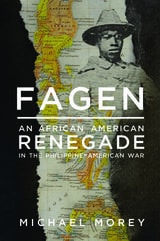
cover of Fagen: An African American Renegade in the Philippine-American War

Fagen

An African American Renegade in the Philippine-American War

Michael Morey

University of Wisconsin Press, 2019

In 1898, in an era of racial terror at home and imperial conquest abroad, the United States sent its troops to suppress the Filipino struggle for independence, including three regiments of the famed African American "Buffalo Soldiers." Among them was David Fagen, a twenty-year-old private in the Twenty-Fourth Infantry, who deserted to join the Filipino guerrillas. He led daring assaults and ambushes against his former comrades and commanders—who relentlessly pursued him without success—and his name became famous in the Philippines and in the African American community.

The outlines of Fagen's legend have been known for more than a century, but the details of his military achievements, his personal history, and his ultimate fate have remained a mystery—until now. Michael Morey tracks Fagen's life from his youth in Tampa as a laborer in a phosphate camp through his troubled sixteen months in the army, and, most importantly, over his long-obscured career as a guerrilla officer. Morey places this history in its larger military, political, and social context to tell the story of the young renegade whose courage and defiance challenged the supremacist assumptions of the time.
[more]
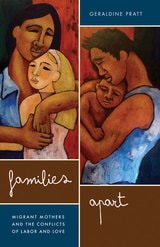
cover of Families Apart: Migrant Mothers and the Conflicts of Labor and Love

Families Apart

Migrant Mothers and the Conflicts of Labor and Love

Geraldine Pratt

University of Minnesota Press, 2012

In a developing nation like the Philippines, many mothers provide for their families by traveling to a foreign country to care for someone else’s. Families Apart focuses on Filipino overseas workers in Canada to reveal what such arrangements mean for families on both sides of the global divide.

The outcome of Geraldine Pratt’s collaboration with the Philippine Women Centre of British Columbia, this study documents the difficulties of family separation and the problems that children have when they reunite with their mothers in Vancouver. Aimed at those who have lived this experience, those who directly benefit from it, and those who simply stand by and watch, Families Apart shows how Filipino migrant domestic workers—often mothers themselves—are caught between competing neoliberal policies of sending and receiving countries and how, rather than paying rich returns, their ambitions as migrants often result in social and economic exclusion for themselves and for their children. This argument takes shape as an open-ended series of encounters, moving between a singular academic voice and the “we” of various research collaborations, between Vancouver and the Philippines, and between genres of “evidence-based” social scientific research, personal testimony, theatrical performance, and nonfictional narrative writing.

Through these experiments with different modes of storytelling, Pratt seeks to transform frameworks of perception, to create and collect sympathetic witnesses—in short, to promote a wide-ranging public discussion and debate about a massive worldwide shift in family (and nonfamily) relations of intimacy and care.
[more]
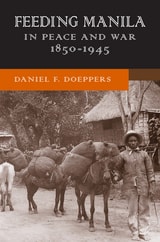
cover of Feeding Manila in Peace and War, 1850–1945

Feeding Manila in Peace and War, 1850–1945

Daniel F. Doeppers

University of Wisconsin Press, 2019

Policymakers and scholars have come to realize that getting food, water, and services to the millions who live in the world’s few dozen megacities is one of the twenty-first century’s most formidable challenges. As these populations continue to grow, apocalyptic scenarios—sprawling slums plagued by hunger, disease, and social disarray—become increasingly plausible. In Feeding Manila in Peace and War, 1850–1945, Daniel F. Doeppers traces nearly a century in the life of Manila, one of the world’s largest cities, to show how it grew and what sustained it.
            Doeppers follows key commodities for the city—rice, produce, fish, fowl, meat, milk, flour, coffee—and their complex interconnections. In the process he considers the changing ecology of the surrounding region as well as the social fabric that weaves together farmers, merchants, transporters, storekeepers, and door-to-door vendors.
[more]
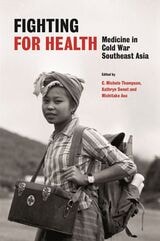
cover of Fighting for Health: Medicine in Cold War Southeast Asia

Fighting for Health

Medicine in Cold War Southeast Asia

Edited by C. Michele Thompson, Kathryn Sweet, and Michitake Aso

National University of Singapore Press, 2024

An overlooked history of Southeast Asia’s varied healthcare regimes during the Cold War.

For far too long, Southeast Asia has been treated as a static backdrop for the exploits and discoveries of Western biomedical doctors. Yet, Southeast Asians have been vital to the significant developments in the prevention and treatment of diseases that have taken place in the region and beyond. Many of the institutions and people that shaped subsequent responses to outbreaks, epidemics, and pandemics first began their work in Southeast Asia during the Cold War. The diversity of approaches to health and medicine during that era also reminds us of the possibilities, and limits, of human intervention in the face of political, social, economic, and microbial realities. The people and places of Southeast Asia have provided clinical trials for different health regimes. Fighting for Health highlights new perspectives and methods that have evolved from research presented at regional conferences, including the History of Medicine in Southeast Asia (HOMSEA) series. These insights serve to challenge dominant models of the medical humanities.
[more]
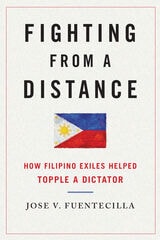
cover of Fighting from a Distance: How Filipino Exiles Helped Topple a Dictator

Fighting from a Distance

How Filipino Exiles Helped Topple a Dictator

Jose V. Fuentecilla

University of Illinois Press, 2013
During February 1986, a grassroots revolution overthrew the fourteen-year dictatorship of former president Ferdinand Marcos in the Philippines. In this book, Jose V. Fuentecilla describes how Filipino exiles and immigrants in the United States played a crucial role in this victory, acting as the overseas arm of the opposition to help return their country to democracy.
 
A member of one of the major U.S.-based anti-Marcos movements, Fuentecilla tells the story of how small groups of Filipino exiles--short on resources and shunned by some of their compatriots--arrived and survived in the United States during the 1970s, overcame fear, apathy, and personal differences to form opposition organizations after Marcos's imposition of martial law, and learned to lobby the U.S. government during the Cold War. In the process, he draws from multiple hours of interviews with the principal activists, personal files of resistance leaders, and U.S. government records revealing the surveillance of the resistance by pro-Marcos White House administrations. The first full-length book to detail the history of U.S.-based opposition to the Marcos regime, Fighting from a Distance provides valuable lessons on how to persevere against a well-entrenched opponent.
[more]
cover of Forsaken Causes: Liberal Democracy and Anticommunism in Cold War Laos

Forsaken Causes

Liberal Democracy and Anticommunism in Cold War Laos

Ryan Wolfson-Ford

University of Wisconsin Press, 2024

In the wake of anticolonial struggles and amid the two world wars, twentieth-century Southeast Asia churned with new political, cultural, and intellectual realities. Liberal democracies flourished briefly, only to be discarded for dictatorships and other authoritarian regimes as the disorder and inefficiencies inherent to democracy appeared unequal to postcolonial and Cold War challenges. Uniquely within the region, Laos maintained a stable democracy until 1975, surviving wars, coups, and revolutions. But Lao history during this period has often been flattened, subsumed within the tug-of-war between the global superpowers and their puppets.

Forsaken Causes offers a groundbreaking intellectual history of the Royal Lao Government (RLG) from 1945 to 1975. In Ryan Wolfson-Ford’s account, the Lao people emerge as not merely pawns of the superpowers but agents in their own right, with the Lao elite wielding particular influence over the nation’s trajectory. Their prevailing ideologies—liberal democracy and anticommunism—were not imposed from outside, but rather established by Lao themselves in the fight against French colonialism. These ideologies were rooted in Lao culture, which prized its traditional monarchy, Buddhist faith, French learning, and nationalist conception of a Lao race. Against histories that have dismissed Lao elites as instruments of foreign powers, Wolfson-Ford shows that the RLG charted its own course, guided by complex motivations, rationales, and beliefs. During this time Lao enjoyed unprecedented democratic freedoms, many of which have not been seen since the government fell to communist takeover in 1975.

By recentering the Lao in their own history, Wolfson-Ford restores our understanding of this robust but often forgotten liberal democracy, recovers lost voices, and broadens our understanding of postcolonial and Cold War Southeast Asia as a whole.
[more]
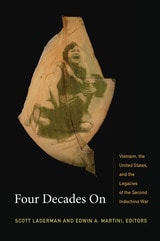
cover of Four Decades On: Vietnam, the United States, and the Legacies of the Second Indochina War

Four Decades On

Vietnam, the United States, and the Legacies of the Second Indochina War

Scott Laderman and Edwin A. Martini, eds.

Duke University Press, 2013

In Four Decades On, historians, anthropologists, and literary critics examine the legacies of the Second Indochina War, or what most Americans call the Vietnam War, nearly forty years after the United States finally left Vietnam. They address matters such as the daunting tasks facing the Vietnamese at the war's end—including rebuilding a nation and consolidating a socialist revolution while fending off China and the Khmer Rouge—and "the Vietnam syndrome," the cynical, frustrated, and pessimistic sense that colored America's views of the rest of the world after its humiliating defeat in Vietnam. The contributors provide unexpected perspectives on Agent Orange, the POW/MIA controversies, the commercial trade relationship between the United States and Vietnam, and representations of the war and its aftermath produced by artists, particularly writers. They show how the war has continued to affect not only international relations but also the everyday lives of millions of people around the world. Most of the contributors take up matters in the United States, Vietnam, or both nations, while several utilize transnational analytic frameworks, recognizing that the war's legacies shape and are shaped by dynamics that transcend the two countries.

Contributors
. Alex Bloom, Diane Niblack Fox, H. Bruce Franklin, Walter Hixson, Heonik Kwon, Scott Laderman, Mariam B. Lam, Ngo Vinh Long, Edwin A. Martini, Viet Thanh Nguyen, Christina Schwenkel, Charles Waugh
[more]
cover of Freedom in Entangled Worlds: West Papua and the Architecture of Global Power

Freedom in Entangled Worlds

West Papua and the Architecture of Global Power

Eben Kirksey

Duke University Press, 2012
Eben Kirksey first went to West Papua, the Indonesian-controlled half of New Guinea, as an exchange student in 1998. His later study of West Papua's resistance to the Indonesian occupiers and the forces of globalization morphed as he discovered that collaboration, rather than resistance, was the primary strategy of this dynamic social movement. Accompanying indigenous activists to Washington, London, and the offices of the oil giant BP, Kirksey saw the revolutionaries' knack for getting inside institutions of power and building coalitions with unlikely allies, including many Indonesians. He discovered that the West Papuans' pragmatic activism was based on visions of dramatic transformations on coming horizons, of a future in which they would give away their natural resources in grand humanitarian gestures, rather than watch their homeland be drained of timber, gold, copper, and natural gas. During a lengthy, brutal occupation, West Papuans have harbored a messianic spirit and channeled it in surprising directions. Kirksey studied West Papua's movement for freedom while a broad-based popular uprising gained traction from 1998 until 2008. Blending ethnographic research with indigenous parables, historical accounts, and narratives of his own experiences, he argues that seeking freedom in entangled worlds requires negotiating complex interdependencies.
[more]
cover of From Modern Production to Imagined Primitive: The Social World of Coffee from Papua New Guinea

From Modern Production to Imagined Primitive

The Social World of Coffee from Papua New Guinea

Paige West

Duke University Press, 2012

In this vivid ethnography, Paige West tracks coffee as it moves from producers in Papua New Guinea to consumers around the world. She illuminates the social lives of the people who produce coffee, and those who process, distribute, market, and consume it. The Gimi peoples, who grow coffee in Papua New Guinea's highlands, are eager to expand their business and social relationships with the buyers who come to their highland villages, as well as with the people working in Goroka, where much of Papua New Guinea's coffee is processed; at the port of Lae, where it is exported; and in Hamburg, Sydney, and London, where it is distributed and consumed. This rich social world is disrupted by neoliberal development strategies, which impose prescriptive regimes of governmentality that are often at odds with Melanesian ways of being in, and relating to, the world. The Gimi are misrepresented in the specialty coffee market, which relies on images of primitivity and poverty to sell coffee. By implying that the "backwardness" of Papua New Guineans impedes economic development, these images obscure the structural relations and global political economy that actually cause poverty in Papua New Guinea.
[more]
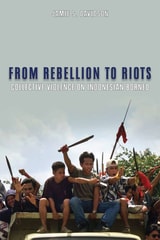
cover of From Rebellion to Riots: Collective Violence on Indonesian Borneo

From Rebellion to Riots

Collective Violence on Indonesian Borneo

Jamie S. Davidson

University of Wisconsin Press, 2008

From Rebellion to Riots is a critical analysis of the roots of contemporary violence in one of Indonesia’s most ethnically heterogeneous provinces, West Kalimantan. Since the late 1960s, this province has suffered periodic outbreaks of ethnic violence among its Dayak, Malay, Madurese, and ethnic Chinese populations. Citing evidence from his research, internal military documents, and ethnographic accounts, Jamie S. Davidson refutes popular explanations for these flare-ups. The recurrent violence has less to do with a clash of cultures, the ills of New Order-led development, or indigenous marginalization than with the ongoing politicization of ethnic and indigenous identity in the region.
            Looking at key historical moments, markedly different in their particulars, Davidson reveals the important links between ethnic violence and subnational politics. In one case, army officers in Soeharto’s recently established New Order regime encouraged anti-Chinese sentiments. To move against communist-inspired rebellion, they recruited indigenous Dayaks to expunge tens of thousands of ethnic Chinese from interior towns and villages. This counter-insurgent bloodshed inadvertently initiated a series of clashes between Dayaks and Madurese, another migrant community. Driven by an indigenous empowerment movement and efforts by local elites to control benefits provided by decentralization and democratization, these low-intensity riots rose to immense proportions in the late 1990s. From Rebellion to Riots demonstrates that the endemic violence in this vast region is not the inevitable outcome of its ethnic diversity, and reveals that the initial impetus for collective bloodshed is not necessarily the same as the forces that sustain it.

“A comprehensive case study . . . . Essential reading for students of the West Kalimantan violence.”—Dave McRae, Indonesia
[more]