Results by title
53 books match the query 'Southwest' and 2 start with f
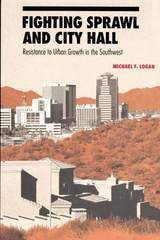
Fighting Sprawl and City Hall
Resistance to Urban Growth in the SouthwestMichael F. Logan
University of Arizona Press, 1995
The line is drawn in cities of the American West: on one side, chambers of commerce, developers, and civic boosters advocating economic growth; on the other, environmentalists and concerned citizens who want to limit what they see as urban sprawl. While this conflict is usually considered to have its origins in the rise of environmental activism during the late 1960s, opposition to urban growth in the Southwest began as early as the economic boom that followed World War II. Evidence of this resistance abounds, but it has been largely ignored by both western and urban historians.
Fighting Sprawl and City Hall now sets the record straight, tracing the roots of antigrowth activism in two southwestern cities, Tucson and Albuquerque, where urbanization proceeded in the face of constant protest. Logan tells how each of these cities witnessed multifaceted opposition to post-war urbanization and a rise in political activism during the 1950s. For each city, he describes the efforts by civic boosters and local government to promote development, showing how these booster-government alliances differed in effectiveness; tells how middle-class Anglos first voiced opposition to annexations and zoning reforms through standard forms of political protest such as referendums and petitions; then documents the shift to ethnic resistance as Hispanics opposed urban renewal plans that targeted barrios. Environmentalism, he reveals, was a relative latecomer to the political arena and became a focal point for otherwise disparate forms of resistance.
Logan's study enables readers to understand not only these similarities in urban activism but also important differences; for example, Tucson provides the stronger example of resistance based on valuation of the physical environment, while Albuquerque better demonstrates anti-annexation politics. For each locale, it offers a testament to grass-roots activism that will be of interest to historians as well as to citizens of its subject cities.
[more]
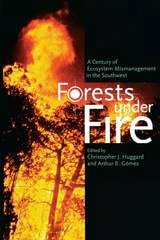
Forests under Fire
A Century of Ecosystem Mismanagement in the SouthwestEdited by Christopher J. Huggard and Arthur R. Gómez
University of Arizona Press, 2001
The devastating fire that swept through Los Alamos, New Mexico, in the spring of 2000 may have been caused by one controlled burn gone wild, but it was far from an isolated event. All through the twentieth century, our national forests have been under assault from all sides: first ranchers and loggers laid their claims to our national forests, then recreationists and environmentalists spoke up for their interests. Who are our national forests really for?
In this book, leading environmental historians show us what has been happening to these fragile woodlands. Taking us from lumber towns to Indian reservations to grazing lands, Forests under Fire reveals the interaction of Anglos, Hispanics, and Native Americans with the forests of the American Southwest. It examines recent controversies ranging from red squirrel conservation on Mt. Graham to increased tourism in our national forests. These case studies offer insights into human-forest relationships in places such as the Coconino National Forest, the Vallecitos Sustained Yield Unit, and the Gila Wilderness Area while also drawing on issues and concerns about similar biospheres in other parts of the West.
Over the past century, forest management has evolved from a field dominated by the "conservationist" perspective—with humans exploiting natural resources-to one that emphasizes biocentrism, in which forests are seen as dynamic ecosystems. Yet despite this progressive shift, the assault on our forests continues through overgrazing of rangelands, lumbering, eroding mountainsides, fire suppression, and threats to the habitats of endangered species. Forests under Fire takes a closer look at the people calling the shots in our national forests, from advocates of timber harvesting to champions of ecosystem management, and calls for a reassessment of our priorities—before our forests are gone.
Contents
Introduction: Toward a Twenty-First-Century Forest Ecosystem Management Strategy / Christopher J. Huggard
Industry and Indian Self-Determination: Northern Arizona’s Apache Lumbering Empire, 1870-1970 / Arthur R. Gómez
A Social History of McPhee: Colorado’s Largest Lumber Town / Duane A. Smith
The Vallecitos Federal Sustained-Yield Unit: The (All Too) Human Dimension of Forest Management in Northern New Mexico, 1945-1998 / Suzanne S. Forrest
Grazing the Southwest Borderlands: The Peloncillo-Animas District of the Coronado National Forest in Arizona and New Mexico, 1906-1996 / Diana Hadley
America’s First Wilderness Area: Aldo Leopold, the Forest Service, and the Gila of New Mexico, 1924-1980 / Christopher J. Huggard
"Where There’s Smoke": Wildfire Policy and Suppression in the American Southwest / John Herron
Struggle in an Endangered Empire: The Search for Total Ecosystem Management in the Forests of Southern Utah, 1976-1999 / Thomas G. Alexander
Biopolitics: A Case Study of Political Influence on Forest Management Decisions, Coronado National Forest, Arizona, 1980s-1990s / Paul W. Hirt
Epilogue: Seeing the Forest Not for the Trees: The Future of Southwestern Forests in Retrospect / Hal K. Rothman
[more]