Results by title
53 books match the query 'Statesmen' and 3 start with f
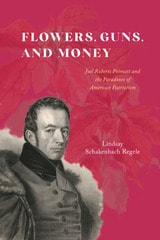
Flowers, Guns, and Money
Joel Roberts Poinsett and the Paradoxes of American PatriotismLindsay Schakenbach Regele
University of Chicago Press, 2023
Joel Roberts Poinsett’s (1779–1851) brand of self-interested patriotism illuminates the paradoxes of the antebellum United States. He was a South Carolina investor and enslaver, a confidant of Andrew Jackson, and a secret agent in South America who fought surreptitiously in Chile’s War for Independence. He was an ambitious Congressman and Secretary of War who oversaw the ignominy of the Trail of Tears and orchestrated America’s longest and costliest war against Native Americans, yet also helped found the Smithsonian. In addition, he was a naturalist, after whom the poinsettia—which he appropriated while he was serving as the first US ambassador to Mexico—is now named.
As Lindsay Schakenbach Regele shows in Flowers, Guns, and Money, Poinsett personified a type of patriotism that emerged following the American Revolution, one in which statesmen served the nation by serving themselves, securing economic prosperity and military security while often prioritizing their own ambitions and financial interests. Whether waging war, opposing states’ rights yet supporting slavery, or pushing for agricultural and infrastructural improvements in his native South Carolina, Poinsett consistently acted in his own self-interest. By examining the man and his actions, Schakenbach Regele reveals an America defined by opportunity and violence, freedom and slavery, and nationalism and self-interest.
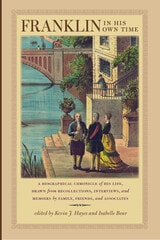
Franklin in His Own Time
A Biographical Chronicle of His Life, Drawn from Recollections, Interviews, and Memoirs by Family, Friends, and AssociatesKevin J. Hayes
University of Iowa Press, 2011
@font-face { font-family: "Courier New";}@font-face { font-family: "Times";}@font-face { font-family: "Cambria";}@font-face { font-family: "Palatino";}p.MsoNormal, li.MsoNormal, div.MsoNormal { margin: 0in 0in 0.0001pt; font-size: 12pt; font-family: "Times New Roman"; }div.Section1 { page: Section1; }
In his time Benjamin Franklin (1706–1790) was the most famous American in the world. Even those personally unacquainted with the man knew him as the author of Poor Richard’s Almanack, as a pioneer in the study of electricity and a major figure in the American Enlightenment, as the creator of such life-changing innovations as the lightning rod and America’s first circulating library, and as a leader of the American Revolution. His friends also knew him as a brilliant conversationalist, a great wit, an intellectual filled with curiosity, and most of all a master anecdotist whose vast store of knowledge complemented his conversational skills. In Franklin in His Own Time, by reprinting the original documents in which those anecdotes occur, Kevin Hayes and Isabelle Bour restore those oft-told stories to their cultural contexts to create a comprehensive narrative of his life and work.
The thirty-five recollections gathered in Franklin in His Own Time form an animated, collaborative biography designed to provide a multitude of perspectives on the “First American.” Opening with an account by botanist Peter Kalm showing that Franklin was doing all he could to encourage the development of science in North America, it includes on-the-spot impressions from Daniel Fisher’s diary, the earliest surviving interview with Franklin, recollections from James Madison and Abigail Adams, Manasseh Cutler’s detailed description of the library at Franklin Court, and extracts from Alexander Hamilton’s unvarnished Minutes of the Tuesday Club. Franklin’s political missions to Great Britain and France, where he took full advantage of rich social and intellectual opportunities, are a source of many reminiscences, some published here in new translations. Genuine memories from such old friends as Thomas Jefferson and John Adams, as opposed to memories influenced by the Autobiography, clarify Franklin’s reputation. Robert Carr may have been the last remaining person who knew Franklin personally, and thus his recollections are particularly signific
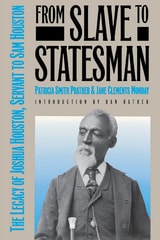
From Slave to Statesman
The Legacy of Joshua Houston, Servant to Sam HoustonPatricia Smith Prather
University of North Texas Press, 1993