Results by title
105 books match the query 'Sustainable development' and 5 start with f
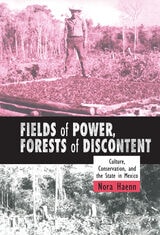
Fields of Power, Forests of Discontent
Culture, Conservation, and the State in MexicoNora Haenn
University of Arizona Press, 2005
In Fields of Power, Forests of Discontent, Nora Haenn questions the rise and fall of this conservation program to examine conservation at the intersection of national-international agendas and local political-economic interests. While other assessments of such programs have typically focused on why they do or do not succeed, Haenn instead considers conservation’s encounter with people’s everyday lives—and how those experiences affect environmental management.
Haenn explores conservation and development from two perspectives: first regionally, to look at how people used conservation to create a new governing entity on a tropical frontier once weakly under national rule; then locally, focusing on personal histories and aspects of community life that shape people's daily lives, farming practices, and immersion in development programs—even though those programs ultimately fail to resolve economic frustrations. She identifies how key political actors, social movements, and identity politics contributed to the instability of the Calakmul alliance. Drawing on extensive interviews with Reserve staff, including its director, she connects regional trends to village life through accounts of disputes at ejido meetings and the failure of ejido development projects.
In the face of continued difficulty in creating a popular conservation in Calakmul, Haenn uses lessons from people's lives—history, livelihood, village organization, expectations—to argue for a "sustaining conservation," one that integrates social justice and local political norms with a new, more robust definition of conservation. In this way, Fields of Power, Forests of Discontent goes beyond local ethnography to encourage creative discussion of conservation's impact on both land and people.

Financing Prosperity by Dealing with Debt
Edited by Christopher Harker and Amy Horton
University College London, 2022
In an era when many of us depend on debt to survive but struggle with its consequences, Financing Prosperity by Dealing with Debt draws together current thinking on how to solve debt crises and promote prosperity. By profiling existing action by credit unions and community organizations, alongside bold proposals for the future, with contributions from artists, activists, and academics, the book shows how we can rethink the validity and inevitability of many contemporary forms of debt through organizing debt audits, promoting debt cancellation, and expanding member-owned co-operatives. The authors set out legal and political methods for changing the rules of the system to provide debt relief and reshape economies for more inclusive and sustainable flourishing. The book also profiles community-based actions that are changing the role of debt in economic, social, and political life—among them, participatory art projects, radical advice networks, and ways of financing feminist green transition. This volume moves beyond critique to present a wealth of concrete ways to tackle debt and forge the prosperous communities we want for the future, making it relevant to a broad audience of academics, practitioners, activists, and policymakers.
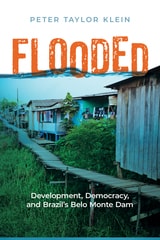
Flooded
Development, Democracy, and Brazil’s Belo Monte DamPeter Taylor Klein
Rutgers University Press, 2022
In the middle of the twentieth century, governments ignored the negative effects of large-scale infrastructure projects. In recent decades, many democratic countries have continued to use dams to promote growth, but have also introduced accompanying programs to alleviate these harmful consequences of dams for local people, to reduce poverty, and to promote participatory governance. This type of dam building undoubtedly represents a step forward in responsible governing. But have these policies really worked?
Flooded provides insights into the little-known effects of these approaches through a close examination of Brazil’s Belo Monte hydroelectric facility. After three decades of controversy over damming the Xingu River, a tributary of the Amazon, the dam was completed in 2019 under the left-of-center Workers’ Party, becoming the world’s fourth largest. Billions of dollars for social welfare programs accompanied construction. Nonetheless, the dam brought extensive social, political, and environmental upheaval to the region. The population soared, cost of living skyrocketed, violence spiked, pollution increased, and already overextended education and healthcare systems were strained. Nearly 40,000 people were displaced and ecosystems were significantly disrupted. Klein tells the stories of dam-affected communities, including activists, social movements, non-governmental organizations, and public defenders and public prosecutors. He details how these groups, as well as government officials and representatives from private companies, negotiated the upheaval through protests, participating in public forums for deliberation, using legal mechanisms to push for protections for the most vulnerable, and engaging in myriad other civic spaces. Flooded provides a rich ethnographic account of democracy and development in the making. In the midst of today’s climate crisis, this book showcases the challenges and opportunities of meeting increasing demands for energy in equitable ways.

Forest Lost
Producing Green Capitalism in the Brazilian AmazonMaron E. Greenleaf
Duke University Press, 2024
From Environmental Loss to Resistance
Infrastructure and the Struggle for Justice in North AmericaMichael Loadenthal
University of Massachusetts Press, 2020
In this new collection, a range of contributors—among them researchers, practitioners, organizers, and activists—explore the ways in which people counter or cope with feelings of despair, leverage action for positive change, and formulate pathways to achieve environmental justice goals. These essays pay particular attention to issues of race, class, economic liberalization, and geography; place contemporary environmental struggles in a critical context that emphasizes justice, connection, and reconciliation; and raise important questions about the challenges and responses that concern those pursuing environmental justice.
Contributors include the volume editors, Carol J. Adams, Randall Amster, Jan Inglis, Eileen Delehanty Pearkes, Zoë Roller, and Michael Truscello.