Results by title
56 books match the query 'Thought' and 5 start with f
Fortune Is a Woman
Gender and Politics in the Thought of Niccolo MachiavelliHanna Fenichel Pitkin
University of Chicago Press, 1999
"Fortune is a woman, and if you want to keep her under, you've got to knock her around some."—Niccolò Machiavelli
Hanna Pitkin's provocative and enduring study of Machiavelli was the first to systematically place gender at the center of its exploration of his political thought. In this edition, Pitkin adds a new afterword, in which she discusses the book's critical reception and situates the book's arguments in the context of recent interpretations of Machiavelli's thought.
"A close and often brilliant exegesis of Machiavelli's writings."—The American Political Science Review
[more]
Frank Lloyd Wright and His Manner of Thought
Jerome Klinkowitz
University of Wisconsin Press, 2014
An iconic figure in American culture, Frank Lloyd Wright is famous throughout the world. Although his achievements in architecture are stunning, it is his importance in cultural history, Jerome Klinkowitz contends, that makes Wright the object of such avid and continuing interest. Designing more than just buildings, Wright offered a concept for living that still influences how people conduct their lives today. Wright's innovations in architecture have been widely studied, but this is the most comprehensive and sustained treatment of his thought.
Klinkowitz presents a critical biography driven by the architect's own work and intellectual growth, focusing on the evolution of Wright's thinking and writings from his first public addresses in 1894 to his last essay in 1959. Did Wright reject all of Victorian thinking about the home, or do his attentions to a minister's sermon on "the house beautiful" deserve closer attention? Was Wright echoing the Transcendentalism of Ralph Waldo Emerson, or was he more in step with the philosophy of William James? Did he reject the Arts and Crafts movement, or repurpose its beliefs and practices for new times? And, what can be said of his deep dissatisfaction with architectural concepts of his own era, the dominant modernism that became the International Style? Even the strongest advocates of Frank Lloyd Wright have been puzzled by his objections to so much that characterized the twentieth century, from ideas for building to styles of living.
In Frank Lloyd Wright and His Manner of Thought, Klinkowitz, a widely published authority on twentieth-century literature, thought, and culture, examines the full extent of Wright's books, essays, and lectures to show how he emerged from the nineteenth century to anticipate the twenty-first.
Outstanding Book, selected by the American Association of School Librarians
Best Books for General Audiences, selected by the Public Library Reviewers
[more]
Freedom and History and Other Essays
An Introduction to the Thought of Richard McKeonRichard McKeon
University of Chicago Press, 1990
This volume of essays is an important introduction to the thought of one of the twentieth century's most significant yet underappreciated philosophers, Richard McKeon. The originator of philosophical pluralism, McKeon made extraordinary contributions to philosophy, to international relations, and to theory-formation in the communication arts, aesthetics, the organization of knowledge, and the practical sciences. This collection, which includes a philosophical autobiography as well as the out-of-print title essay "Freedom and History" and a previously unpublished essay on "Philosophic Semantics and Philosophic Inquiry," is a testimony to the range and systematic power of McKeon's thinking for the social sciences and the humanities.
[more]
From Puella to Platus
An Introduction to Latin Language and Thought, Volume 2Tamara Trykar-Lu
Catholic University of America Press, 2019
Whether to enlarge your general education, improve your English, or just because you are curious about the society that has had such a lasting influence on our history, our language, our thoughts, and our culture, you should and can learn Latin.
Tamara Trykar-Lu's charming and delightful introduction to Latin, From Puella to Plautus, Part I, is designed for beginning to intermediate Latin study, at the high school or college level, either with the aid of a teacher and classroom or simply for personal enjoyment and enrichment. A thorough review of English grammar with detailed explanations makes it easy for the reader to grasp new concepts in Latin. Learning Latin vocabulary becomes manageable once you realize how much ‘Latin’ vocabulary there is in English. You will quickly learn to read Latin with short stories and, gradually, more demanding selections. Readers will translate the story of Romulus and Remus and the founding of Rome, but also the tale of Nivea -- Snow White -- and some parts of Shakespeare's plays. Short sections show how English developed, how Latin influenced it, and where they both belong in the world of languages.
Each chapter ends with a brief outline of some aspect of Roman culture, such as housing, fauna and flora, games, crafts, water supply, and cooking – with recipes. And last but not least there are informative tidbits, drawings, cartoons, jokes, riddles, crossword puzzles, and, of course, pictures distributed throughout the book. For while foreign-language study should be logical, coherent, and rigorous, it need not be heavy-handed or pedantic, and certainly not dull. Ideal for use in courses or for brushing up your language skills, From Puella to Plautus is a lively and engaging book about the Latin language and life in the Roman Empire.
[more]
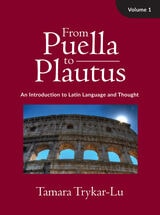
From Puella to Plautus
An Introduction to Latin Language and Thought, Volume 1Tamara Trykar-Lu
Catholic University of America Press, 2019
Whether to enlarge your general education, improve your English, or just because you are curious about the society that has had such a lasting influence on our history, our language, our thoughts, and our culture, you should and can learn Latin.
Tamara Trykar-Lu's charming and delightful introduction to Latin, From Puella to Plautus, Part I, is designed for beginning to intermediate Latin study, at the high school or college level, either with the aid of a teacher and classroom or simply for personal enjoyment and enrichment. A thorough review of English grammar with detailed explanations makes it easy for the reader to grasp new concepts in Latin. Learning Latin vocabulary becomes manageable once you realize how much ‘Latin’ vocabulary there is in English. You will quickly learn to read Latin with short stories and, gradually, more demanding selections. Readers will translate the story of Romulus and Remus and the founding of Rome, but also the tale of Nivea -- Snow White -- and some parts of Shakespeare's plays. Short sections show how English developed, how Latin influenced it, and where they both belong in the world of languages.
Each chapter ends with a brief outline of some aspect of Roman culture, such as housing, fauna and flora, games, crafts, water supply, and cooking – with recipes. And last but not least there are informative tidbits, drawings, cartoons, jokes, riddles, crossword puzzles, and, of course, pictures distributed throughout the book. For while foreign-language study should be logical, coherent, and rigorous, it need not be heavy-handed or pedantic, and certainly not dull. Ideal for use in courses or for brushing up your language skills, From Puella to Plautus is a lively and engaging book about the Latin language and life in the Roman Empire.
[more]