Results by title
90 books match the query 'Trees' and 4 start with f
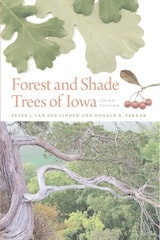
Forest and Shade Trees of Iowa
Peter J. van der Linden
University of Iowa Press, 2011
@font-face { font-family: "Times";}@font-face { font-family: "Palatino";}p.MsoNormal, li.MsoNormal, div.MsoNormal { margin: 0in 0in 0.0001pt; font-size: 12pt; font-family: "Times New Roman"; }div.Section1 { page: Section1; }
Back in print at last in a third edition, the classic Forest and Shade Trees of Iowa now has a wealth of full-color photographs and updated, reorganized information that will please both new and returning readers.
Part 1 of this guide focuses on identification, with user-friendly keys to both summer and winter trees and illustrated descriptions of more than one hundred common species. The trees are arranged according to similarities in foliage; each entry includes a large scan of a leafy branch along with two or three smaller photos of buds, flowers, fruits, and winter twigs. The text contains a description of the species, its geographical distribution, and notes on how to distinguish it from similar species. Part 2 is divided into conifers and flowering trees and includes all trees native to Iowa, trees that are widely planted, invasive species, some less commonly planted trees, and tall native shrubs that might be mistaken for trees. The authors provide information about the natural history of individual trees, their ecological requirements, pests and diseases that affect them, and their usefulness for such different purposes as windbreaks, landscaping, wildlife plantings, fuel, lumber, and food. Following these two main parts, three shorter sections describe the planting and care of trees, Iowa’s forest communities, and good places to see trees in the state; a glossary and a bibliography are also included.
A complete guide to Iowa’s trees, both native and introduced, full of hundreds of color photos, this new edition of Forest and Shade Trees of Iowa will be immensely useful to arborists, foresters, horticulturists, landscape architects, gardeners, and all Iowans and midwesterners who appreciate the beauty and value of trees and want to learn more about them.
Forests
A Naturalist’s Guide to Woodland TreesBy Laurence C. Walker
University of Texas Press, 1997
First published in 1990, Forests explores the ecological, economic, and human influences on over thirty significant types of woodlands. Laurence Walker focuses especially on the effects of site factors—climate, physiography, biology, and soils—upon the growth of various kinds of trees. Projects for amateur naturalists, reading lists, and a glossary make this the perfect introduction for general readers.

Foundations of Tropical Forest Biology
Classic Papers with CommentariesEdited by Robin L. Chazdon and T. C. Whitmore
University of Chicago Press, 2002
Foundations of Tropical Forest Biology makes essential works in the development of tropical biology available in a convenient form to both senior scholars interested in the roots of their discipline and to students encountering the field for the first time, as well as to everyone concerned with tropical conservation.
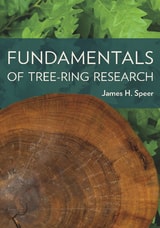
Fundamentals of Tree Ring Research
James H. Speer
University of Arizona Press, 2010
This comprehensive text addresses all of the subjects that a reader who is new to the field will need to know and will be a welcome reference for practitioners at all levels. It includes a history of the discipline, biological and ecological background, principles of the field, basic scientific information on the structure and growth of trees, the complete range of dendrochronology methods, and a full description of each of the relevant subdisciplines.
Individual chapters address the composition of wood, methods of field and laboratory study, dendroarchaeology, dendroclimatology, dendroecology, dendrogeomorphology, and dendrochemistry. The book also provides thorough introductions to common computer programs and methods of statistical analysis. In the final chapter, the author describes “frontiers in dendrochronology,” with an eye toward future directions in the field. He concludes with several useful appendixes, including a listing of tree and shrub species that have been used successfully by dendrochronologists. Throughout, photographs and illustrations visually represent the state of knowledge in the field.